Three Attributes of a Sustainable Open and Stable Global Order

The IMF/World Bank meetings were held in Bali last week. In addition to the many good beaches there were many good panels including one I was on with Mark Carney and Agustin Carstens. It was organized by the Group of Thirty, led by Jacob Frenkel and Tharman Shanmugaratnam, and focused on “Sustaining an Open and Stable Global Order,” a broad topic, within which I focused on the global monetary and financial system in the following way:

A long-held view of mine—based on solid economic theory and much empirical evidence—is that a global monetary and financial system conducive to a stable global order has three attributes: (1) open capital markets, (2) flexible exchange rates between countries or blocs and (3) a predictable and transparent, or rules-based, monetary policy.

To be sure this is a goal, and we are not there yet, though I think we have very recently started moving in that direction.  One of the three attributes—open capital markets—was just recommended as a long-term goal in a Report by the G20 Eminent Persons Group (EPG) on Global Financial Governance on which I served. The idea of open capital markets carries through intellectually and practically to goods markets. The current emphasis on “capital flow management measures” or restrictions on capital flows easily carries over to restrictions on goods flow which we all want to reduce and avoid.

When policy moves closer to those three attributes, as in the 1980s and 1990s for the advanced countries and more recently for emerging market countries, the economy does well, growing in a stable manner. When policy deviates from those three, as U.S. monetary policy did going into the tragic global financial crisis, the economy does poorly. And continued deviations in many of the past 12 years have led to poorer performance, competitive devaluations of exchange rates, and complaints of currency manipulation. These claims diminish when there is greater transparency about monetary policy.

How do we get from here to there? We need an international policy framework in which each central bank follows its own rules-based monetary policy, and in doing so contributes to a global rules-based system. In my view the framework should embody those same three attributes as a goal. There is no need for one central bank to tell another central bank what to do except to be transparent about its strategy or rule. The IMF, the FSB, and the BIS could all be involved in monitoring the rules-based policy, which should be a key part of their new integrated “coherent global risk map” role also recommended by the EPG.

The most practical way forward is for one or more central banks to “just do it,” to start to move in a rules-based direction.   It appears that the Fed has begun to normalize in this way. This can be seen in the past year and a half in actions, appointments, publications, and speeches.  Actions include the transparent well-telegraphed move to normalize the policy interest rate and reduce the size of the balance sheet. Appointments at the FOMC include more people who have thought of policy in terms of rules, including Randy Quarles and Rich Clarida as vice chairs, and the move from San Francisco to New York by John Williams. Publications include the quantum shift in the semiannual Monetary Policy Report which now has whole sections on policy rules and how the Fed uses them.  Speeches include Janet Yellen’s January 2017 speeches describing the Fed’s strategy for the policy instruments (“When the economy is weak…we encourage spending and investing by pushing short-term interest rates lower….when the economy is threatening to push inflation too high down the road, we increase interest rates…”), comparing Fed strategy with the Taylor rule and other rules, and explaining the differences. Also in February of last year, Stanley Fischer gave a talk with a similar message, comparing actual policy with monetary rules and explaining how rules-based analyses feed into FOMC discussions to arrive at policy decisions. In February of this year, Jay Powell, in his first testimony as Fed Chair, talked about making monetary policy with policy rules, saying that “In evaluating the stance of monetary policy, the FOMC routinely consults monetary policy rules that connect prescriptions for the policy rate with variables associated with our mandated objectives. Personally, I find these rule prescriptions helpful. Careful judgments are required about the measurement of the variables used, as well as about the implications of the many issues these rules do not take into account.”

This emphasis on rules and strategy did not go unnoticed by those who follow policy: As Larry Kudlow put it before he moved to the White House: “I’ve never seen that in any testimony before….and I think that’s progress.”  More recently, President Donald Trump said: “We’re normalizing money, and that’s good,” though he added that “I think we don’t have to go as fast.”

Other central banks need to follow in a global normalization. It will not be easy, so it is important to be predictable and gradual.  We are beginning to see such changes at the ECB, and the BOJ may be next, with small open economies, many represented at these meetings, moving when they can.

There are risks, of course, but an international policy framework will help if it is based on those three attributes: Rules-based monetary policy at each central bank, flexible exchange rates between countries or blocs, and open capital markets. Those are the keys to a sustaining a more open and stable global financial order.
Posted in International Economics, Monetary Policy | Leave a comment

Econ 1, Tiger Woods, and the Crisis@10

Today is the first day of the fall quarter at Stanford, and I begin teaching Economics 1, the introductory economics course, and the course after which this blog is named. The first day is always exciting, especially with many first-year students in class as is the case with Economics 1.

With Tiger Woods just winning the Tour Championship, I have a wonderful example today of opportunity costs. Tiger took my course in 1996. He was the best economics student: As I have often said, he learned opportunity costs so well that he left Stanford and joined the pro tour.

On the first day, I of course focus on the central idea that economics is about choices people make when faced with scarcity and the interaction between people when they make these choices. That interaction is emphasized as markets bring ideas and people together. We modify slightly the Stanford motto, “The Winds of Freedom Blow” (Die Luft der Freiheit Weht) to get the Economics 1 motto: “The Winds of Economic Freedom Blow.  This year we have a lot of good lecturers joining with me:  Mark Tendall on how to run firms & interact with people in markets, Caroline Hoxby on economics of education & income inequality, Pascaline Dupas on how to bank the unbanked in Africa, and Chad Jones on how to raise economic growth & reduce global poverty.

We continue teaching the whole principles course in one term combining micro and macro. I think this approach makes economics more interesting for students, and is especially needed when discussing key topics like the financial crisis of ten years ago. The crisis along with the slow recovery and other associated changes can only be understood with a mix of micro and macro. As I wrote earlier, “One must know about supply and demand for housing (micro), interest rates that may have been too low for too long (macro), moral hazard (micro), a stimulus package (macro) aimed at such things as health care (micro), a new type of monetary policy (macro) that focuses on specific sectors (micro), debates about the size of the multiplier (macro), excessive risk taking (micro), a great recession (macro), and so on.” It you look at any explanation of the crisis and the slow recovery, you’ll see a mix of micro and macro.

I think a combined micro-macro approach works no matter what your view is of the crisis and the policy response. In my view the problem was that economic policy deviated from basic economic principles which had worked well. The result was a financial panic, a great recession, and a slow recovery. The deviations included a monetary policy which set interest rates too low for too long. The good news for the economy is that economic growth and stability are being restored as new policies are being implemented.

Of course there are different views, but the heated disagreement among economists about economic crises, their causes, and their effects, presents a great opportunity to make economics more interesting.

Posted in Financial Crisis, Monetary Policy, Slow Recovery, Teaching Economics | Leave a comment

Stiglitz, Summers, Secular Stagnation, and the Supply Side

Joe Stiglitz recently published an attack, “The Myth of Secular Stagnation,” on Larry Summers’ hypothesis of secular stagnation, a revival of a term used by Alvin Hansen decades ago. Larry first presented his secular stagnation hypothesis at a conference jointly hosted by the Brookings Institution and the Hoover Institution on October 1, 2013, during the fifth anniversary of the financial crisis. It has gone viral since then.

In his critique, Stiglitz argues that Summers was wrong to say that the slow growth was secular; there was nothing secular about it, Stiglitz argued: if there had been a counterfactual larger demand-side stimulus package, there would have been a faster recovery without stagnation.  In his response, Summers lumps the Stiglitz  critique in with earlier critiques of secular stagnation, including mine “The Economic Hokum of ‘Secular Stagnation’” WSJ Jan 2014, which suggested, in Summers words “that secular stagnation was a fatalistic doctrine invented to provide an excuse for poor economic performance during the Obama years.”

I think that Summers’ critique of what Stiglitz writes is good.The irony is that I and other critics of secular stagnation have a completely different view from Stiglitz, who argues that the problem was insufficient demand and that a larger discretionary stimulus package would have avoided stagnation.  But my empirical research along with John Cogan, Tobias Cwik and Volker Wieland  shows that the demand-side stimulus packages were not successful. A larger package of those types would have done no better. In a 2011 Journal of Economic Literature article I wrote: “Some argue that the economy would have been worse off without these stimulus packages, but the results do not support that view….Others argue that the stimulus was too small, but the results do not lend support to that view either.”

Instead, the alternative view, outlined in my book First Principles, and elsewhere was that tax reform, regulatory reform, monetary reform and budget reform would increase economic growth by raising productivity and labor force participation. These supply side reforms–especially lowering marginal tax rates on investment and reducing costly regulations–were meant to provide incentives to do the things that would raise economic growth. I agree with Stiglitz that there was nothing secular about the stagnation we were seeing when Summers wrote. But the problem with slow growth was the lack of policies on the supply side, not the lack of larger demand-side discretionary stimulus packages.

With the tax reform and regulatory reform of the past two years we are seeing a marked improvement in economic growth. The economy is beginning to roar, as predicted, as these policies are being put in place.

Posted in Regulatory Policy, Slow Recovery, Stimulus Impact | Leave a comment

A Boot Camp with a Good Policy Workout

The annual Hoover Institution Summer Policy Boot Camp is now underway with a great group of college students and recent graduates from around the world.  The one-week program consists of lectures, workshops, and informal discussions, but it’s best described as a good “policy workout” on today’s top national and international issues grounded with data and theory.

I led off with the first session on “Monetary Policy: What Works and What Doesn’t.” The session began with a short review of monetary economics including the functions of money, the effect of money on inflation, and the role of central banks such as the Fed. It then examined monetary history—both old and recent—and explained how good monetary policy results in a smooth operating economy with low inflation and low unemployment, while poor monetary policy leads to instability, crises, and deep recessions. Finally, we then used this information to recommend a monetary policy for the future.

Monetary economics and policy are two of the most important topics in economics and government policy, and thus is a good place to start off the Boot Camp. Mistakes in monetary policy – such as those leading to the Great Depression and the Global Financial Crisis—are devastating to people’s lives. Central banks are one of the most powerful agencies of government, and yet they have a great deal of freedom in a democracy. The most important lessons from this session are that monetary reform is needed, that the Fed is getting back on track in the past year and a half, and that it is crucial that it stays on track in the future.

Other policy topics during week include tax policy, budget policy, public pensions, immigration, education, environmental policy, health care, regulatory policy, foreign policy and domestic politics.  The teachers in the program are faculty and fellows from the Hoover Institution, including experts with experience in economics, government, law, history, political science, and foreign policy. The lineup this summer includes Scott Atlas and Josh Rauh (the conference organizers) along with Terry Anderson, Michael Auslin, Michael Boskin, David Brady, John Cogan. Michael McConnell, James Ellis, Morris Fiorina, Stephen Haber, Victor Davis Hanson, Daniel Heil, Caroline Hoxby, Edward Lazear, Amit Seru, George Shultz, Kiron Skinner, Bill Whalen, and John Yoo, with guest dinner speakers Joe Lonsdale, Amy Wax, and Jason Riley.  A series of videos on the various topics is planned for the future.

It’s fun and free of charge, including lodging and meals. So think about applying for next summer!

Posted in Teaching Economics | Leave a comment

Turkey Tantrum Contagion Not Automatic, Rather Policy Dependent

Many have been talking about possible international contagion of the financial crisis in Turkey, and Peter Coy touched on the key issues in yesterday’s Bloomberg piece. Recent economic history and theory offer powerful lessons about contagion. Most important is that contagion isn’t automatic, but rather depends crucially on economic policy. And that lesson is fortunately showing up in virtually all the market commentary during the past few days

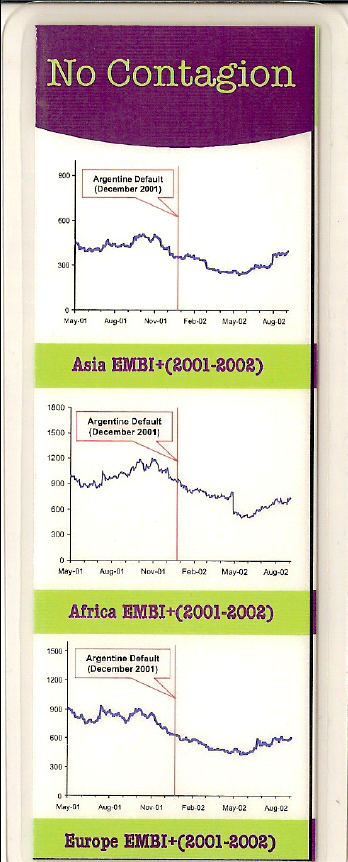
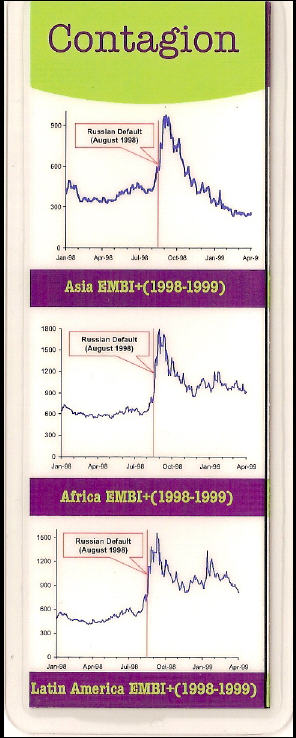
Consider in contrast the situation exactly twenty years ago on August 17, 1998 when Russia—in the middle of its own financial crisis—defaulted on its debt and the impact spread instantaneously around the world. The three charts on my bookmark, shown here, illustrate that experience. The emerging market bond index (EMBI) spread jumped in Asia, Africa, and Latin America at the time of the Russian dealt which is marked by the red vertical line.

Many argued at the time that this was the way the world markets had become in the globalized economy; policy makers at the IMF and elsewhere, it was argued, had to be ready with bailouts to deal with the inevitability that a financial crisis in one country would automatically lead to crises in many other countries.

This was the still a common view in January 2001 when I joined the U.S. Treasury to run the international division. A crisis was brewing in Argentina then, and many argued that we needed to be ready for bailouts of emerging markets around the world to deal with predicted contagion.

Argentina in 2001, like Russia in 1998, was in a financial crisis and it did default on its debt; however, unlike the Russia case, the international contagion effects were nowhere to be seen, as illustrated on the reverse “no contagion” side of the bookmark shown next.  The EMBI spread in Asia, Africa and Latin America was unaffected by the default.  

There were important policy differences between the two episodes. International policy was becoming more predictable and gradual so that the Argentinian default was widely anticipated, discounted and had little or no impact.  Other countries were better prepared, and, by this time, the notion that there were important policy differences that affected the likelihood of contagion became more widely discussed. One could find a great deal of difference between countries and thus find ways to discriminate between good policy and bad policy.  Kristin Forbes, then at MIT and the Treasury, was doing a lot of the research. There was also the new view that an orderly restructuring rather than a sudden default would lead to less contagion and would be possible if collective action clauses were introduced in sovereign debt.

In my view, it is encouraging that now the policy differences between countries are being examined carefully. Analysts are pointing to poor monetary and fiscal policy in Turkey as the source of the problem. They are creating heat maps, as shown below and drawn from the paper by Peter Coy that tries to show the differences in policy in different countries. Those most susceptible to contagion are countries where policy has been relatively poor in recent years such as Argentina and South Africa.

There is still a danger of poor policy responses in Turkey or elsewhere that could make the problem worse, and even lead to contagion.  Trade policy skirmishes could become a trade war and are already a source of uncertainty.  If Turkey resorted to capital controls to limit outflows, then investors might expect such controls in other countries, and get out while the getting is good, which could result in contagion. The fact that the IMF has developed and publicized the concept of capital flow management in recent years could hastened this contagion.

Some are blaming the normalization of policy in the United States, and suggesting that the policy be slowed or halted. The normalization by the Fed seems to put downward pressure on exchange rates in some emerging market countries. But it would be a mistake for the US and the world economy to change policy at this time.

Posted in Financial Crisis, Monetary Policy, Teaching Economics | Leave a comment

Rules and Strategies in the Fed’s New Monetary Policy Report

The Fed’s Monetary Policy Report released last Friday devotes a lot of space to monetary policy rules. This is the third time in a row that the monetary policy report has included such discussions, the first being in July 2017 and the second in February 2018.  Compared with the previous two monetary policy reports, this Report adds new material on policy rules, and is joined with a helpful discussion of policy rules now integrated into the Monetary Policy Principles and Practice section of the Fed’s web page.

All this represents progress in my view. It would be good if the new material generates some questions and answers in the Senate and House hearings with Fed Chair Jay Powell this week. Having such a discussion is one of the purposes of the bills in Congress under which the Fed would report on policy rules and strategies.

As with Fed minutes, there is something to be gained from examining the similarities and differences compared the most recent and previous reports, though the process of reporting is probably still evolving and a purpose of policy rules is that they entail less not more fine-tuning.

The new report presents (p. 37) the same key principles of policy embedded in the Taylor rule and other policy rules as discussed in previous reports: “Policy rules can incorporate key principles of good monetary policy. One key principle is that monetary policy should respond in a predictable way to changes in economic conditions. A second key principle is that monetary policy should be accommodative when inflation is below the desired level and employment is below its maximum sustainable level; conversely, monetary policy should be restrictive when the opposite holds. A third key principle is that, to stabilize inflation, the policy rate should be adjusted by more than one-for-one in response to persistent increases or decreases in inflation.” The section “Principles for the Conduct of Monetary Policy” on the Fed’s web site discusses in more detail how these principles relate to policy rules and explains the rationale for the third principle, sometimes called the Taylor principle.

Another similarity is that that the new report focuses on the same five rules as in February: the “well-known Taylor (1993) rule” and “Other rules” which “include the ‘balanced approach’ rule [Taylor rule with a higher coefficient on the output variable], the ‘adjusted Taylor (1993)’ rule, the ‘price level’ rule, and the ‘first difference’rule.”

The paragraph with the title Monetary policy rules (p. 3) is identical to the previous reports.  Among other things, it states that monetary policymakers “routinely consult monetary policy rules.”  But later paragraphs differ (italics added to show this):

Feb 2018: “However, the use and interpretation of such prescriptions require careful judgments about the choice and measurement of the inputs to these rules as well as the implications of the many considerations these rules do not take into account. (pp. 31-32)

July 2018” “However, the use and interpretation of such prescriptions require, among other considerations, careful judgments about the choice and measurement of the inputs to these rules such as estimates of the neutral interest rate, which are highly uncertain (p 36)

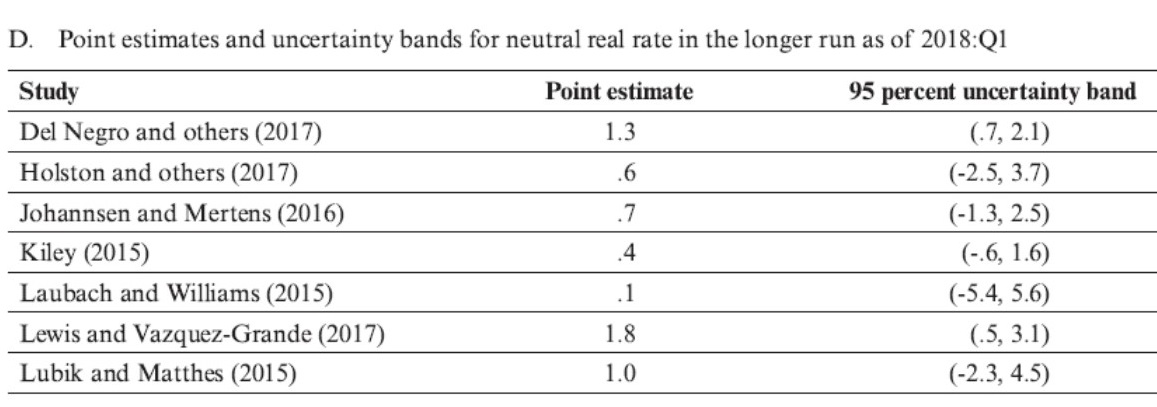
That is, the latest report focuses on uncertainty about the “neutral” or “equilibrium real” interest rate while the earlier reports also focused on uncertainty about the neutral  unemployment rate and the measures of inflation. Indeed, the latest report has a new table (p. 41) shown below, and long discussion reporting on recent research on the neutral rate. Note that the point estimates range from 0.1 percent to 1.8 percent.

I think it is significant that the discussion of the neutral rate is placed within the discussion of policy rules in the report. Like many aspects of uncertainty, this particular uncertainty has profound effects on policy making whether policy is rules-based or not. However, the discussion of the policy implications of this uncertainty is much clearer and more informative when it falls, as in this report, within a framework of policy rules.

That there is a wide range of uncertainty is illustrated in this time-series diagram drawn from the report. Note that the the estimated neutral rate was much higher in the years from 2002 to 2007 before the Great Recession indicating that, according to these estimates, the “two-low-for-too long” period cannot be rationalized as due to a decline in the neutral rate.

There is more on policy rules in the report and also, as mentioned above, on the the web page. I would note in particular the section Policy Rules and How Policymakers Use Them which discusses alternative policy rules, the section on Challenges Associated with Using Rules to Make Monetary Policy which delves  into issues that the Fed faces when it implements rules, and the section Monetary Policy Strategies of Major Central Banks which contains a good discussion of what is happening abroad with the conclusion that “other major central banks use policy rules in a similar fashion.”  This section is very important when one considers monetary policy normalization and monetary reform on a global scale, which is entirely appropriate in today’s integrated world economy

Posted in Monetary Policy | Leave a comment

Still Exploding After All These Years

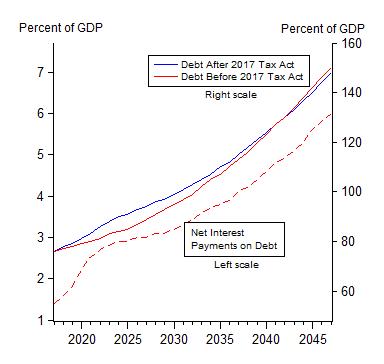
For the past nine years on Independence Day (see here and here for example), I’ve plotted the most recent long-term projection of the federal debt by the Congressional Budget Office as a reminder that it’s as explosive as the Fourth of July fireworks seen all over America. The CBO just released its latest long-term forecast, and while their shortening of the horizon and eliminating the alternative fiscal scenario may blur the underlying problems, the message, like the fireworks display, is still loud and clear: The debt is still exploding after all these years.

The figure shows three explosions: Net interest payments on the debt as a share of GDP and the debt as a share of GDP before and after the “Tax Cuts and Jobs Act of 2017.” The chart is constructed from CBO forecasts for 2018 to 2048 in 2018 Long-Term Budget Outlook released on June 26, 2018.

Note first that net interest payments quadruple as a share of GDP over the period, rising from 1-1/2 percent to 6 percent, due to a combination of rising interest rates and rising debt. This will bring net interest payments to 21 percent of the federal budget. If interest rates on the debt rise to level higher than the 4.4 percent assumed in the forecast, then the debt situation will be even worse.

Second, note that the debt was on an explosive path before the 2017 Tax Act and it is still on an explosive path even though, and this is important to note, the debt is a couple of percentage points lower as a share of GDP in 2048 with forecast after the 2017 Tax Act.

While the CBO no longer goes out more than 30 years, the scary trajectory for the rest of the century is unmistakable.  In my view, as in most of the past decade, there is not enough attention paid to this problem in Washington. The problem is increased entitlement growth, not the recent tax reform, as was pointed out in a recent oped by Michael Boskin, John Cochrane, John Cogan, George Shultz and me in the Washington Post.

Posted in Budget & Debt | Leave a comment

What We Wanted We Got: A Debate on the Fed’s Balance Sheet

A big question addressed at this year’s annual Hoover monetary conference was “The Future of the Central Bank Balance Sheet,” including the amount of reserve balances that banks hold at the Fed. The issue is one that “the [Federal Reserve] Board and the FOMC are in the process of observing and evaluating” as Vice-Chair Randy Quarles put it at the conference.

There are two basic approaches to the question. One is for the Fed to aim for a supply of reserve balances in which the interest rate is determined by the demand and supply of reserves—in other words, by market forces.  Sometimes called the corridor approach, it’s what Fed used for decades before financial crisis. The second approach is for the Fed to aim at a supply of reserves well above quantity demanded, and then set the interest rate through interest on excess reserves.  This method is sometimes called a floor system.

I’ve written in favor of the first approach which implies a much lower level of reserves. But it’s a crucial decision, and the Fed needs a good open debate of different views. That is what we got at the conference with a panel of Fed officials, market participants, and academics:

This is a topic where any short summary will miss the mark, and there’s no substitute for reading the the fascinating evidence-based papers, some with really catchy titles.

Lorie Logan, from the NY Fed trading desk, argued for the second view, emphasizing that markets would be less volatile if the Fed sticks to a floor system. Fisher, who used to run the NY Fed trading desk, disagreed, saying that operational considerations for the staying Big are not convincing, and that the rationale is completely orthogonal to the case made of going Big in the first place. Bill Nelson, who is familiar with operational considerations from his time at the Board, argued in favor of the first approach, and Mickey Levy noted the economic and political risks of maintaining an “out-sized balance sheet,” and concluded that “The Fed’s exposure to Congress’s dysfunctional budget and fiscal policy making in the face of mounting government debt and debt service costs is particularly concerning.”

I understand that a Fed decision is likely in the next year. So let the debate go on.

Posted in Monetary Policy | Leave a comment

Still Crazy After All These Years—And What About the Next 50

Yesterday I was talking to a friend in my office about the great benefit to students from writing undergraduate honors theses in their senior year.  I have long advised students to do so, perhaps because of the rewarding experience I had years ago.  It got me thinking, so I pulled my undergraduate thesis off the shelf, and I noted that it was dated April 5, 1968–submitted exactly 50 years ago to the day. The thesis was all about policy rules, and, yes, I am still working on that topic, “still crazy after all these years.”

I got the idea from Phil Howrey who was then on the Princeton faculty. Phil was doing research with Michio Hatanaka, who had just published Spectral Analysis of Economic Time Series with Clive Granger who had visited Princeton.  They were all interested in dynamic stochastic models of the economy, and so I got interested. How lucky for me. I had taken a macro course from Phil, without ISLM but with many dynamic stochastic equations—quite unusual for the time, and I was forced to view the economy as a moving dynamic structure. The idea of policy as a rule made so much sense. There was no other way to do policy with those models.

I recall that I really loved working on this project. I spent long hours in a carrel in the basement of the library reading and deriving equations in the winter and spring of 1968.

I did the simulations of the differential equations at the Princeton University Computer Center on a digital computer (an IBM 7094)

and on an electro-analog computer (an Electronic Associates TR-20 located at the Engineering School)—a circuit with capacitors, resistors, and amplifiers hooked up to an oscilloscope.

I simulated monetary policy rules of the kind that engineers had used to stabilize mechanical processes: proportional, derivative and integral. The monetary policy rules had the money supply on the left-hand side, rather than the interest rate.

Milton Friedman gave his famous AEA presidential address that academic year (on December 29, 1967) in which he criticized the Phillips curve and discussed the role of monetary policy. My thesis combined two strands of A.W. Phillips research: evaluation of policy rules and a model cyclical growth. But, fortunately, the thesis did not exploit any long-run trade-off implicit in the Phillips curve by trying to raise money growth and inflation permanently to get a permanently lower unemployment.

We have made progress in the development and application of monetary policy rules in the past 50 years, but I am optimistic that we will make much more progress in the next 50 years. Laptops are thousands of times faster than that old IBM 7094, and we now have artificial intelligence, machine learning, big data, bitcoin, now-casting, and instantaneous and global communications. And we are accumulating vast amounts of practical experience over time and in different countries. So, students, get started on that thesis.

Posted in Monetary Policy, Teaching Economics | Leave a comment

Monetary Policy Getting Back on Track

In many ways, the Fed has begun to bring monetary policy back on track as it emphasizes a strategy and the use of monetary policy rules:

On January 18 of last year, former Chair Janet Yellen described the Fed’s strategy for the policy instruments, saying that “When the economy is weak…we encourage spending and investing by pushing short-term interest rates lower….when the economy is threatening to push inflation too high down the road, we increase interest rates…”  In a speech the following day, she compared this strategy with the Taylor rule and other rules, and she explained the differences.

On February 11 of last year, former Vice-Chair Stanley Fischer gave a talk with a similar message, comparing actual policy with monetary rules and explaining how rules-based analyses feed into FOMC discussions to arrive at policy decisions.

On July 7 of last year, the Fed added, for the first time ever, a whole new section on “Monetary Policy Rules and Their Role in the Federal Reserve’s Policy Process” in its Monetary Policy Report . It noted that “key principles of good monetary policy” are incorporated into policy rules. It listed specific policy rules, including the Taylor rule and variations on that rule. It showed that the interest rate was too low for too long in the 2003-2005 period according to the Taylor rule. It showed that, according to three of the rules, the current fed funds rate should be moving up.

On February 23 of this year, the Fed, now with new Chair Jerome Powell, again included a whole section on policy rules in its latest Monetary Policy Report, elaborating on last July’s Report and thus indicating that the new approach will continue.

On February 27 and March 1 of this year, in his first testimony in the House and Senate as Fed Chair, Jerome Powell referred explicitly to making monetary policy with policy rules. He said that “In evaluating the stance of monetary policy, the FOMC routinely consults monetary policy rules that connect prescriptions for the policy rate with variables associated with our mandated objectives. Personally, I find these rule prescriptions helpful. Careful judgments are required about the measurement of the variables used, as well as about the implications of the many issues these rules do not take into account. I would like to note that this Monetary Policy Report provides further discussion of monetary policy rules and their role in the Federal Reserve’s policy process, extending the analysis we introduced in July.”  This emphasis on rules and strategy did not go unnoticed by those who follow policy: As Larry Kudlow put it: “I’ve never seen that in any testimony before….and I think that’s progress.”

On March 8 of this year, the Fed posted a new web site on the principles of sound monetary policy, Monetary Policy Principles and Practice, with a very helpful note on Policy Rules and How Policymakers Use Them.

While the Fed has not yet endorsed the “Monetary Policy Transparency and Accountability Act,” these reforms represent substantial progress in that direction and should be acknowledged.

Posted in Monetary Policy | Leave a comment