A Fast and Fun Way to Learn about Rules Versus Discretion

The Hoover Institution has initiated a fascinating Perspectives on Policy video series in which experienced experts give clear explanations of key policy issues assisted by the latest in animation technology. This is not the typical video of talking heads as you might expect.  In this imaginative series tabletop cartoon figures join the experts, move around the screen, bend and twist to show emotions, and even wave at each other from time to time. Topics range from economics, including government entitlement reform and innovative market-based environmental policies, to politics, including health care and immigration.

This week Perspectives on Policy launched a whole new 5-minute video on monetary policy and the Federal Reserve.

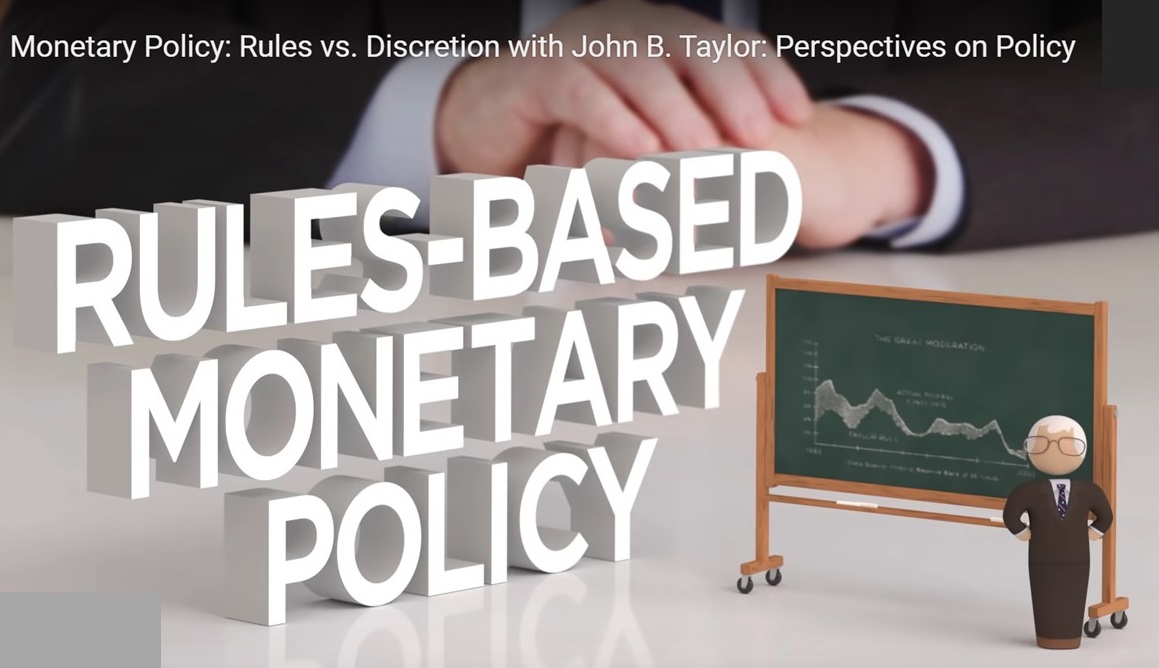
I do most of the talking in this video, but I am joined by puppet size caricatures of policy makers such as Paul Volcker and Alan Greenspan as shown in this screen shot.

There is also a clever machine on the video with a gauge and a lever to raise and lower the federal funds interest rate, though the connection with the money supply is not forgotten. Note that monetary policy is not on automatic pilot in that people have to operate the machine.

I naturally refer to the Taylor rule to show why basic reasoning and data support rules over discretion and the importance of rules-based monetary policy.

The animation also shows the money supply, the interest rate, the inflation rate, the housing boom and bust, and even Federal Open Market Committee of monetary policy makers.

I loved working the talented Hoover production team on this video, and the reaction thus far is very positive and encouraging.

Who says monetary policy is arcane and technical? It’s fun, and, besides the video, there are key facts, quizzes, etc. that can be found at the link.


Posted in Monetary Policy | Leave a comment

Congressional Testimony on the Costs of Rapidly Growing Government Debt

Yesterday I testified at the Committee on the Budget of the House of Representative.  John Yarmuth chaired, and Steve Womack was the ranking member. The Committee titled the hearing “Reexamining the Economic Costs of Debt,” which was quite different from the title “Why Congress Must Balance the Budget” of a hearing of the same House Committee at which I testified only a few years ago in 2015.

At the earlier hearing I showed that basic economic theory grounded in real world data implies that high federal government debt has a cost: it reduces real GDP and real income per household compared to lower debt levels. At yesterday’s hearing I reported that a reexamination of the economic costs yields the same results. A fiscal consolidation plan which reduced debt to GDP would lead to an immediate and permanent increase in real GDP according to model calculations.

Recently the Congressional Budget Office (CBO) reported similar results. They compared their “extended baseline” in which the debt goes up to 144 percent of GDP by 2047 with an “extended alternative fiscal scenario” in which the federal debt goes to 219 percent of GDP.  CBO found that real GNP is 3.6 percent lower when debt is higher. So, the higher level of debt has real economic costs.

The CBO also analyzed scenarios in which debt is lower as share of GDP: 42 percent and 78 percent. In the 42 percent scenario, real GNP would be 5.8 percent higher; in the 78 percent scenario, real GNP would be 3.7 percent higher.

With the CBO currently projecting large increases in the federal debt relative to GDP in the United States, this reexamination implies the need for a credible fiscal consolidation strategy. Under such a strategy spending would still grow, but at a slower rate than GDP, thereby reducing debt as a share of GDP compared with current projections. Such a fiscal strategy would greatly benefit the American economy. It would also reduce the risk of the debt spiraling up much faster than projected by the CBO.

This conclusion is robust. Olivier Blanchard also testified at the hearing emphasizing that if the growth rate of the economy is greater than the relevant interest rate on the public debt, then there will be a tendency for the debt to GDP ratio to decline over time. In most of Blanchard’s simulations, the primary surplus is held to zero.  However, the primary deficit is far from zero, and, according to CBO, it is growing. Moreover, the economic costs do not distinguish between the primary and the total deficit.

Another view of the economic costs of debt is related to what is sometimes called “Modern Monetary Theory.”  It is difficult to determine how this approach would work in the future, and it is frequently associated large spending programs and wage and price controls. Model simulations would be useful, but history can be a valuable guide:

In the 1970s the United States imposed wage and price controls and the Fed helped finance the federal deficit by creating money.  The result was a terrible economy with unemployment and inflation both rising. This ended when money growth was reduced in the late 1970s and early 1980s. As explained in a forthcoming book by George Shultz and me, it is an example where poor economic reasoning led to poor economic policy and poor economic performance. It was reversed when good economics again prevailed, and policy changed.

Posted in Budget & Debt | Leave a comment

A Beautiful Model Now Questioned

A few days ago, an amazing thing happened when Thomas Brand (@thlbr) tweeted about a short article I posted on my blog EconomicsOne.com. My post was old–posted 10 years ago on October 3, 2009–and I titled it “A Beautiful Model, A Clear Prediction.”

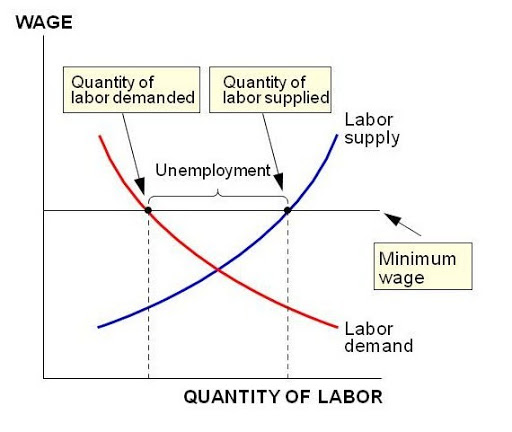
It was about the effect of the minimum wage on employment and the wage. The basic supply and demand model was displayed with the following graph. It was drawn from the Principles of Economics (Economics 1) course that I taught at Stanford in the Fall of 2009, and will still be teaching at Stanford in the Fall of 2019 (and in online form this summer).

The amazing thing was that Brand’s tweet resulted in a huge amount of renewed traffic and hits to the blog, many more in 2019 than in 2009.  Also, unlike 2009, much of the traffic in 2019 was very critical of the model. One of the several thousand tweeters changed the diagram as shown here for the case where the minimum was lower than market equilibrium and thus not binding.

It is encouraging that more people are interested in economic models and their policy implications. But I cannot help but think that fewer people understand or believe the basic supply and demand model than 10 years ago.  Yes, I know there are underlying assumptions, and these must be explained.

But opinion is shifting, even though the model is as accurate and as beautiful as ever.  I’ll have my work cut out for me next fall in Economics 1.

Posted in Teaching Economics | Leave a comment

Central Bank Independence Is Not Enough

Four former chairs of the Fed  wrote in the Wall Street Journal today about the importance of Fed independence. I agree, but their article should have emphasized that independence is not enough.  Economic performance has been affected by large shifts between more rules-based and less rules-based policy by the Fed without any concomitant change in the legal basis for independence. De jure independence has not prevented the Fed from harmful departures from rules-based policies.

The absence of a rules-based policy at the Fed in the 1970s was accompanied by high inflation and high unemployment. The move to rules-based policy during the two decades starting in the early 1980s was accompanied by improved price stability and output stability. And a move away from rules-based policy starting around 2003-2005, was followed by poor economic performance including the Great Recession and the Not-So-Great Recovery, as shown in this article in Swedish Riksbank Economic Review

There, of course, have been swings in de facto independence. For example, the Fed sacrificed its de facto independence in the late 1960s and 1970s and regained it in the 1980s and 1990s. There is a close correlation between de facto independence and rules-based policy.

But within a given legal framework, the Fed has engaged in varying degrees of adherence to rules-based policy. We have seen major shifts in the effectiveness of monetary policy within a single framework of central bank independence. Monetary policy needs to focus more on ways to encourage more rules-based policy as well as on ways of maintaining independence.

Posted in Monetary Policy | Leave a comment

Africa Meeting of Econometricians: History, Revival and Ways Forward

I just spent a wonderful few days at the 2019 Africa Meeting of the Econometric Society held in Rabat, Morocco with the central bank, the Bank Al-Maghrib, providing an excellent venue.  Congratulations to the Bank Al Maghrib for its 60th anniversary year and also to the Econometric Society for its upcoming 90th anniversary in 2020.

One sees positive economic changes coming to this part of Africa, and it is good that the Econometric Society is meeting here. Morocco is looking to join the Economic Community of West African States (ECOWAS) which includes, among other countries, Nigeria, Senegal, Côte d’Ivoire, Ghana, Liberia, Mali, Niger, Benin and Togo. I have travelled to these countries and worked on the US-Moroccan Free Trade Agreement a while back. The idea of an expanding free trade zone is breathtaking especially if combined with other pro-growth reforms. The Bank Al-Maghrib has widened the exchange rate band and capital controls are gradually being relaxed. Several years ago, I spoke in Casablanca about the promise of economic reform, and now it seems to be underway.

But most of all I was impressed by the many sessions of the Econometric Society which demonstrate how economic ideas are spreading throughout the region and the world. The latest econometric methods were evident throughout.  So was big data. One paper examined export and import data in Malawi from 219 countries, with tens of thousands of observations. Another examined the impact on net interest margins of 2,442 banks affected by negative interest rates. This transmission and global conversation is in marked contrast to days when I started out in econometrics, long before there were African meetings of the Econometric Society. It bodes well for the spread of technology generally as a means to improve people’s lives.

My keynote address at the conference delved into the history of the use of econometric models for monetary policy going right up to what has happened in the past few months.  I started out with “path-space” models such as the Tinbergen model which looked at the impact of different paths of the instruments on target variables.  Then “rules-space” approaches began with a major paradigm shift, and central bank models changed for the benefit of policy and performance. Then there was a retrogression, at least in major parts of central banking world, as central banks deviated away from more rules-based approaches, and economic performance deteriorated in the global financial crisis. The lesson learned from history is that we need to get back to rules-space.  Now, just in time, there is a revival of policy rules research, evident in papers, publications, actions, and statements by Fed officials and other central bankers.

The history shows that there are important benefits from a rules-based monetary policy, while it lasts, and that even expectations of a return to rules has benefits. The recent changes in research are promising, as are the other developments in Africa.  What can econometricians do to prevent the deviations and encourage rules-based policy. How can econometric research ideas help? My suggestions at the meeting included more robustness studies on different models and parameters, more development and use of international models to evaluate rules, more research with “quantitative easing” as an instrument in a rule, and a greater focus on the interface between research on rules in central bank research departments and the decisions of central bank policy officials.

Posted in Financial Crisis, Monetary Policy | Leave a comment

A Decade of July 4th Debt Explosions: Are They Getting Less Spectacular?

Starting a decade ago, I’ve charted on Independence Day the most recent long-term projection of the federal debt by the Congressional Budget Office (CBO). Over the years the chart has continued to look much like the Fourth of July fireworks, as you can see here 2010, 20112012, 2013, 2016, 2017, 2018 .

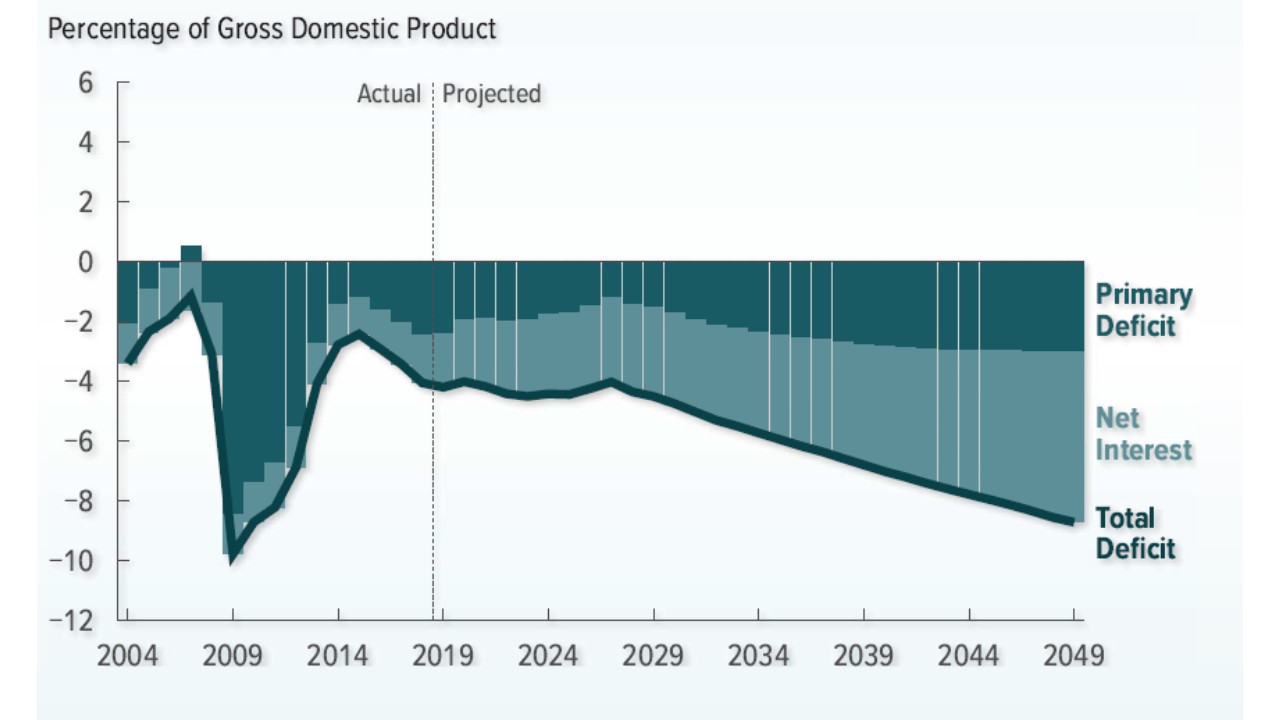
The CBO just released its 2019 Long-Term Budget Otutlook  on June 25, and so it’s time for a July 4th update. The chart of the total deficit on the front cover of the report (reproduced here) is a sight to behold.  As CBO says: “If current laws generally remained unchanged, large budget deficits would boost federal debt to unprecedented levels over the next 30 years.”

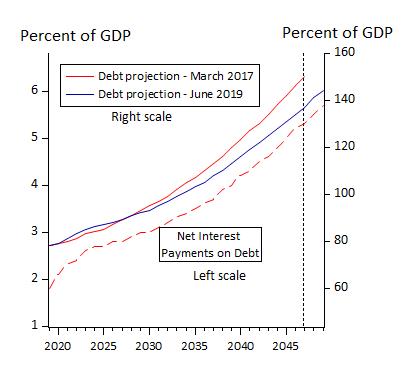
What about the debt? I plotted in the next chart the forecast of the debt as share of GDP (solid blue line) along with the forecast of net interest payments on the debt as a share of GDP (dashed red line) and, for comparison, the debt as a share of GDP (solid red line) as projected through 2047 by the CBO in March 2017 before the Tax Cuts and Jobs Act of 2017.

The message, like the fireworks display, is still loud and clear: The debt is exploding, and net interest payments are rising rapidly as a share of GDP. No new news here.

But there are two pieces of news in the debt chart. First, the debt is now projected to be 11 percentage points lower as a share of GDP in 2047 compared to the projection at this time last year. That’s an improvement. Second, the 2017 Tax Act did not increase the debt to GDP ratio going forward: The projected trajectory of the debt to GDP ratio is lower after the tax cut than before, except for a small increase at the start of the projection.  The debt problem is still due to rising spending growth not the tax reform. Maybe less spectacular, but no reason for complacency.

Posted in Budget & Debt, Fiscal Policy and Reforms | Leave a comment

Recent Decisions and Rules of the Fed

Last week, after attending monetary policy conferences at Stanford, Chicago and Frankfurt, I put forth evidence in EconomicsOne.com of a revival of research on monetary policy rules for the instruments, whether at the conferences, in research papers, or in Fed publications. I offered possible explanations for the revival, also with evidence, including revealed preference by policymakers, the need to deal with the effective lower bound, disappointments with past departures from rules, threats of legislation, and concerns about political pressure.

This week, Peter Ireland posted an article with a carefully worked-through analysis of recent actual monetary decisions, which takes the idea of the Fed using policy rules for the instruments a significant step further, well beyond research papers and into policy arena.

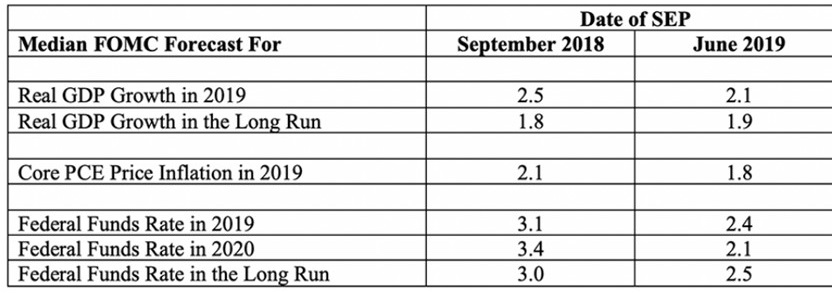
In the article, entitled A Rule That Makes Sense of the Fed, Peter examines recent changes in the Fed’s interest rate target, and he shows they are consistent, according to the Taylor Rule, with changes in real GDP, inflation, and r-star. Going line-by-line through the table below (which I draw from his article)

he shows the Fed’s Summary of Economic Projections (SEP) and demonstrates how a change in the federal funds rate from September 2018 to June 2019 can be explained, via a Taylor Rule, by changes in real GDP, the core PCE inflation rate, and r-star over the same period.

Peter thereby demonstrates that the Fed could be more explicit that these decisions are rules-based. In this way, he shows that “policymakers could explain more easily that the substantial downward adjustment to their expected interest-rate path represents a deliberate response to changes in their outlook for economic growth and inflation, together with their best judgement that r-star is considerably lower than previously thought. Even more important, they could use the Taylor Rule to demonstrate that their interest rate decisions are driven by economic analysis alone and not influenced by political pressure.”

It is another reason for Fed policymakers and other central bank official to strive to make their decisions within a rules-based framework, which can be analyzed with economic models, checked for robustness, and integrated internationally.

Posted in Monetary Policy | Leave a comment

Let’s Twist Again with Online Econ 1

This summer we will be offering Stanford’s Principles of Economics course online.  As explained in this Wall Street Journal article, “A Twist in Online Learning at Stanford,” the twist again is that we’ll offer it both (1) to the general public and (2) for credit to matriculated Stanford students, incoming freshman, and visiting students in the Stanford Summer School.

Those seeking credit can register here for the for-credit course, which is just starting with the first week’s videos and other course content posted on Monday, June 24. This is the same as the on-campus course, Economics 1, which I give at Stanford during the academic year, and it fulfills all the same requirements. Getting credit requires regular homework, a mid-term exam, and a final exam, all of which are taken online.

The open online course for the general public is also based on my lectures in the on-campus Stanford course. It begins one week later, on July 1, and next week information will available here. People who participate in the open online course and take the short quizzes following each video will be awarded a Statement of Accomplishment, or a Statement of Accomplishment with Distinction.

The on-line courses cover all of economics at a basic level.  They stress the key idea that economics is about making purposeful choice with limited resources and about people interacting with other people as they make these choices. Most of those interactions occur in markets, and this course is mainly about markets, including the market for bikes on campus, or labor markets, or capital markets.  We will show why free competitive markets work well to improve people’s lives and how they have removed millions from people from poverty around the world, with many more, we hope, still to come.

The textbook for the course is Principles of Economics by John B. Taylor and Akila Weerapana and it is available online as well

I am looking forward to another great summer quarter. Here is a sampling of views about the online course, either for the general public or for credit, which have been posted on Twitter:

  • Russell Roberts‏ @EconTalker: Great class. Great teacher. No charge. Get your basics right here.
  • Ike Brannon‏ @coachbuckethead: The most entertaining economist I know.
  • Brian Wesbury‏ @wesbury:  If you want to learn Economics from one of the best, click on this link!  What great news!
  • Juan Carlos Martinez‏ @juank700410: Educación gratuita y de calidad
  • Tom Church @TomVChurch Interested in economics? Take Econ-1 online. Pass the quizzes and get a statement of accomplishment! Plus, you’ll learn a thing or two.
  • Chris Pippin @ChrisPippin This is the class and the professor that made me an Econ major. Thanks to the generosity of @EconomicsOne and the miracle of the internet, now anyone can take it.
  • Nicolas Petit  @CompetitionProf Great course by terrific teacher, comprehensive & more than all eye opening on real world problems like trade wars and monetary policy.


Posted in Teaching Economics | Leave a comment

A Different Kind of Revisiting the 2008 Financial Crisis

During the past few months, John Cochrane and I organized a series of workshops on the 2008 financial crisis. Monika Piazzesi, George Shultz, Niall Ferguson, Caroline Hoxby, and Darrell Duffie joined us in making presentations and, along with other colleagues who attended, turned the series into a vigorous and informative discussion. We defined each workshop by topic: Causes, Panic, Recession, and Lessons, and posted papers or summaries by each presenter as well as full transcripts of each of the four workshops:

An enormous amount of research on the crisis during the past ten years is found in these links, so we also had an overview session where the presenters gave 5-minute summaries and took questions from an audience where 300 showed up.  Here’s a transcript and a video of that overview session. It reveals a revisiting that challenges in many ways conventional wisdom recently emanating from journalist summaries, memoirs of public officials, and even other anniversary events recently held at BrookingsCATO, and AEI. Here is a quick overview of that overview:

I started off by reviewing the empirical evidence on the role of “monetary policy in causing, in bringing about, the financial crisis…because that [interest] rate was so low, with excess risk taking to get a higher rate, excesses that spread to the housing market.” I also noted that Monika Piazzesi, who could not be at the overview session, “explored in great detail the excesses in the housing market, that brought a housing boom on a scale that had never been seen before, and an ultimate collapse.” Of course, that monetary policy explanation is not stressed by Fed officials in recent revisits of the 2008 crisis. I also discussed why the fiscal “stimulus packages…really didn’t do much good. Money just went in people’s pockets, and there really wasn’t much effect on the economy.”

George Shultz then noted, more basically, that the crisis was the result of violating “three fundamental principles that need to be kept in mind. One is accountability. From the ground up, there was no accountability. Number two is the sense of competence. Are the people competent running things? That was violated. Number three: trust. You have to have trust that the people doing things know what they’re doing, and that was violated. So, I think the net of all this was a very bad episode, and we still pay the price for it…” The view is quite different from recent revisits that focus in the clean-up operation rather than on these basic problems.

Niall Ferguson then mentioned other policy problems: “undercapitalization of banks” and “the way that structured financial products like collateralized debt obligations proliferated, and rating agencies insisted that they were AAA rated when they really were nothing of the kind…. Monetary policy…had been loose for most of 2002 to 2004 in a way that really wasn’t defensible. There was funny stuff, as George Shultz has mentioned, going on in the US real estate market….a whole bunch of rather opaque contingent liabilities that hadn’t been there before. And finally, I think you have to include in the explanation China, and what we used to call global imbalances….”

Caroline Hoxby sensibly focused on labor markets as a reason for the very slow recovery from the crisis. She noted that “…labor markets really did not adjust quickly…leading to a much longer recovery, a much slower recovery, and in many ways a recovery that has never completely occurred. Despite the fact that we have low unemployment rates…The labor force participation rate fell very sharply during the Great Recession, immediately following the financial crisis, and it has never really recovered.” Citing government policies relating to disabilities and education, she then concluded that “I’m less optimistic than most of my fellow economists here, because I am very concentrated very much on the labor market, where I see a lot of indications that the Great Recession to some extent still continues.”

Darrell Duffie and John Cochrane concentrated on lessons for financial markets and banks. Duffie discussed the problem of “too-big-to-fail” at the time of the crisis. The “banks correctly assumed at the time, that if one of these banks were to fail, that it would cause a crater on the economy…. And creditors before the financial crisis said to themselves, ‘They’d never let that happen. The government wouldn’t let that happen. The government, if necessary, will bail out these banks, because surely they wouldn’t cause a crater on the economy.’ ” While he argues that more could still be done, including reforming the bankruptcy law, he also notes that “Since then, things have changed. The idea that the government will bail out a large bank has been disposed of, or at least in the minds of the creditors; they no longer give credit to the idea that they will get bailed out if the bank gets in trouble.”

John Cochrane focused on having enough capital and on preventing runs.  “…we’re finally figuring out the one central answer is not: send in a bunch of regulators to make sure the assets are even safer, so you can finance them 30 to 1 with overnight debt. The answer is, risky investments need to be financed like the tech stocks, with investors’ money, where if it’s a risky adventure that loses value, if your statement goes down in price and you can’t run and say, ‘Give me back my money now,’ and you can’t do it instantly, you’re out of business. That’s the mechanics that caused the crisis. So, capital is the salve of all wounds, and I think we’re figuring that out…. So, where are we now? Capital’s a good deal higher. It’s, rough numbers, from five percent, it’s now ten percent. In my view, ten percent is nowhere near enough. Ten percent is good enough for a while,” and he worries that political forces are again moving in the wrong direction.

In sum, while there was by no means full agreement, the series brought attention in different ways to the central unifying fact that many economic policy issues still need to be addressed–from accountable top-level leadership to underlying legislative changes–if we are to prevent crises and keep the economy growing  smoothly in the future.

Posted in Financial Crisis | Leave a comment

Now They’re All Saying “It’s Time to Write Chapter 14 into Law”

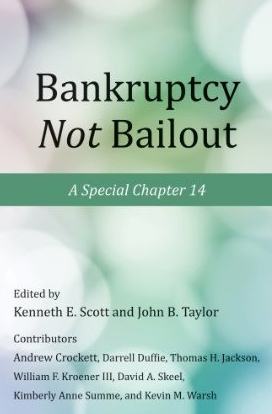
Yesterday the Senate Judiciary Committee held an important hearing entitled “Big Bank Bankruptcy: 10 Years After Lehman Brothers.” Originally scheduled for October, but postponed because of the debate over the Kavanaugh confirmation, the hearing concentrated on legislation that would create a new “Chapter 14” of the bankruptcy code under which large financial institutions could go into bankruptcy without spreading the crisis to the rest of the financial system. The idea came out of research by the Resolution Project at Stanford’s Hoover Institution, books such as Bankruptcy Not Bailout: A Special Chapter 14, and many suggestions, including by the witnesses at this hearing.

The hearing was significant because there was so much support expressed in favor of Chapter 14.  Here is a video and written testimony. All three witnesses—Donald Bernstein of Davis Polk & Wardwell, Mark Roe of Harvard Law School, and Stephen Hessler of Kirkland & Ellis—were basically in favor of Chapter 14.  This support follows endorsement by the Administration in a thorough Report issued last February by the US Treasury. It also builds on  unanimous support by the House Judiciary Committee after hearings held there last year. Significantly, most experts are now fine with passing Chapter 14 without also repealing Title II of Dodd-Frank. Repeal had previously been an impediment to bi-partisan support in the Senate. Now Title II can stay in the law, even if it will not be used much with Chapter 14 there.

In any case, there is now no serious obstacle to passing Chapter 14 legislation, and while national attention on yesterday’s hearing was nowhere near that on the Kavanaugh hearings, the issue is no less important. As Emily Kapur shows in a counterfactual, having a Chapter 14 reform of the bankruptcy code could prevent the catastrophic meltdown experienced 10 years ago which devastated many people’s lives and left wreckage which we are still clearing up after ten years.

Posted in Financial Crisis, Regulatory Policy | Leave a comment