The Fed’s Normalization: How Long and How Far?

The Monetary Policy Subcommittee of the House held a hearing yesterday on “Interest on Reserves and the Fed’s Balance Sheet,” a difficult, but important and timely subject as the Fed begins what it calls its normalization process, or its transition to normal monetary policy, in its Policy Normalization Principles and Plans. I was a witness (here is written testimony) and because reserves are a very large part of Fed’s balance sheet, I started with a “before and after” look at Fed’s balance sheet focusing on the major items in 2006 and 2016:

Fed balance sheet

A quick glance shows that:

  • The size (total assets) grew enormously from $842 B to $4,478 B.
  • Currency increased from $758 B to $1,407 B (6% growth, pretty typical)
  • Securities jumped from $760 B to $4,234 B due to “quantitative easing”.
  • Reserves exploded from $14 B to $2,410 B as the Fed payed for securities by crediting banks with deposits on itself.

The chart shows the details of the jump in reserves at the times of QE1, QE2, and QE3. Clearly the large amount of reserves is a legacy of quantitative easing.

Resbal

This big jump in the supply of reserves with no rise in demand would be expected to cause the interest rate to fall to zero. So to raise the interest rate above zero the Fed has to pay interest rate on reserves (IOR) near its interest rate target. Thus when the Fed raised the interest rate target in December by .25 percentage points, it raised IOR by .25 percentage points.

Thus with the current bloated balance sheet, the interest rate is not market determined by supply & demand. Rather it is administered by the Fed. This disconnect between the interest rate and reserves is unavoidable with balance sheet so large, but as a normal policy, the disconnect is a mistake. It enables the Fed to be a multi-purpose discretionary institution—allowing its balance sheet to remain large and available for many purposes, including credit allocation—rather than a limited-purpose rules-based institution. This detracts from good monetary policy.  If Congress wants these other things, such as credit allocation, it should assign another agency.

Given these problems, it is promising that the Fed says in its “Policy Normalization Principles and Plans” that it “will, in the longer run, hold no more securities than necessary to implement monetary policy efficiently and effectively, and that it will hold primarily Treasury securities….”  But more specificity about the meaning of “efficiently”, “effectively” and “primarily” is clearly warranted. In my view, a statement that in the longer run the Fed will pay interest only on required reserves and that the federal funds rate will be determined by the supply and demand for reserves would help clarify the nature of monetary policy in the normal state following the normalization period.

In sum, my testimony showed that the high level of reserves is a legacy of QE, that with the supply of reserves now much greater than demand, the Fed has no alternative to paying interest on reserves as it normalizes policy, and that in the years ahead the balance sheet should be bought down in size to be consistent with a market determined interest rate rather than administratively determined by the Fed. The normalization period, during which monetary policy returns to a normal state, should be as short as possible. In my view, normalization should be shorter than currently implied by the Fed’s “Policy Normalization Principles and Plans.”

Posted in Monetary Policy | Leave a comment

A Reawakening of International Monetary Policy Research

International Monetary Stability: Past Present and Future was the topic of this year’s monetary policy conference held last week at Stanford’s Hoover Institution. With highly volatile exchange rates, the spread of unusual monetary policies, and disappointing growth and stability, it was a hot topic for the researchers, the market participants, the media, and the four FOMC members who attended. In contrast to the frequent focus on exchange rate interventions and capital flow management at many other international meetings recently, this conference focused more on the need for a classic rules-based reform of the international monetary system.  In this respect, especially when combined with two previous monetary conferences (with books here and here), it constituted a reawakening of monetary research.  A book on the conference proceedings is planned, but in the meantime here is a quick summary.

Sebastian Edwards led off with his work on international monetary policy independence showing that despite flexible exchange rates (and despite arguments to the contrary by central bankers) there is significant policy spillover or contagion from the Fed to central bank decisions in Latin American countries. David Papell, in discussing the paper, considered whether this was due to recent departures from optimal policy rules in the US, concentrating on the concluding lines of Edwards paper that “to the extent that the advanced country central bank (i.e. the Fed) pursues a destabilizing policy, this will be imported by the smaller nations, creating a more volatile macroeconomic environment at home.”

David Beckworth and Chris Crowe came next with a novel paper that demonstrated some of the destabilizing impacts of such policy spillovers especially when the United States is “banker to the world” with a large portfolio of longer term assets financed by short term liabilities.  They considered ways in which more rules-based policy could alleviate these international instabilities. In his comments, Chris Erceg raised some empirical issues and noted that the results implied a positive effect of U.S. policy deviations (shocks to policy rules) on real GDP abroad.

V.V. Chari and Pat Kehoe then examined rules-based policy in the context of a fixed exchange rate system or a currency union. They showed that currency unions bring about more rules-based and less discretionary monetary policy, but noted that such unions have disadvantages in dealing with incentives to bailout the debt of member countries. In his discussion, Harald Uhlig explained in detail the nature of the assumptions and noted that some of the price-stability effects of monetary union observed in the countries of Europe are also observed in the United States.

Pierre-Olivier Gourinchas then presented a model which he has developed along with Ricardo Caballero and Emmanuel Farhi. He showed that the existence of the zero lower bound on the central bank interest rate combined with a shortage of safe assets in the global economy gave rise to the current account imbalances and currency wars that we see in the data.  In his comments on the paper, John Cochrane questioned the relevance of the zero lower bound, and he argued real factors such as the marginal product of capital provide a better explanation of what is going on in the world today. While praising the paper for laying out a model that could be discussed substantively, he also questioned the existence of aggregate demand deficiency so many years after the financial crisis.

The fifth research paper of the conference was an historical analysis by Michael Bordo and Catherine Schenk which focused on the importance of rules. They covered a range of different international monetary systems from the gold standard, to the early Bretton Woods, to the 1980s and 1990s, looking at particular episodes of formal policy coordination. Their over-riding finding is that systems that are more rules-based and do not require active coordination of policy actions work better than more discretionary systems.  Their discussant, Allan Meltzer, delved into some of the reasons underlying their findings based on his studies of the history of the Federal Reserve.

Following these research papers, a panel of three economists with experience with international economic policy coordination at the US Treasury—Richard Clarida, George Shultz and I—discussed Rules-Based International Monetary Reform. Clarida explained how his own research led to the conclusion that a nearly optimal rules-based international system could be generated by optimal rules in each country. He also emphasized, however, that certain inherently global developments—such as a change in the equilibrium real interest rate—required an analysis of trends in other countries. George Shultz described how international reforms that first brought about flexible exchange rates were implemented in practice during his own experience as Treasury Secretary.  I reviewed my proposal for a rules-based international monetary system in which each country announces and commits to its own policy rule.

In many ways the highlight of the conference was the final panel on international monetary policy and reform in practice with four current members of the Federal Open Market Committee: Jim Bullard of St. Louis, Rob Kaplan of Dallas, Dennis Lockhart of Atlanta, and John Williams of San Francisco. Though there was some disagreement, there seemed to be a lot of consensus that the equilibrium real interest rate (r* was the term most commonly used) had declined.  This did not have much bearing on their current interest rate decisions, but it meant that gradual normalization would be to a lower rate than earlier anticipated.  In addition, Jim Bullard presented an analysis in which deviations from optimal rules-based policy could cause instabilities in other countries, a possibility raised by Sebastian Edwards at the start of the conference.

Following each of these presentations there was a lively and robust exchange with the other conference participants—too much to summarize here—which will be brought out in due course in the forthcoming conference volume. While there is no way to summarize a main finding of the conference, George Shultz commented that he heard a wide consensus for a rules-based monetary policy and international system, about which no one disagreed, though differences of opinion about which rule is best were heard throughout the day.

Posted in International Economics, Monetary Policy | Leave a comment

New Book on Fed Oversight Reform

Recent legislation to rein in Fed power, including the Fed Oversight Reform and Modernization (FORM) Act, has generated a load of opinion pieces and acrimonious debate, but so far little in the way of in-depth policy research. The purpose of the papers and analysis in a newly published book is to do such research.

CBGOR CoverThe book, Central Bank Governance Oversight and Monetary Reform edited by John Cochrane and me, comes out of a conference held at the Hoover institution last year. The papers by the monetary experts in the book are interesting and candid, and they raise new questions about the effectiveness of Fed deliberations. The whole book is now available for purchase and the individual chapters as well as the discussion and policy debate (maybe the best part) can be downloaded for free. Here’s a list of contents starting with a Preface by John Cochrane and me:

ONE: How Can Central Banks Deliver Credible Commitment and Be “Emergency Institutions? by Paul Tucker with Comments by John H. Cochrane, and General Discussion with Michael D. Bordo, John H. Cochrane, Peter Fisher, Robert Hodrick, Charles I. Plosser, George P. Shultz, John B. Taylor, Paul Tucker, Kevin M. Warsh

TWO: Policy Rule Legislation in Practice by David H. Papell, Alex Nikolsko-Rzhevskyy and Ruxandra Prodan with Comments by Michael Dotsey and General Discussion by John H. Cochrane, Michael Dotsey, Peter Fisher, Andrew Levin, David H. Papell, Charle I. Plosser, John B. Taylor, Paul Tucker, Carl E. Walsh, John C. Williams

THREE: Goals versus Rules as Central Bank Performance Measures by Carl E. Walsh with Comments by Andrew Levin and General Discussion by John H. Cochrane, Michael Dotsey, David H. Papell, John B. Taylor, Carl E. Walsh, John C. Williams

FOUR: Institutional Design: Deliberations, Decisions, and Committee Dynamics by Kevin M. Warsh with Comments by Peter Fisher and General Discussion by Binyamin Appelbaum, Michael D. Bordo, John H. Cochrane, Michael Dotsey, Peter Fisher, Andrew Levin, Charles I. Plosser, George P. Shultz, Paul Tucker, Kevin M. Warsh, John C. Williams

FIVE: Some Historical Reflections on the Governance of the Federal Reserve by Michael D. Bordo with Comments by Mary H. Karr and General Discussion with Michael D. Bordo, John H. Cochrane, Peter Fisher, Mary H. Karr, Andrew Levin, Charles I. Plosser, George P. Shultz, John B. Taylor, Paul Tucker, Kevin M. Warsh, John C. Williams

SIX: Panel on Independence, Accountability, and Transparency in Central Bank Governance with Charles I. Plosser, George P. Shultz, and John C. Williams and General Discussion byMichael J. Boskin, John H. Cochrane, Peter Fisher, Robert Hodrick, Andrew Levin, David Papell, Charles I. Plosser, John B. Taylor, Paul Tucker, Kevin M. Warsh, John C. Williams

To get an idea what’s in the book, here’s a quick summary: In the first chapter Paul Tucker shows that a systematic strategy for setting the instruments of policy is desirable, but that integrating that strategy into a discretionary lender-of-last resort function is difficult. He concludes that “the central bank…should publish the Operating Principles” stressing that simply doing this “is more important than that any particular set of principles or any particular instrument-rule be entrenched in the law.” John Cochrane has different views. He argues that “Crisis-response and lender-of-last-resort actions need rules, or ‘regimes,’ even more than monetary policy actions need rules.”

Next David Papell and his colleagues explore how the recent legislation to require the Fed to adopt a policy rule would work in practice. This is the first paper to apply formal econometric methods to these legislative questions, and it generated a heated commentary from Mike Dotsey and discussion by many others.

Carl Walsh then investigates whether a policy “rules requirement” could improve on a “goals requirement” in which the central bank is simply required to achieve a goal of 2% inflation. He finds that in the case where the required rule is optimal one should put all the weight on the rules-based requirement, but if the required rule is not optimal then the weight depends on whether shocks are demand-side or supply-side.  Andy Levin argues that the gains from using and reporting on the central bank’s strategy for the instruments go well beyond the calculations in Walsh’s paper.

Kevin Warsh’s report on the lack of effective deliberations at the FOMC is one of the most surprising parts of the book. In his commentary Peter Fisher notes Warsh’s refreshing candor, and uses it to jump off on a critique of policy committees, including the unwillingness of committee members to change priors  when presented with new arguments or data.

Michael Bordo argues for a diversity of opinion coming from the district Fed banks and their presidents, and the danger of centering more power in Washington.  He prefers a more rules-based monetary policy as in the legislation. In discussing Bordo’s paper, Mary Karr reviews the ways in which there are checks and balances in the current system.

In a concluding policy chapter, John Williams notes that  Fed minutes are becoming too detailed and thereby detract from Fed deliberations, Charles Plosser indicates the FOMC deliberations are more constructive when viewed from a multi-meeting perspective than by a single meeting, and George Shultz argues that the Fed is in dire need of developing and communicating a strategy for the policy instruments.

In general, the authors in the book agree that rules-based monetary policy is important, but disagree about how a central bank should deliberate, implement and communicate about such policies. So there is more to think about at the next Hoover monetary conference which is on May 5.

Posted in Monetary Policy, Regulatory Policy | Leave a comment

Economic Exasperation

At the end of this quarter, according to most economists, the U.S. economy will have completed 7 years of so-called expansion (28 quarters from 2009Q3 to 2016Q2) with an anemic annual growth rate of 2 percent. I have been writing about the persistence of this slow crawl—along with anemic productivity growth, anemic employment growth, anemic income growth—since the recovery’s early days, and blaming government economic policy all the way. See the list below of 30 posts on EconomicsOne.com which have also considered counter arguments from “weak recovery denial” to its just “secular stagnation” (click on “Slow Recovery” category in box over on the left for details).

But people’s exasperation and anger about the economy and Washington policy revealed in this presidential election proves the point better than any abstract statistic ever could. Many people are hurting in many ways.  It is a tragedy and policy should change. For many, it’s economic exasperation rather than economic expansion.

Here is an update of a graph I used early on to compare this recovery with the 1980s recovery.

gdp comp 2015q4

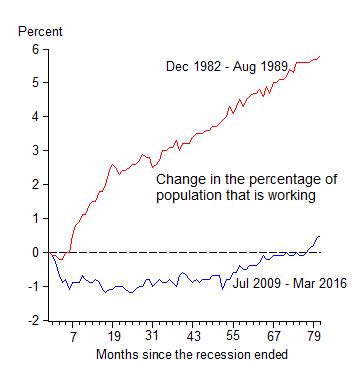
And here is an update of a graph that makes the same comparison using the change in the employment to population ratio.

emp to pop 2016-3

The recent performance pales in comparison as does economic policy. Compared with my charts in previous posts, it’s really “same old, same old” for GDP growth and while, if you look closely, you can see a welcome uptick in the employment to population ratio, even at that pace it will take many years to close the gap.

Here is a list of the EconomicsOne.com posts:

  • Can We Restart This Recovery All Over Again? September 12, 2015,
  • Growth Accounting for a Liberated Recovery, June 22, 2015,
  • Liberate the Recovery March 4, 2015
  • A Review of Recoveries in Contrast February 15, 2015
  • The American Economy: Turtle or Caged Eagle? August 1, 2014
  • Why Still No Real Jobs Takeoff? March 7, 2014
  • First Principles Versus Secular Stagnation January 31, 2014
  • With Better Policy, the Recovery Could Have Been V-Shaped September 16, 2013
  • Detecting the Source of Our Recent Poor Economic Performance September 3, 2013
  • What to Call This Very Slow Recovery? August 12, 2013*
  • Crawling Along August 3, 2013
  • Policy Uncertainty Makes Firms Reluctant to Hire: New Evidence July 31, 2013
  • It’s Not Whether, It’s Why Recovery Has Been So Weak July 8, 2013
  • Don’t Blame Weak Recovery on State and Local Spending Cuts June 15, 2013
  • Job Growth–Barely Keeping Pace with Population June 10, 2013
  • Ed Leamer on the Weak Recovery June 3, 2013
  • Same Old Slow Recovery February 4, 2013
  • A Slow and Declining Growth Rate Delays Prosperity November 1, 2012
  • An Unusually Weak Recovery as Usually Defined October 26, 2012
  • Weak Recovery Denial October 18, 2012
  • More on the Unusually Weak Recovery October 15, 2012
  • Simple Proof That Strong Growth Has Typically Followed Financial Crises October 11, 2012
  • From Economic Scare Stories to the Other Side of Reality October 8, 2012
  • Government Policies and the Delayed Economic Recovery August 29, 2012
  • It’s Still a Recovery in Name Only–A Real Tragedy August 4, 2012
  • More Evidence on What Is Holding the Economy Back May 13, 2012
  • Debate and Evidence on the Weak Recovery May 2, 2012
  • Reassessing the Recovery February 6, 2012
  • The Two Year Anniversary of the Non-Recovery June 22, 2011
  • Government Policy and the Slowdown July 20, 2010

*David Wessel ‏@davidmwessel  answered this question in a tweet on Aug 12, 2013: “John Taylor wonders what to call this very slow economic recovery? Suggest ‘The Great Delay’?”  But after three more years, and seven years and counting, I think there’s “Waiting for Godot” absurdity to David’s suggestion.

Posted in Slow Recovery | Leave a comment

A Firm Conclusion About the Role of Fed Leading Up to the Crisis

Matthew Klein recently wrote a nice piece for the Financial Times on the role of the Fed in the asset price bubble in 2003-2005 and thereby in the subsequent bust leading to the financial crisis. He begins by reviewing a fascinating  speech by Tim Lane, deputy governor of the Bank of Canada. Lane uses the following chart of macroeconomic gaps and financial gaps to show that during the period before the financial crisis (Case 1) monetary policy should have been tighter in many countries–including the United States–based on the macro gap (a combined output and inflation gap) and that this was associated with a large financial gap measured by housing price excesses and credit excesses.

TimLane

I made a similar critique back in a 2007 Jackson Hole paper arguing that the Fed played a role in 2003-2005 in causing the search for yield, risk-taking, the housing boom and the eventual bust which were big factors in the financial crisis.

Klein also takes apart Ben Bernanke’s later denial of this critique in a 2010 speech at the American Economic Association meetings. Klein does a little investigative research, reporting that there were conflicting statements at the time made by Don Kohn when he was at the Fed.  I had earlier responded to Bernanke’s speech on different grounds, but all this recent research is adding to the evidence that Fed played a role in bringing on the financial crisis.

And there’s a lot of other recent research accumulating.  Recently a paper by Qiao Yu, Hanwen Fan and Xun Wu of Tsinghua University on the pre-crisis period finds that “appreciation of housing prices in the advanced countries is statistically significant and the impact of monetary policy on housing prices cannot be neglected” with the interest rate set by the Fed being unusually low and thus a factor in the housing bubble. They find that this policy deviation was much more significant than a global saving glut which Bernanke claims was the problem.

There is also a recent paper by Graeme O’Meara that looks at both deviations from policy rules and deviations from housing fundamentals.  The paper is generally supportive of the  original work for the U.S. regarding sign and significance of the impact of monetary policy during the housing boom, with regulatory policy sharing some of the blame.

This recent research should be considered in conjunction with earlier research with similar findings. In 2008 Jarocinski and Smets of the European Central Bank found evidence in the U.S. that “monetary policy has significant effects on housing investment and house prices and that easy monetary policy designed to stave off perceived risks of deflation in 2002-04 has contributed to the boom in the housing market in 2004 and 2005.”

In 2010, George Kahn of the Federal Reserve Bank of Kansas City found that “When the Taylor rule deviations are excluded from the forecasting equation, the bubble in housing prices looks more like a bump.”

Also in 2010 Rudiger Ahrend of the OECD found “‘below Taylor [rule] episodes have generally been associated with the build-up of financial imbalances in housing markets.”

And there’s historical evidence by Mike Bordo and Landon Lane who reviewed the existing literature and showed that over  many countries and across many time periods asset price acceleration regularly follows such  excessive monetary accommodation, And in his comprehensive history of the Fed, monetary historian Allan Meltzer said that it “was a mistake” to hold interest rates so low during the 2003-05  period (p 1248).

Of course Ben Bernanke is not the only central banker who disagrees with this research. In an  article “Alan Greenspan: What Went Wrong” in the Wall Street Journal  Alexandra Wolfe reported that Greenspan told her that he disagreed with my 2007 paper, though she also reported that I stood by the paper and said that “Other economists have corroborated the findings” and “the results are quite robust.”

Several years ago in comments on a paper I gave at the Bank for International Settlements, Ken Rogoff said (pp. 29-31) that “John Taylor’s critiques of post-2000 ultra-loose monetary policies are well known and have been widely discussed. His ideas are a subject of ongoing research, with no firm conclusion as yet.”  When you add what has been done since Ken spoke to what was done before–amounting to about a decade of research, I’d say there’s a very firm conclusion now.

Posted in Monetary Policy | Leave a comment

Economists State Why Policy Rules Legislation Is Needed

Recent policy rules legislation introduced in the House and Senate has attracted  much attention—including in op-eds, blog posts, tweets, editorials, speeches, research papers, conferences and Congressional testimony over the past few years. A particular version of this legislation passed the full House of Representatives on November 19, 2015.  It is entitled “Requirements for Policy Rules of the Federal Open Market Committee” and was passed as Section 2 of the Fed Oversight Reform and Modernization Act.  There is debate about what the next steps will be.

In the meantime there is a useful statement in support of this legislation signed on to by a group of economists. The group includes Nobel Prize winners with seminal contributions to the field of macroeconomics, former senior economic policy officials—including several who have served as members of the Federal Open Market Committee, distinguished monetary historians and economists. The signatories—listed at the end of the statement—are Lars Peter Hansen, Robert Lucas, Edward Prescott, George Shultz, Robert Heller, Jerry Jordan, Athanasios Orphanides, William Poole, Michael Bordo, Michael Boskin, Charles Calomiris, Varadarajan Chari, John Cochrane, John Cogan, Steven Davis, Marvin Goodfriend, Gregory Hess, Peter Ireland, Mickey Levy, Bennett McCallum, Allan Meltzer, Gerald O’Driscoll, Lee Ohanian, and John Taylor.

The statement gives specific reasons why the legislation is needed.

Posted in Monetary Policy | Leave a comment

The Economic Hokum of Secular Stagnation Redux

Two years ago I published a piece in the Wall Street Journal titled The Economic Hokum of ‘Secular Stagnation.’ I wrote it after Larry Summers presented the secular stagnation view at a joint Brookings-Hoover conference. I argued that the bout of slow growth was not secular, but rather due to recent—and entirely reversible—swings away from good economic policy.   Since then economic policy has not reversed course, economic growth has not picked up, and the economic hokum has engulfed the public intellectual world. If the past two years are any guide, the longer a policy reversal is delayed, the more that secular stagnation will appear to be real.  taylorfig2

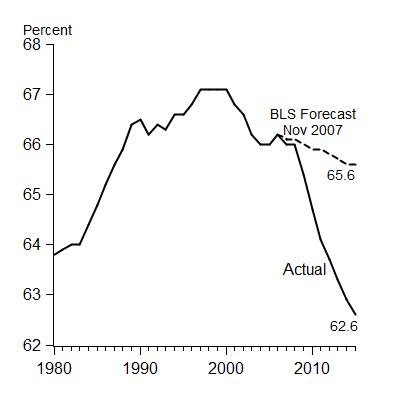
In the meantime, evidence keeps accumulating that the slow economic growth is anything but secular.  Economic growth equals the sum of employment growth and labor productivity growth. With the unemployment rate at 5 percent, boosting employment growth requires an undoing of the recent sharp drop in the labor force participation rate (shown in the chart). Such an undoing is possible with right policy incentives. Comparing the 2007 BLS forecast, which took demographics into account, with the actual labor force participation rate, indicates that the sharp drop is not due to secular demographics and should be responsive to incentives from policy reforms which encourage firms to expand and hire. A three percentage point rise in the labor force participation rate from 62.6 percent to 65.6 percent—as the BLS predicted —would mean a 5 percent increase in the labor force. Over 5 years it would mean a 1 percentage point rise in the growth rate. Over ten years it would mean another .5 percent per year rise which would double the .5 percent per year now forecast by the BLS.

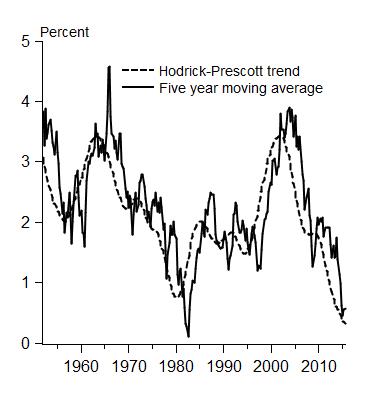
Recent labor productivity growth also reveals nothing secular.  The chart below shows the cyclical-like swings in labor productivity growth in the nonfarm business sector. In my view the swings are related to policy. taylorfig1According to the BLS, annual labor productivity growth fell from 3.0 percent during the years 1996-2005 to 0.7 percent during the years 2011-2014, or by 2.3 percentage points.  Over those same two periods, multifactor productivity growth fell from 1.6 percent to .6 percent per year, and growth in capital services per hour fell from 3.7 percent to -.5 percent per year.  Restoring these two contributors to growth to their pre-crisis levels would give a huge boost to productivity growth.

It’s time to change policy and get all this started.

Posted in Slow Recovery | Leave a comment

Trying Out a New Video on the Power of Markets

49a96-li3I always enjoy teaching the introductory economics class—we call it Econ 1 at Stanford— and I’m teaching the course again this winter. Part of the fun is trying out new teaching ideas. During the first couple of weeks I emphasize the power of the price system in competitive markets, and later we consider various market failures and, of course, government failures.

In the “free market” lectures I wear this Adam Smith tie, give a summary of Smith’s invisible hand idea, and show Milton Friedman’s famous two-minute pencil lecture on YouTube. While such stories and videos are wonderful, they do not convey the idea of how exactly competitive markets and the price system lead to a Pareto efficient allocation of resources and production. So I also dive into a technical explanation trying to keep as close as I can in a first course with no math to the spirit of the first fundamental theorem of welfare economics which we teach graduate students.

This year I tried out a short new video for this purpose. I produced it with the help of four graduate teaching assistants (who appear with me in the video) and the online course production staff at Stanford. I tried it out this past week in the free market lectures. It’s called Illustration of the Famous Invisible Hand Theoremand it’s a little corny, but judging from the response of the students in the lecture hall, it conveys a pretty good idea of the economic reasoning behind the market efficiency theorem. Before showing the video the students learned about deriving the supply curve and demand curve for price-taking profit-maximizing firms and utility-maximizing consumers.

The video effectively illustrates or “proves” efficiency by showing that in market equilibrium the efficiency conditions hold. After a short pause (at 8.50), the video then shows the consumer and firm response to a supply shock. I also use the video in an online version of the course, but it is easier to judge its effectiveness in a live lecture because I am in the same room as the students.

Posted in Teaching Economics | Leave a comment

An Economic Policy–Performance Cycle

For several years I have writing about an cycle in which economic policy swings toward and away from certain key principles of economic freedom. The poor performance of the U.S. economy during the past decade —the Great Recession, the Not-So-Great Recovery, the stagnation of real income growth—can be traced to a Great Deviation from these principles, or, as John Cochrane writes, to an Era of Great Forgetting of what policy works well.  In the prior two decades—the period of the Great Moderation in the 1980s and 1990s—policy moved toward a greater adherence to these economic principles, and in the period before that, in the late 1960s and 1970s, policy swung away. During the past 5 decades policy appears to have swung back and forth with a frequency somewhat longer than typical business cycle, but shorter than the word secular conveys.

For remarks at a session at the recent AEA meetings on “The U.S. Economy: Where To From Here?” I looked at smoothed trends in labor productivity growth. I produced the graph below showing labor productivity growth for the nonfarm private business sector with high-frequency fluctuations smoothed out using a five-year moving average and a Hodrick-Prescott trend. Note how productivity has swung down and up and down again, roughly in tandem with the changes in policy, giving some evidence of an economic policy–performance cycle, which contrasts greatly with secular stagnation stories and gives hope for another upturn if there is a change in policies.

taylorfig1

Regarding the recent low productivity growth, the Solow growth accounting formula points to both a decline in growth of total factor productivity and capital services per hour worked as explanations. According to the Bureau of Labor Statistics, annual labor productivity growth fell from 3.0% during the years 1996-2005 to 0.7% during the years 2011-2014, or by 2.3 percentage points.  Over those same two periods, multifactor productivity growth fell from 1.6% to .6% per year, and growth in capital services per hour fell from 3.7% to an amazingly low -.5% per year. Thus a capital share of 1/3 implies a reduction in the contribution of capital from 1.2% to -.2%.

Restoring these two contributors to growth to their pre-crisis levels would give a 2.4% per year boost to productivity growth going forward far above the forecasts of economists who have written off a major change in policy such as pro-growth tax and regulatory reform.

Even assuming the “low hanging fruit have already been picked” story of technological progress and thus a continuation of low multifactor productivity growth, we could get a 1.4% increase in labor productivity growth to around 2% through more private investment which would raise the capital stock and services of both physical and intellectual capital. Tax and regulatory reforms—part of a move toward First Principles—would be expected to do just that

The recent swing down in labor productivity growth, along with the unusually low contribution from capital services, suggests that it could turn up again if boosted by reform-induced incentives. If so, policy reforms would not only raise the long-run growth rate of the economy, they would also likely bring an extra boost to growth in the short run.

Posted in Fiscal Policy and Reforms, Regulatory Policy | Leave a comment

Listen to the Economic Experts

Each year I look forward to reading the Annual Report of the President’s Council of Economic Advisers which endeavors to explain the economy and policy from the perspective of the current Administration; my interest may have been piqued from working on Reports in the ’70s and ’90s.

There are similar reports from other governments, of course, including the Annual Economic Report of the German Council of Economic Experts (GCEE), which this year is particularly good with chapter one and some other chapters available in English. Unlike in the US, the Council in an independent economic-policy advisory body–now consisting of Christoph Schmidt, Peter Bofinger, Lars Feld, Isabel Schnabel and Volker Wieland–which submitted the Report to Angela Merkel last month.  This year’s Report has excellent  policy analysis on topics ranging from regulatory policy to bailout policy to monetary policy.

This year they examined the controversy over secular stagnation and the equilibrium real interest rate.  They concluded that evidence “contradicts the hypothesis that there is a ‘secular stagnation’ across the euro area, which would be accompanied by negative long-term equilibrium interest rates. Instead, there are indications that structural reforms, which strengthen markets and competitiveness…” are the way to exit from the crisis and restore growth.

I particularly liked two very interesting and informative charts relating to the US in the macro chapter of the Report.  In one they examine an idea discussed by Janet Yellen in a widely-cited speech from March of this year. Janet Yellen shows that if you insert estimates of the equilibrium interest rate computed by Thomas Laubach and John Williams (LW) into a Taylor rule, you get a lower policy interest rate in the US than if you assume a 2 percent real rate as in the original version of the rule. However, as the Report of the Council of Economic Experts shows, that’s not true if you also insert, along with the LW equilibrium interest rate, the LW output gap as logic and consistency would suggest. The chart below from the Report (with boxes in English by me) shows this.Chart YTLWAnother chart in the macro chapter of the Report provides estimates of the equilibrium real interest rate from the famous Smets-Wouters model estimated using rolling 20-year windows of real time data.  It shows that the equilibrium real interest rate in the US is now a bit more than 2 percent (not zero percent as some, including Laubach and Williams, have argued) and has changed by a relatively small amount over the years—from around 3 percent in the early 1990s. Chart Rstar SW GOverall the Report warns that there is high degree of uncertainty in estimating and using time-varying estimates of the equilibrium real interest rate in monetary policy analysis, whether using rules or discretion.


Posted in Monetary Policy | Leave a comment