It’s Not Whether, It’s Why Recovery Has Been So Weak

The June employment report released last Friday marks the 48th month of recovery from the recession which ended back in June 2009.  We should be pleased that more jobs were created this June, but the disappointing fact is that job growth has not kept pace with population growth during the now four full years of recovery, so a smaller percentage of the working age population has a job than when the recovery began. This chart, which is an updated version of a favorite I have been using throughout the recovery, shows that the employment to population ratio “changed little in June.” as the BLS put it in the release, and has yet to take off after four years.
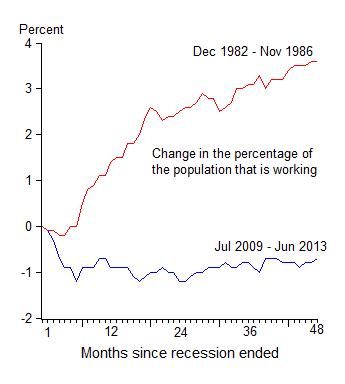
emptopopjun13

Last year there was a hot debate involving Mike Bordo, Paul Krugman, Martin Wolf and many others (see here and here) about whether this recovery has been abnormally weak compared to previous US recoveries from deep recessions.  After another year of disappointing economic growth, you hear much less debate.  The disagreement has shifted from whether to why the recovery has been so weak.

Top on my list of reasons has been economic policy, from its growing unpredictability to the expanded scope of the federal government in certain areas of the economy. It was a Great Deviation from policies that had worked well in the 1980s, 1990s and until recently as explained in First Principles: Five Keys to Restoring America’s Prosperity.    What a disappointment policy has been.
Posted in Slow Recovery | Leave a comment

CBO Is Late, Fireworks Postponed

For the past several years, I contributed to the 4th of July fireworks by posting (here and here for example) on CBO’s latest explosive debt projections, regularly released as part of its long-term outlook just before Independence Day.  But this year the CBO is way behind. It says won’t release its long-term debt projection until September.  So, for this part of the fireworks, we’ll have to wait until summer is over. 

Posted in Budget & Debt | Leave a comment

Make Replication Easy in Economics

An interesting profile “The Dismal Science’s Crusading Voice: Economist Bruce McCullough Continues a Largely Solitary Push to Require Replication in Research” just published in the Wall Street Journal highlights the importance of replication in economics and how elusive that goal has been in practice at economic journals.  To understand fully the problem one must go back further than the past decade covered in the article.

Nearly three decades ago the American Economic Review (AER, 1986, Vol. 76, No. 4) published a rather devastating article by Bill Dewald, Jerry Thursby and Richard Anerson called “Replication in Empirical Economics.” As the authors stated in the abstract, the

paper examines the role of replication in empirical economic research. It presents the findings of a two-year study that collected programs and data from authors and attempted to replicate their published results. Our research provides new and important information about the extent and causes of failures to replicate published results in economics. Our findings suggest that inadvertent errors in published empirical articles are a commonplace rather than a rare occurrence.

Because of that study the editors of the AER at that time (Orley Ashenfelter, Bob Haveman, John Riley, and I) published an Editorial Statement in the same issue of the AER putting forth a new replication policy:

It is the policy of the American Economic Review to publish papers only where the data used in the analysis are clearly and precisely documented, are readily available to any researcher for purposes of replication, and where details of the computations sufficient to permit replication are provided. The Managing Editor should be notified at the  time of submission if the data used in a paper are proprietary, or if, for some other reason, the above requirements cannot be met.

What is worrisome is that years later in 2003 McCullough found that this replication policy was not being enforced. He reported that the authors of half the AER papers he examined declined to provide the data and computer code need to replicate, forcing Ben Bernanke the editor at that time to step up the enforcement.  

Recently there are some good signs of more interest in replication in the economics profession, with Volker Wieland’s macro model data base in Frankfurt being a prime example. But let’s hope that today’s journal editors are taking their policies seriously.  The major difficulties are that there is little incentive to replicate other peoples work in economics and it is hard to make replication easy. There’s a lot of economic policy that is being based on this research.

Posted in Teaching Economics | Leave a comment

Toward a Rule for All Seasons

In my article on British monetary policy in yesterday’s Financial Times, I suggested (recommendation 5) that as the Bank of England seeks a way to implement forward guidance it might want to consider a “rule for all seasons” as a guideline.   This rule would allow for the possibility that bank rate would be extra low in periods following a stint at the zero lower bound, but by a measurable rules-based amount that depends in a consistent way on the degree to which the desired bank rate has fallen below zero bound.

The idea comes from a very early paper (perhaps the first) on using forward guidance to deal with the zero bound. It was presented at a conference in Woodstock, Vermont more than a decade ago and published  by David Reifschneider and John Williams (now president of the San Francisco Fed).   I used the term “rule for all seasons” in the FT to convey the idea that it is a kind of meta-rule which would apply consistently whether or not the zero bound was constraining.  In principle, it thereby mitigates the time inconsistency problems that the Fed’s current forward guidance has created.

As Reifschneider and Williams explained: “What we seek is a policy that deviates from the Taylor rule in a negative direction at times when interest rates are unconstrained and there is a ‘backlog’ of past deviations—i. e. immediately following episodes of zero interest rates….”

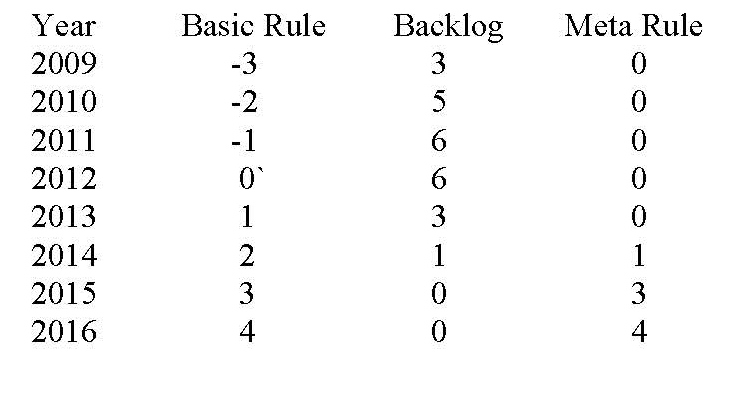
The specific policy they propose can be written down algebraically (see equation 4 in their paper), so technically speaking it is a rule.  It would require keeping track of the backlog by summing up all the past deviations, as explained in the following example.  Suppose that the zero bound was not constraining, according to the basic Taylor rule, in the years up to 2008.  Suppose also that in the years from 2009 to 2016 the basic rule algebraically called for the interest rate shown in the first column of the table, labeled “basic rule”. The resulting 4-year backlog and the interest rate implied by the meta-rule, which is the maximum of (1) zero and (2) the basic rate minus the backlog, are shown in  second and third columns:

meta rule table

Notice that even though the basic rule calls for 1% in 2013, the actual rate would still be zero due to the backlog correction in the meta-rule.  The actual rate is lower than the basic rule in 2014 and by 2015 the meta-rule is back to the basic rule.

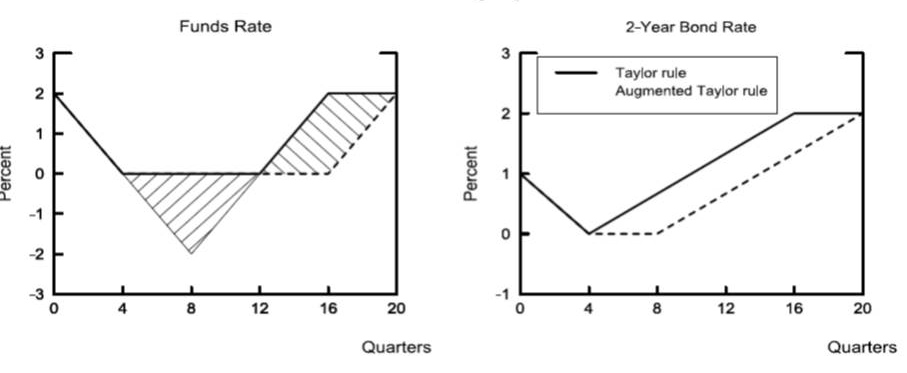
The following chart copied from the Reifschneider-Williams paper illustrates how such a path for the short rate could affect a longer rate using an expectations theory of the term structure.

RW chart

Posted in Monetary Policy | Leave a comment

Thanks Mervyn, for the Adam Smith £20 Note and Many Other Things

With Mervyn King stepping down as head of the Bank of England this weekend there are many good things that can be said and have been said about his public service.  (Here is what I said at the conference in his honor.)

But we economists should be very grateful to him for his decision to put Adam Smith on the £20 note along with an illustration of the pin factory in Smith’s famous story from the Wealth of Nations. Here is what the £20 note looks like

20 pound

and here is a close up of the pin factory.

Adam Smith on £20 Pound Note

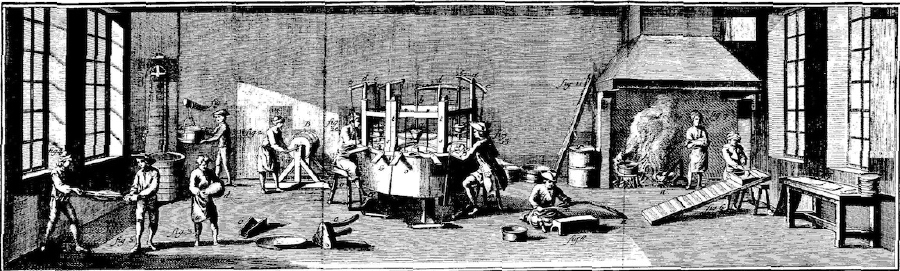
For many years Adam Smith has visited  my Economics 1 class to talk about the pin factory.  Here is an excerpt from a recording  Smith2 where he tells the students how: one man draws out the wire, another straights it, a third cuts it, a fourth points it, a fifth grinds it at the top for receiving the head; to make the head requires two or three distinct operations; to put it on, is a peculiar business, to whiten the pins is another; it is even a trade by itself to put them into the paper.  It is actually hard to see all these activities in the drawing on the note. Perhaps this is because it is not the same pin factory but rather this drawing from a French reference book 

EPINGLIER3-detail900

Épinglier (Pin-Maker) III, L’Encyclopédie (1760s)

Posted in Monetary Policy | Leave a comment

More on Monetary Policy Before and After the Panic of 2008

Many agree that the provision of liquidity by the Fed during the panic period in the fall of 2008 was helpful in alleviating severe stress in the markets and rebuilding confidence. Most criticism of the Fed pertains to the period before and after the panic, which, in my view, helped cause the crisis and the slow recovery.  In several recent posts I have given examples of the growing criticism of post-panic monetary policy including by Paul Volcker and Raghu Rajan.  Criticism of policy leading up to the crisis seems to be growing too.

For example, a new book by Justin Lin, former chief economist at the World Bank, was just reviewed by Howard Davies (former deputy governor of the Bank of England) in the Financial Times.  Lin argues that the very low interest rates during the recovery from the 2001 recession were a cause of the housing boom and thus the bust which led to the crisis.  As quoted in the Davies review, Lin says:   “The loose monetary policy introduced in 2001 in response to the bursting of the dotcom bubble, magnified by financial deregulation and innovations in financial instruments, resulted in a boom in the US housing market.”  My 2007 Jackson Hole paper endeavored to show this using a simple model to measure how “loose” monetary policy was and to run a counterfactual simulation showing how that was a factor in the boom and bust.

Posted in Monetary Policy | Leave a comment

So Much Spent, With So Little Evidence, By So Few

I listened to Raghu Rajan deliver the first Andrew Crockett Memorial Lecture at the BIS last Sunday (written version here).  Raghu’s lecture followed several moving tributes to Andrew’s remarkable contributions to policy at the IMF, the Bank of England, the BIS, and the Financial Stability Forum. During the past several years until he died last September, Andrew was an active member in the Working Group on Economic Policy at Stanford’s Hoover Institution and contributed to our most recent book in Bankruptcy Not Bailout.  Andrew always conveyed clear sensible messages in a diplomatic style that made people listen.

Raghu’s message in the Crockett lecture was also clear and sensible. The title “A Step in the Dark: Unconventional Monetary Policy After the Crisis” conveyed his main message that unconventional monetary policy—such as quantitative easing in the United States—has not worked to help the economy grow during the past four years.  Though his style was polite and respectful of the central bankers present, he did not mince words. For example, he paraphrased Churchill near the end of his talk to describe the unconventional policies: “Never in the field of economic policy has so much been spent, with so little evidence, by so few”

I have been critical of the Fed’s quantitative easing for quite a while now. In September 9, 2010 I wrote in the Wall Street Journal that the last thing we needed as “another large dose of quantitative easing in which the Fed’s balance sheet explodes even further, raising more uncertainty about how it will ever be unwound.”  So I largely agree with Raghu about the ineffectiveness. Moreover, I would say that the list of people in agreement is getting longer and  longer, though some of the central bankers who responded to Raghu, such as Bill Dudley (remarks here),  do not yet agree.

Posted in Monetary Policy | Leave a comment

Price Stability and Overvaluation: The Basel Big Mac

Here’s a price list at the McDonald’s on Barfusserplatz in Basel on the day of the BIS annual general meeting one year ago and today.  Big Mac cost 6.50 Swiss francs on both days. Now that’s price stability. At an exchange rate of 1.07 US dollars per Swiss franc that’s $6.96! It would be even pricier in foreign currency without the Swiss National Banks’s minimum exchange rate policy which keeps the franc from becoming even more overvalued.

June 23, 2012

????????????? 

June 23, 2013

Basel Big Mac June 23 2013


Posted in International Economics | Leave a comment

The Most FAQ in Basel This Weekend

The most frequently asked question by central bankers at the various gatherings at the BIS annual general meeting in Basel was:

Q: What do you think caused the market turbulence last week?

And there were nearly as many answers as central bankers. Here are a few:

A: It was very temporary and will disappear soon. Don’t worry.

A: Traders were surprised that the Fed’s forecast for growth was higher than the consensus of private forecasters, so they guessed the zero interest rate would not last so long.

A: It was a cynical response of major investors who think the Fed should do more

A: Poor communications. Ben should not have given a 7% threshold

A: No, it was not poor communications. People recognize the normalization will take more than simply unwinding QE. The normalization process will involve many other changes which we are uncertain about including exchange rate realignments.

A: The effect of QE is not well understood.  Exit causes as much uncertainty as entry.

A: It is just the inevitable downside effects following any earlier positive upside.

A: Japan and the US are going in opposite directions, so it is very confusing to traders

When I was asked here was my answer:

A: I’ve been warning for quite a while that a big risk of QE would be the exit strategy. So what you are seeing is that risk being realized.

Q (a typical follow-up): But the FOMC or press conference announcement was small in terms of the change in the stock of assets that will be purchased.

A:  No, it was actually quite large.  Before announcement, the peak level of reserve balances could have reached $4.2 trillion. With Wednesday’s announcement, it will reasonably be expected to reach $2.8 trillion. That’s a cut in the expected stock of $1.4 trillion—about the same as the increase that will have occurred since the QE3 announcement last year: $2.8T – $1.4T (in Sept 2012) = $1.4T).  So the effect should be big.  (See here for calculations.)

Posted in Monetary Policy | Leave a comment

A Monetary Meeting in the Midst of Market Turmoil

The Bank for International Settlements (BIS) held its annual monetary conference in Luzern Switzerland over the past two days. I presented a paper on cross-border monetary policy spillovers, which was unexpectedly and vividly brought to life by the turmoil in financial markets following last Wednesday’s FOMC meeting and its global impact. Many central bank governors from emerging market countries who attended the conference had to spend a lot of time on cell phones and Blackberry’s monitoring the financial market situation back home. Others had to cancel their trip.

Though their views might have understandably been overly influenced by the recent turmoil, I noticed several interesting areas of agreement among the central bankers and others who spoke at the conference. First, many longed for a return to the type of rules-based monetary policy associated with the so-called great moderation of the 1980s, 1990s, and until recently.  Second, they agreed that monetary policy has become overburdened with too many tasks far removed from the traditional monetary policy objectives. Third, they admitted that there were significant monetary policy spillovers on emerging market countries of the current unconventional policies in advanced countries.  Fourth, they lamented that it would be a long uncertain road back to normalization.

In my paper I argued that deviations from rules-based policy at several central banks, including the Fed in recent years, created incentives for other central banks to deviate from such policies and that this had created the current Global Great Deviation.  Another view—which I reviewed in the paper—is that the global state of monetary policy is either not a deviation from good policy or that such deviations are benign and appropriate.  I was surprised that there was considerable support for the first view rather than the alternative at the conference, though there was by no means a consensus and probably not a majority. I had thought that there would be more support for the alternative view and for unconventional monetary policies.

Eventually all the papers and comments by the discussants will be posted on the BIS website as with last last year’s conference papers. (My discussants were Arminio Fraga and Ken Rogoff). In the meantime I am off to Basle for the Annual General Meeting of the BIS which many more of the world’s central bankers will attend.

Posted in Monetary Policy | Leave a comment