Economic and Political Leadership on the Budget

The Wall Street Journal’s headline for my article today In Praise of Debt Limit ‘Chicken’ nicely conveys the idea that linking a hike in the debt to a cut in spending—which pundits call a game of chicken—is not a game at all. It’s good economic policy. Economists in Washington should show some leadership and try to implement that policy.

But political leadership is needed too, and from the White House not just from the House of Representatives. Here President Obama could take a page from historian David Kennedy’s Freedom From Fear (page 138 to be exact) which describes how none other than FDR, in March 1933, showed political leadership and trimmed the largest entitlement of the day. As I explain in this short piece from today’s Bloomberg View’s Echoes, the entitlement in question amounted to 25 percent of the budget, a much larger percentage than Social Security today.

Posted in Budget & Debt | Comments Off on Economic and Political Leadership on the Budget

Taylor Rule Recommends Raising Rates

  • Over at Market Beat: WSJ.com’s inside look at the markets, Mark Gongloff reports that Standard Chartered’s David Semmens says that “Based on a strict Taylor-rule calculation, the first effective fed-funds rate increase shouldn’t come until the first quarter of 2013.”
  • And over at Business Insider, Art Cashin of UBS reports that Jim Brown of Premium Investor says that “the Taylor rule says the Fed funds rate should be -1.65%” suggesting the need for a QE 2.5.
  • But no calculations are provided in either report.
  • Over here at Economics One, I can report that the Taylor Rule says that the fed funds rate should now be 1 percent, and I can provide the calculations. Available data (through the 1st quarter) show that the inflation rate is about 1.6 percent (GDP deflator smoothed over four quarters) and the GDP gap is about 4.8 percent (average of San Francisco Fed survey). This implies an interest rate of 1.5 X1.6 + .5X(-4.8) + 1 = 2.4 – 2.4 +1 = 1.0 percent. I am not sure why other reports differ, but at least the coefficients and numbers are here to see and check. Perhaps they are using different coefficients, but David Papell writing at Econbrowser earlier this month showed why the coefficients reported here work well.
  • So I think the economy would be better off if the Fed started moving to a higher funds rate now rather than later, and I certainly see no rationale for another round of quantitative easing. Unfortunately, it looks like the Fed will continue with its zero interest rate for a while longer, and traders will continue to debate whether or not there will be a QE3 adding volatility to the market.
Posted in Monetary Policy | Comments Off on Taylor Rule Recommends Raising Rates

Splitting Difference Would Reduce Federal Spending By $4 Trillion

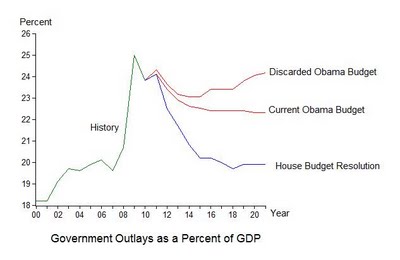
When the Senate voted down the House Budget Resolution (the Ryan budget) by a vote of 40-57, it also voted down an Obama Administration budget (submitted in February) by a vote of 0-97. But the Obama Administration had already discarded that budget when President Obama outlined in general terms a new budget in his speech on April 13. The chart below shows the discarded budget and an estimate of the current budget based on the speech. (The chart is adapted from my April 22 Wall Street Journal oped)


The White House responded to last week’s votes by saying that “both sides will need to give some ground in order to reach a bipartisan agreement on meaningful deficit reduction.” That is, of course, true. But what should be the starting point for the negotiations? What would splitting the difference mean?

Currently there are two budgets on the table—the House budget proposal and the Administration’s April 13 outline of a proposal. The Administration’s outline proposal would reduce spending by $2 trillion over ten years, while the House would reduce spending by $6 trillion. Hence the bipartisan agreement should be to reduce spending by between $2 trillion and $6 trillion over ten years. Simply splitting the difference would be $4 trillion.

Posted in Fiscal Policy and Reforms | Comments Off on Splitting Difference Would Reduce Federal Spending By $4 Trillion

Speaking and Remembering on Memorial Day

This year I was honored to speak at Stanford’s Memorial Day military appreciation barbecue. There are now 51 enrolled Stanford students who are veterans. I was once a Stanford student veteran. In 1969 I temporarily left Stanford’s Ph.D. program in economics for a tour in the Navy. That year the Stanford Faculty Senate voted to remove ROTC from campus, and this year, I was pleased to remind everyone at the barbecue, the Faculty Senate reversed that decision.

But I mainly spoke about a Stanford student, Ryan McGlothlin, who did not return to complete his Ph.D. and whose memory inspires us on Memorial Day. In 2004 Ryan left the Stanford Ph.D. program in chemistry to join the Marines. In November 2005 he was killed in Iraq. He is now honored in Stanford’s Memorial Auditorium, built 74 years ago to honor alumni who lost their lives in World War I and later expanded for World War II, Korea, Viet Nam, and now Iraq and Afghanistan.

Ryan was serving in Anbar province, close to the Syrian border, where Al-Qaida terrorists were streaming through. He was a rifle platoon commander, part of Operation Steel Curtain, with the mission to clear terrorists out of the town of Ubaydi and to protect the Iraqi people. Ryan was posthumously honored with a Silver Star for his heroic acts, and I can do no better than read from the award citation. “Second Lieutenant McGlothlin’s platoon was engaged by 21 enemy personnel. The enemy delivered frontal and flanking automatic fire from four well-fortified, mutually supporting positions.… With complete disregard for his own safety, Second Lieutenant McGlothlin maneuvered through the insurgents’ strongpoint and immediately engaged the insurgents to secure and recover his embattled Marines…. While his last Marine was being evacuated from the building, Second Lieutenant McGlothlin shielded the recovery effort from grenade blasts and commenced a fierce exchange of small arms fire with the enemy until he was mortally wounded…. By his bold leadership, selfless act of bravery, and complete dedication to duty, Second Lieutenant McGlothlin reflected great credit upon himself and upheld the highest traditions of the Marine Corps and the United States Naval Service.”

Posted in Teaching Economics | Comments Off on Speaking and Remembering on Memorial Day

Regulatory Capture and Reckless Endangerment

My review of the book Reckless Endangerment by Gretchen Morgenson and Joshua Rosner (published in yesterday’s Washington Post) gives examples of the many ways in which cozy relations between government and industry lead to reckless policies. Students of economics will recognize the problem as regulatory capture, which George Stigler introduced to economics many years ago.

How can we prevent regulatory capture and thereby avoid the harmful policy it causes? Studying economics is not enough, at least according to Reckless Endangerment: Amazingly, twenty-five economists appear in the book (if you count those with a PhD): Dean Baker, Ben Bernanke, Gerald Corrigan, William Dudley, Roger Ferguson, Phil Gramm, Alan Greenspan, Glenn Hubbard, Lawrence Lindsey, Rick Mishkin, Alicia Munnell, June O’Neill, Peter Orszag, Jonathan McCarthy, Robert Parry, Wayne Passmore, Richard Peach, Marvin Phaup, Robert Reischauer, John Snow, Gary Stern, Joseph Stiglitz, Larry Summers, Lawrence White, and Walker Todd. Yet only a handful of these are characterized as standing up to regulatory capture. I mentioned June O’Neill, John Snow, and Marvin Phaup in my review, and there are a few others, but many are criticized for not standing up. This isn’t proof, of course, and I am sure that many of those criticized did a good job.

Still, regulatory capture exists, and dealing with it is difficult. Lobbying per se can’t be avoided in a democracy, and industry should be able explain its case to the government. Some have suggested incentives for government officials so they can withstand pressures. Others have suggested more independence, or closing the revolving doors. Perhaps the best thing is to keep the regulatory rules simple and transparent so that it is clear if industry is getting favors. Reducing government subsidies to private firms will help. So will avoiding over-regulation.

In this regard, I am reminded of these lines from the latest Keynes-Hayek rap video:
Keynes: “Even you must admit that the lesson we’ve learned is that more oversight’s needed or else we’ll get burned”
Hayek: “Oversight? The government ‘s long been in bed with those Wall Street execs and the firms that they’ve led.”

Reckless Endangerment should make liberals and conservatives alike see the wisdom in Hayek’s reply to Keynes.

Posted in Regulatory Policy | Comments Off on Regulatory Capture and Reckless Endangerment

Opportunity Cost and the 20 Under 20 Prize

On PBS NewsHour yesterday Peter Thiel argued that the opportunity cost of college may be surprisingly high for many students, and indeed, as widely reported this past week, he raised the opportunity cost for some impressive 20 Under 20 prize-winning entrepreneurs. Economist Richard Vedder was on Peter’s side of the argument, and not so surprisingly Wesleyan University President Michael Roth was not.

But the opportunity cost argument is worth taking seriously, and the entrepreneurship example is certainly a good one for the introductory economics course. Ever since Tiger Woods took my Stanford Economics 1 course in 1996, I’ve started my text book and first lecture with the story about how he dropped out of Stanford and joined the pro tour after learning about opportunity cost from me. But in the 7th Edition (out this fall) we are using examples closer to Peter Thiel’s (who also was a Stanford student).

This photo is a great visual aid for discussing opportunity cost. It shows Barack Obama along with entrepreneurs and chief executives of top technology firms: Apple, Cisco, Facebook, Genentech, Google, Netflix, Oracle, Twitter, and Yahoo. They’re meeting over dinner to talk about the economy.


Everyone at the table has amazing stories about making choices. Mark Zuckerberg, sitting to President Obama’s right, faced a big choice when he was in college in 2004: whether to finish his degree or to drop out and devote all his time to transform a novel idea into a start-up firm. Doing both college and the start-up was not an option because time is scarce, only 24 hours in a day, not enough time to do both activities and sleep a bit. So he had to make a choice. In choosing one activity, he would have to incur the cost of giving up the other activity. Dropping out would mean passing up a college degree which would help him get a good job. Staying in college would mean he could not start up a new firm. Zuckerberg chose to drop out, and it looks like he made the right choice.

Steve Jobs, sitting to the left of the president in the photo, also dropped out of college, but it was because he felt the cost of tuition was too high compared to what he was getting out of the formal courses. Better, he thought, to let his parents keep the money. A couple of years later Jobs founded Apple computer, but he credits its success to the freedom he gained to explore new activities without the structure of a college degree. Larry Ellison of Oracle, sitting right across from the president, also chose not to complete a college degree.

But it is very important to point out that not every executive in the photo chose to drop out of college. Carol Bartz, at the far end of the table, graduated with a degree in computer science, earning tuition money as cocktail waitress. Years later, it seems clear that she made the right choice for her: the college degree prepared her to run tech firms like Yahoo. Dick Costolo of Twitter also finished college. Others not only chose to finish college, they chose to go on for more advanced degrees. Reed Hastings of Netflix chose to get a masters in business. President Obama chose to go law school. Eric Schmidt of Google and Art Levinson of Genentech chose to get a Ph.D.

So behind the people in the photo are many different stories of scarcity, choice, and opportunity cost. Of course, neither the people in this photo nor the 20 Under 20 prize-winners are a representative sample. Gary Becker provides data that may be more relevant to most students.
Posted in Teaching Economics | Comments Off on Opportunity Cost and the 20 Under 20 Prize

To the G8: Don’t Let Aid Perpetuate Barriers to Growth in Tunisia and Egypt

In this Bloomberg Echoes post, I argue that the United States should do whatever it can to promote economic freedom in the post-Jasmine Revolution Middle East and North Africa, and strongly support economic leaders who are committed to creating a private market economy. This is the lesson learned from the transitions from government control to market economies two decades ago in Eastern Europe, especially Poland and the Czech Republic. The U.S. government strongly supported those economic reforms—the removal of price controls, of barriers to new businesses, and of subsidies of old state enterprises, along with a restoration of the rule of law and property rights. And the United States also supported the reformers, including Leszek Balcerowicz in Poland, who carried out the reforms against much oppostion.

In this regard it is alarming to hear that the G8 support package for Tunisia and Egypt–being developed at the meeting in Deauville France today and tomorrow–may do just the opposite: encourage more government subsidies and controls. Indeed, a recommend list of actions in a recent letter to the G8 from top economists—mostly from France but including Joe Stiglitz and Nouriel Roubini from the United States—starts with the case for government subsidies. But as argued persuasively by Ned Phelps yesterday in an article in Le Monde (in English here), Tunisia needs an immediate and dramatic reduction in the barriers to entrepreneurship and job creation. It needs to open the economy, domestically and internationally, and the G8 can help in both as it implements a support package.

Are there new leaders in the Middle East and North Africa (MENA) who will support such economic changes? Of course there are. For example, it is very encouraging that the new Tunisian central bank Governor Mustapha Nabli, who obtained his Ph.D. in economics from UCLA in 1974, is a reformer. His recently published book Breaking the Barriers to Higher Economic Growth in MENA argues that “at its core, [economic growth] requires the region’s public sector-dominated economies to move to private sector-driven economies, from closed economies to more open economies, and from oil-dominated and volatile economies to more stable and diversified economies.” His case is based on hard facts including a careful empirical comparison of Eastern European transitions with MENA, and an analysis of reform in practice, which strongly suggest a serious, relatively fast-paced reform worthy of strong support from the United States and the whole G8.

Posted in International Economics | Comments Off on To the G8: Don’t Let Aid Perpetuate Barriers to Growth in Tunisia and Egypt

Causation From Base Money To The Multiplier: The QE2 Evidence

During the panic in the fall of 2008 some interpreted the explosion of the Fed’s balance sheet and the monetary base (MB)—currency plus reserves of banks at the Fed—as an appropriate monetary policy response to a shift in the demand for the monetary base. That monetary policy should try to accomodate such shifts in demand is a classic monetary principle.

Evidence offered in support of that interpretation was the sharp drop in the money multiplier (m)—the ratio of money (M) to the monetary base (m = M/MB). The claim was that the Fed offset the decline in the multiplier (m) by increasing MB, thus leaving the money supply (M = m times MB) comparatively unaffected by the drop in m. Indeed there is a striking negative correlation between the multiplier and the monetary base during the late 2008 and 2009 period, as shown in this graph.


However, I argued in a Business Economics article at the time that this striking correlation had another interpretation. It was due to a reverse causation: the increase in the monetary base caused the multiplier to decline as banks simply absorbed the inflow of reserves. The cause of the increase in the monetary base was the need for the Fed to finance its loans to bailout financial institutions, provide swaps to foreign central banks, and eventually make purchases of mortgage backed securities in its quantitative easing program—a strategy I called mondustrial policy in part to drive home this reverse causation.

But the very severity of the panic in 2008 makes it difficult to convince people that there was not a panic-driven increase in the demand for the monetary base at that time, and I frequently hear economists and economic students sticking to the original interpretation. In this respect QE2 provides more convincing evidence for the second interpretation. The months since the start of QE2 are not even close to the panic observed in the fall of 2008. So it is much more difficult to argue that the Fed was responding to a panic-driven or otherwise autonomous increase in the demand for the monetary base. Much more likely is that—as in the fall of 2008—banks simply absorbed the increased supply of the monetary base which the Fed used to finance QE2. In fact, if you look at the chart (which goes through April 2011), you can see the same inverse relationship between the money multiplier and the monetary base during QE2 as during 2008–2009

Regarding mondustrial policy, several new articles written this Spring expore its implications from an Hayekian perspective, raising concerns similar to the ones I mentioned when I coined the term, but with more emphasis on accountability, rules, and discretion.

Posted in Monetary Policy | Comments Off on Causation From Base Money To The Multiplier: The QE2 Evidence

Linking the Debt Limit Hike To Spending Cuts Is Good Economics

For months now top economic officials in Washington have been arguing that the Congress should vote to increase the debt limit without any reductions in the growth of spending—in other words a “clean debt limit hike.” Just last Thursday Ben Bernanke compared linking the debt limit and spending reductions to playing a game of chicken with U.S. credit worthiness, adding “I think using the debt limit as a bargaining chip is quite risky.” CEA Chairman Austan Goolsbee and Treasury Secretary Timothy Geithner have been saying much the same thing.

But these arguments do not take account of important economic advantages of linking the debt limit to spending reductions. Such a link is good economics in theory and in practice. It is essential to a credible return to sound fiscal policy and an end to the ongoing debt explosion.

Here’s why. In the current political and economic environment—where more people than ever in the United States and around the world are aware of, and paying attention to, the country’s debt problem—the decision about the debt limit will be precedent-setting. They also know that government spending has increased rapidly in recent years, rising from 18.2 percent of GDP in 2000 to over 24 percent now. If Washington does not change the budget game now, people will sensibly reason, it will never change the game. If politicians just increase the debt limit now when spending has been growing so rapidly compared to revenues without correcting that rapid growth of spending, then they will be expected to do so in the future. In contrast if they tie any increase in the debt limit to a halt in the explosion of spending, then people will be more likely to expect them to control spending in the future. Linking the debt limit vote with spending establishes a precedent and valuable credibility.

Another way to think about this approach is to contrast it with the debt failsafe mechanism that President Obama has proposed. Under the debt failsafe plan, if spending grows too rapidly in the future (after 2015) relative to forecast, and the debt thereby rises more than budgeted for, then there would be an automatic reduction in spending. In other words, debt increases and spending reductions are linked in future. But if there is no link in the present, as in a case of a clean debt limit increase, how can one expect one to be followed in the future? How can today’s politicians expect future politicians to adhere to such a policy if they can’t do so today? This is a common problem in economics, called the time inconsistency problem, covered from principles courses to Ph.D. courses.

The principle of linking the debt increase and spending reductions—put forth in a recent speech to the New York Economics Club by Speaker John Boehner—is therefore an important goal which is worth trying to achieve. True, it may run some risks as the deadline is approached, but those risks are far smaller than the risks caused by the debt explosion which is likely if the Boehner link is severed.

Posted in Budget & Debt | Comments Off on Linking the Debt Limit Hike To Spending Cuts Is Good Economics

More on Seniors, Guns And Money

Paul Krugman returned to the debate with me about federal spending in his New York Times column yesterday. He says that federal spending cannot be brought back from its current high levels to the 19 to 20 percent range as a share of GDP, which we saw as recently as 2007. His argument consists of two points.

He declares that military spending as a share of GDP cannot go down. Why? Because, he says, “Republicans, needless to say, oppose.” But as I wrote when he first made this point, defense spending as a share of GDP can come down. And it could come down by an especially large amount as the size of GDP increases with higher economic growth. Krugman is taking defense off the table, not me, and not Republicans who are part of the budget debate in Washington. And he does not mention economic growth.

Krugman also points out that the number of retirees is projected to grow at a more rapid rate than the number of workers paying taxes. This point should not come as a surprise to anyone. But the implication is not that we should tax working people more. Rather the implication is that we should insist that programs like Medicare be reformed to improve their efficiency and deliver improved outcomes for future retirees for each tax dollar spent.

There is a good reform plan on the table which does just this. It would bring federal spending as a share of GDP to the 19-20 percent range and it would improve health care for Medicare recipients; it is none other than the House Budget Resolution of 2012; yes, the Ryan plan. Like the Obama Administration’s proposal, it aims to bring down the growth rate of future Medicare spending from the unsustainable levels under current law. Indeed, depending on economic projections, the Obama Administration’s new plan (presented by President Obama on April 13) proposes to bring the growth rate of future Medicare spending per beneficiary to about the same rate as the House budget plan, which has Medicare payments increasing faster than the CPI as people age.

But by reforming Medicare and thereby avoiding the destructive price controls needed to limit spending in the Administration’s proposal without reform, the House plan would make Medicare recipients relatively better off. The Ryan and Obama plans both propose to reign in the explosive future growth of Medicare spending. The difference is that the Ryan plan does so in a way that is much more beneficial for seniors.

Posted in Fiscal Policy and Reforms | Comments Off on More on Seniors, Guns And Money