The Fed’s New View is a Little Less Scary

Today’s FOMC meeting and press conference clarified to some degree how large the Fed intends to let its balance sheet grow under quantitative easing.   Under the FOMC’s current economic outlook, the Fed intends to slow, before the end of the year, the pace of bond purchases from $85 billion per month and stop the purchases by the middle of next year.  With the FOMC’s forecast for the unemployment rate around 7% in the middle of 2014, this also clarifies that the criterion for ending QE is explicitly different from the 6.5% unemployment criterion for the commitment to the zero interest rate policy.

The impact of this new view can be assessed with the following chart of reserve balances (which I have used on this blog and in congressional testimony).  To finance large-scale bond purchases, the Fed credits banks with these reserve balances (deposits at the Fed), so they closely track purchases under QE. The chart illustrates how unprecedented the Fed’s recent policy has been, not only compared with the response to the physical damage in 9/11/2001 but also in comparison with the liquidity provisions during the panic of 2008.resbal new view
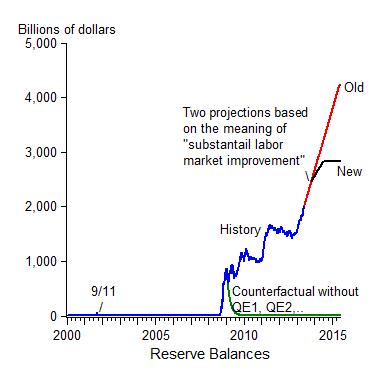
The red line shows a projection consistent with the assumption that the $85 billion would continue until the unemployment rate hit 6.5 % (which until today was one interpretation of the “substantial labor market improvement” criterion) in which case tapering would have started in mid-2015.  Note that this is essentially a continuation of the recent history (blue line).

The black line shows a projection consistent with the new view that was expressed today. Although we still do not know what the degree of slowing will be, the chart assumes that the pace is cut in half (to $42.5 billion per month) in October and then to zero in the summer of 2014.  If this is what actually transpires, reserve balances will peak around $2.8 trillion rather than $4.2 trillion under the previous projection. That’s a big revision.  Markets likely had already been assuming (at least since Bernanke’s Joint Economic Committee hearing a month ago) a tapering before the middle of 2015.  Still that downward revision is larger than the total increase in reserve balances under QE3.

Ever since QE3 began I have been giving lectures pointing to the red line, hoping it would not happen, and asking, as in the story of Scrooge, “Are these the shadows of the things that will be…. . . or are they the shadows of things that may be, only?”  The new projection is less scary, and that is something to be grateful for.  Still even though the peak is lower than one might have feared, exit from that peak will be very difficult for the Fed as the market volatility for the past month has shown as various Fed officials have endeavored to broach the subject. Unfortunately, Fed policy makers are still not clear about the exit and they are far from what Justin Wolfers recommends that they: “Tell us what they are going to do, then follow through by doing it.”


Posted in Monetary Policy | Leave a comment

Notes on an Economics Graduation

I like graduations. Sunday was Stanford’s. It was a beautiful day, especially for economics graduates, who gathered under a big tent with family and friends in front of Stanford’s Hoover Tower, listened to a fascinating speech on matching by Nobel Prize winner Al Roth, and received their diplomas.  The weather was typical for June: low humidity, a mild 75 degrees, not a cloud in the sky.

Economics teaching was celebrated.  Caroline Hoxby won a major prize for teaching and advising a slew of Ph.D. theses, Scott McKeon for heroic teaching of undergraduate econometrics, Matt Jackson for his MOOCs. This academic year Al Roth, Susan Athey and Guido Imbens followed Caroline from Harvard and moved to Stanford. And Stanford won the Rose Bowl, another economic teaching opportunity.

Student research was celebrated.  Evan Storms, who worked on large scale matching model (with Paul Milgrom advising), and Cynthia Liu, who worked on the end of the Great Moderation (with me advising), won the university undergraduate research award.

Four years ago many of the graduates took Economics 1A (Principles of Microeconomics). One of the guest lecturers that year was my granddaughter who was not yet one year old.  Now four years old, she came by Sunday for the reception.  Over those four years the S&P 500 soared from 1K to 1.6K, but the employment to population ratio stagnated.

This year was the last for Economics 1A and Economics 1B (Principles of Macroeconomics) at Stanford. From now on we’ll combine 1A and 1B into a one-term course—Economics 1—the Principles of Economics.  I’ll be giving Economics 1 and blogging on Economics One.

Posted in Teaching Economics | Leave a comment

Paul Krugman is Wrong about Fiscal Policy Research

Over the weekend, Paul Krugman responded to my post in which I show that the slowdown in state and local government purchases of goods and services is a consequence, rather than a cause, of the weak recovery.  My basic point is that state and local tax revenues have flattened out because of the persistently weak economy and this has resulted in fewer purchases.

Krugman does not register any disagreement with this finding.  Instead he resorts to arguing that the finding is inconsistent with my earlier fiscal policy research on discretionary stimulus packages, citing my congressional testimony in February 2011.  But Krugman is wrong about this earlier research.

Here is what I said in that testimony about the ARRA stimulus package as well as previous temporary fiscal actions:

My empirical research during the past two years shows that ARRA did not have a significant impact in stimulating the economy. I do not think this finding should come as a surprise. Earlier research on the discretionary countercyclical Economic Stimulus Act of 2008— enacted three years ago this week—indicates that it too did little to stimulate the economy. Research on the discretionary countercyclical actions in the late 1960s and 1970s—the most recent period of such large interventions prior to this past decade—also shows disappointing results…

The empirical research referred to in the testimony found no significant positive effect of the temporary ARRA funds on state and local government purchases, but it did find large and significant effects from more lasting changes in revenue from tax receipts.   These responses of state and local governments reflect, among other things, the distinction between temporary and more persistent changes in income.  For similar reasons consumers respond differently to temporary versus permanent changes in income, which is why the temporary 2008 stimulus had little effect. So there is no inconsistency between that empirical research and my recent post.  

Moreover, despite Krugman’s accusations to the contrary, it is not only during the Obama Administration that I find that such temporary discretionary fiscal actions have had little positive effect.   As the above quote from my February 2011 testimony makes clear, I also found little positive effect from the discretionary fiscal actions during the Bush Administration in 2008 as well as from discretionary fiscal actions during the administrations in the late 1960s and 1970s—Johnson, Nixon, Ford, and Carter.

Posted in Fiscal Policy and Reforms | Leave a comment

Don’t Blame Weak Recovery on State and Local Spending Cuts

As the economic recovery has remained weak well into its fourth year, some Washington policy makers have increasingly been blaming cuts in government spending, with much of their finger pointing at state and local governments where purchases of goods and services have slowed or declined.  For example, in a speech last February Janet Yellen blamed the slow recovery in part on the fact that “State and local governments were cutting spending…”

As a matter of national income and product accounting, it is true that cuts in state and local government purchases subtract from GDP, but these cuts are mainly an endogenous consequence not an exogenous cause of the weak recovery.

Consider the following two charts.  The first shows how state and local government purchases have been essentially flat in nominal terms in the past few years. But it also shows how this is largely due to the flattening out of revenues, which is, of course, caused by the weak economic recovery and resulting the slow growth of tax receipts. s&l purchases receipts

The second chart shows how the purchases squeeze is exacerbated by increased transfer payments which are also caused by the weak recovery. It subtracts out transfer payments from revenues showing the funds available for purchasing goods and services. The halt in available funds and the halt in purchases in recent years are nearly perfectly synchronized.

s&l purchases available

Blaming cuts in state and local government purchases takes attention away from the real culprits in the slow recovery which are the unpredictable and uncertain monetary, fiscal, tax and regulatory policies.

Posted in Slow Recovery | Leave a comment

A Victory for Markets and a California Raisin Suit

Enlivening the principles of economics course (we call it Economics 1 at Stanford) with skits and stunts to make it more understandable, relevant and memorable is a passion for many teachers. Reporter Kathy O’Toole once wrote about one of my stunts in an article in Stanford Today describing how I would dress up in a California raisin suit:

a few years from now, what these students will remember is the morning their stately professor morphed into a brown, wrinkled California raisin with six white stubs for fingers.  ‘I woke up this way this morning,’ he mumbles to the class, his misshapen hands fumbling to straighten his supply-demand curves on the overhead projector. ‘But the lecture must go on.’ And on it goes at its usual pace until Kresge [Auditorium] suddenly is jolted by a blast of bass guitar. The pudgy raisin on the stage, graph pointer still in hand, begins to wiggle, bend and shuffle to Marvin Gaye’s voice blaring “Heard It Through the Grapevine.” The lyrics miraculously replace the supply-demand curves on the overhead. By the time the raisin stumbles breathless, rumpled and sweaty through the last chorus, Kresge is rocking.,.

My purpose in all this craziness?  Simply to illustrate the workings of a famous government intervention—in this case agricultural price supports and the California raisin ad they led to.  One time a New York Times article endeavored to link this stunt to my position on bailouts as Treasury Under Secretary.

I always hoped that the price supports would be removed even if that would make my stunt obsolete. So my ears perked up when I heard my friend Ed Feulner tell a story at lunch yesterday about how free markets might be breaking through raisin controls in California. A few producers refused to cooperate, were fined and took the case to court. And thanks to the Supreme Court and Justice Kagan in particular, they might win.   The uplifting story is told in the Washington Times. And here is one of those ads

Posted in Regulatory Policy | Leave a comment

Former Fed Chairs Speak Out

Paul Krugman’s reply to my post on Allan Meltzer’s and Paul Volcker’s critiques of monetary policy failed to mention what Paul Volcker has been saying. Yet Volcker’s views are important, especially since, as Krugman points out, he “deserves immense respect for past achievements.”

In his recent Economic Club of New York speech (which has been under-reported and deserves to be read carefully), Volcker argues that the “Beneficial effects of the actual and potential monetization of public and private debt, the essence of the QE program, appear limited and diminishing over time.  The old ‘pushing on a string’ analogy is relevant.  The risks of encouraging speculative distortions and the inflationary potential of the current approach plainly deserve attention.  All of this has given rise to debate within the Federal Reserve itself.  In that debate, I trust sight is not lost of the merits – economically and politically – of an ultimate return to a more orthodox central banking approach.”

Like many others, Volcker is pointing to a two types of risk:  speculative distortions and inflationary potential.  Inflation, even if down the road, is not the only problem. There are already distortions caused by the unprecedented interventions in the mortgage market, the Treasury bond market and the inter-bank loan market, including the multi-year zero interest rate administered by the Fed.

It is also important to note, as I did in my earlier post, that Volcker is critical of the Fed’s dual mandate, which he says is “operationally confusing and ultimately illusory: operationally confusing in breeding incessant debate in the Fed and the markets about which way should policy lean month-to-month or quarter-to-quarter with minute inspection of every passing statistic; illusory in the sense it implies a trade-off between economic growth and price stability, a concept that I thought had long ago been refuted not just by Nobel prize winners but by experience.”

During his chairmanship of the Fed, Volcker found a way to deal with this dual mandate and still run a reasonably predictable monetary policy.  More recently the Fed has used the dual mandate to rationalize a less predictable and more interventionist monetary policy.

It’s unusual for former central bankers to speak about current monetary policy, yet Volcker is not the only one to do so. In a recent CNBC interview, Alan Greenspan also raised concerns about current policy saying:   “The sooner we come to grips with this excessive level of assets on the balance sheet of the Federal Reserve, which everyone agrees is excessive, the better.” and “The issue is not only a question of when we taper down, but when do we turn?  And I think that the markets may not give us all of the leeway we would like to do that.”

Posted in Monetary Policy | Leave a comment

Job Growth–Barely Keeping Pace with Population

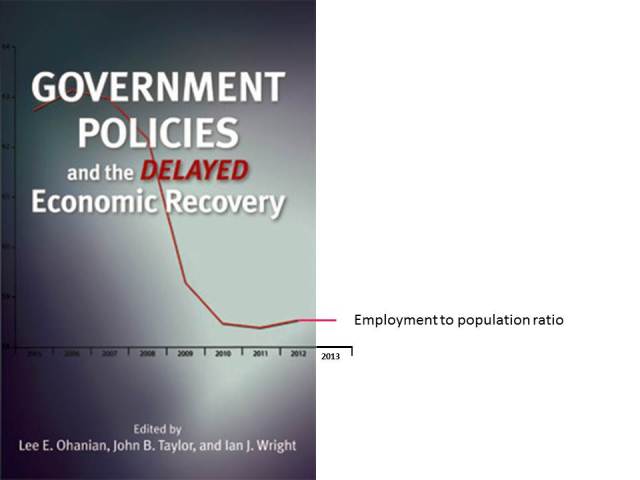
Last Friday’s employment report revealed little sign of a lift off of the employment to population ratio.   It’s the same as it was in May of last year—58.6 percent. Employment grew by about 1 percent (or 1.6 million) over the past year. But the working age population also grew at about 1 percent (or 2.4 million), so the ratio of employment to population stayed the same.  For the policy book I edited with Lee Ohanian and Ian Wright last year we put the employment to population ratio on the cover. Here’s the sad extrapolation.cover

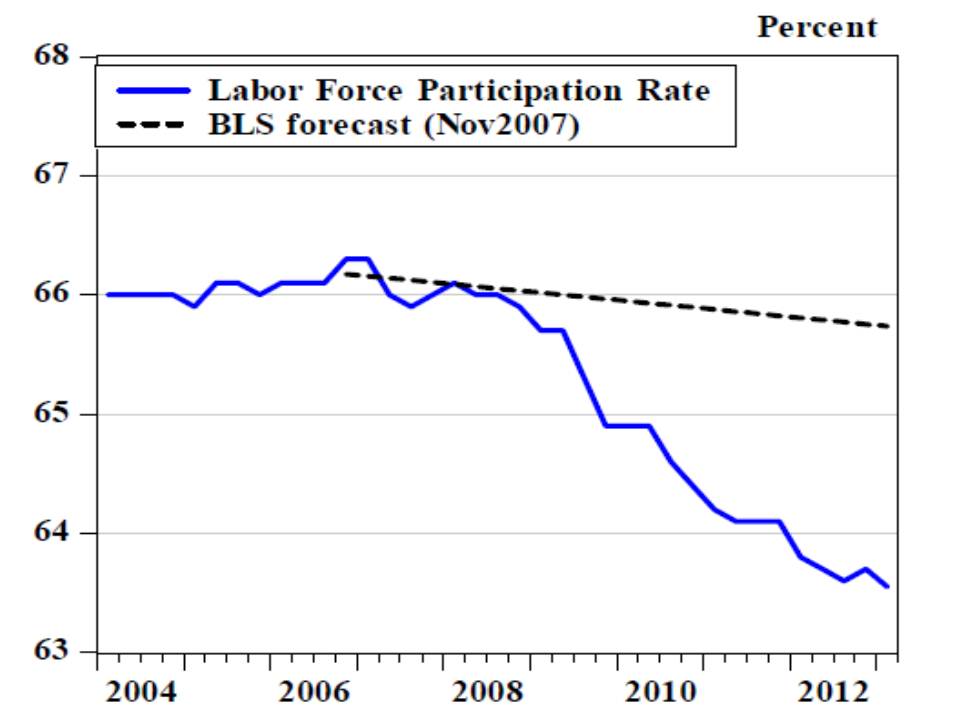
The main reason why this measure of employment has not shown improvement while the unemployment rate has declined over the past year is that the labor force participation rate has declined (from 63.8 to 63.4). Some argue that the declining labor force participation is what one would expect from the demographic changes as the baby boom generation retires.  But the labor force dropout rate is much larger than that and must have to do with the prolonged slow recovery.

A simple way to show this is to look at what BLS was projecting—using demographic factors—for labor force participation before the recession and the slow recovery.  The fascinating chart below is from a recent paper Chris Erceg and Andrew Levin. It shows  that the decline in labor force participation rate is far greater than the demographics would suggest. Erceg Levin Chart

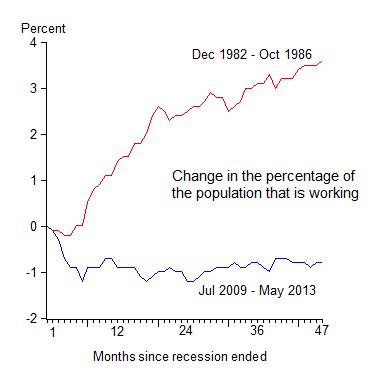
Finally, here is an updated version of the chart I have used throughout the recovery  to show changes in the employment-population ratio compared with the 1980s recovery. emp pop

Posted in Slow Recovery | Leave a comment

Meltzer and Volcker on the Fed

In a new piece called “Quantitative Quicksand” published in Project Syndicate, Allan Meltzer argues that the U.S. recovery would be better off if the Fed had not engaged in quantitative easing.  The banks are just loaning the extra liquidity to credit worthy borrowers and the government, rather than to the smaller businesses that need it.  The economic problems lie elsewhere. In the meantime the risks of not being able to exit smoothly from the Quantitative Quicksand (what a great title) are mounting.

Meltzer is one of many economists and policy makers—on both sides of the political spectrum—who have been speaking or writing on the risks and the already-realized downsides of the Fed’s recent policy.

Just last week Paul Volcker weighed in at the Economic Club of New York, arguing that the exit problems are indeed tough while the benefits of the policy are “limited and diminishing.” Volcker also makes the case for getting rid of the dual mandate because of the risks it too causes. The recent market volatility over tapering—exiting from the quicksand—is just an early realization of the risks that many have long been warning about.

Posted in Monetary Policy | Leave a comment

Memo to World Bank–Keep “Doing Business”

Several weeks ago on Economics One I wrote that it would be a big mistake for the World Bank to drop or water down its Doing Business reports.

It is good news and a nice show of bipartisanship that Members of Congress Jeb Hensarling (R), Karen Bass (D), Edward Royce (R), and Gregory Meeks (D) wrote a letter to President Jim Kim of the World Bank urging him to keep the annual report started 10 years ago.

In a recent oped former U.S.A.I.D. Administrator Andrew Natsios makes an even stronger case.

Posted in Regulatory Policy | Leave a comment

Ed Leamer on the Weak Recovery

In a recent “chart cast” video posted on YouTube, Russ Roberts interviewed Ed Leamer of UCLA on why the recent economic recovery has been so weak.  Ed’s list of causes differs a lot from mine, which Russ discussed with me in chart cast videos Part 1Part 2, Part 3 last year.  See also the book on the recovery which Lee Ohanian (Ed’s UCLA colleague), Ian Wright and I edited.

First, Ed argues that the recent recovery is not unusually weak in comparison with the recoveries from the 1990-91 and 2001 recessions. But those recessions were much milder than the recent recession.  Slow recoveries following shallow recessions are not unusual. The current weak recovery is very unusual because it followed a deep recession. This makes Ed’s focus on manufacturing declines, which are common to all three recessions, much less plausible as an explanation.

In addition, Ed’s benchmark for measuring the recoveries is a constant 3% long-term trend line. But longer term trends can vary can vary over time. The chart below uses the CBO’s trend line, which varies over time. You can see how unusual the recent recovery is.potential actual 1978-

When asked by Russ to respond to my view that the slow recovery is due to government policy (around 13:21 into the Leamer interview), Ed says I overstate the importance of government fiscal and monetary policy, and then refers to housing as a source of weakness. It is true that housing has been weak following the bust, but all recoveries have their weak sectors. In the 1980s it was exports. Moreover, housing has picked up recently, and overall growth still is quite slow. Going forward, few are predicting the kind of growth rates seen after previous deep recessions.

Posted in Slow Recovery | Leave a comment