A Chart for the Fourth of July

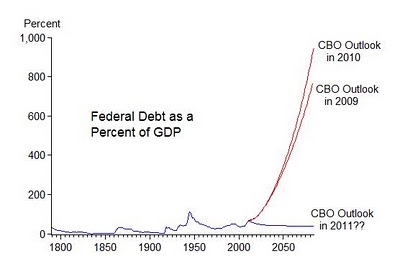
Just before Americans started celebrating the July 4th weekend, the Congressional Budget Office (CBO) released its annual Long Term Budget Outlook. The chart shows the CBO projection of the federal debt (as a percent of GDP) assuming that current law or policies do not change as defined in the CBO alternative fiscal scenario (CBO Outlook in 2010). The chart also shows the CBO’s long term projection at the same time last year (CBO Outlook in 2009). And for comparison the chart also shows the history of the debt going back to the time of the founding of the country. Like the fireworks tonight, you can see one explosion after another, and one higher than the one before. But unlike the fireworks tonight, these are not the kind of explosions you want to see.

We can hope that Washington gets its act together in time for next year’s July 4th celebration so that CBO can make a non-exploding debt projection, like the one at the lower right of the chart. In this lower projection the debt is equal to the 67 percent of GDP currently forecast for 2011, but it then declines in an orderly manner until it reaches 40 percent of GDP, rather than the 947 percent of GDP now projected for 2084. As I testified at the House Budget Committee last Thursday, I think such a plan—if it is clear and credible—would be a much better stimulus to growth and job creation than another “stimulus package” of the kind we saw in recent years.

For more information about the CBO projection, you can examine their spreadsheet by clicking on “additional info.”

Posted in Budget & Debt | Comments Off on A Chart for the Fourth of July

Financial Reform with False Remedies and Errors of Omission

A common criticism of the Dodd-Frank bill keeps coming up as more people wade through the several hundred sections, or at least summaries of them. This common criticism is that the bill contains many false remedies and errors of omission. The criticism comes from both the left and the right. See, for example, these two pieces: “The Failure of Financial Reform, Itemized” by John Talbott in the Huffington Post and “Phony Financial Reform” by Thomas Donlan in Barron’s. While political factors—special interest lobbying, social activist pressures, covering up past mistakes—were probably behind much of the bill, economic analysis shows that the problem is that it is based on a misdiagnosis of the financial crisis, as I wrote in this op-ed which appeared in the July 1 Wall Street Journal.

The bill will be taken up by the Senate later in the month, but is it too much to ask that they wait until the Financial Crisis Inquiry Commission finishes its diagnosis in December? If you want to find out more about the bill, you can download all 2300+ pages, but beware that it is 74 megabytes.

Posted in Financial Crisis | Comments Off on Financial Reform with False Remedies and Errors of Omission

Why Was Poland the Only EU Country to Avoid Recession?

Poland is the only country in the European Union which did not have a recession during 2009, as shown in this chart. And among all the OECD countries, Poland had the best real growth performance in 2009. I visited Poland this past week to give some talks and to better understand Poland’s resiliency. One particularly enjoyable talk was joint with Leszek Balcerowicz the former central bank governor and finance minister who deserves much of the credit for transforming Poland’s economy from central planning to a market economy back in 1989.

What are the reasons for Poland’s extraordinary performance in 2009? Good economic policy had much to do with it. As with some other emerging market economies Poland was in a much better macroeconomic position in 2009 than it was 10 years ago. It kept its inflation rate and its debt levels low, limited its borrowing in foreign currencies, and accumulated a large amount of foreign reserves. It also did not overact to the financial crisis, despite urging of many inside and outside of Poland to do more to stimulate the economy with discretionary fiscal policy. By not overacting it prevented the kind of panic seen in other countries.

Some say that the flexible exchange rate was a factor in avoiding recession as the depreciation of the Zloty helped keep net exports from declining as sharply as in other countries. However, the Zloty appreciated before the crisis which would have had negative effects, and the subsequent depreciation essentially took the exchange rate back to about where it was before that appreciation, as shown in the second chart.

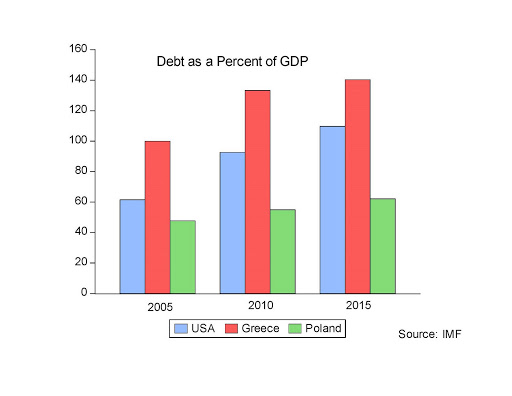
While Poland still needs to be vigilant and keep its government debt from rising as a share of GDP, it is currently in far better shape than other countries according IMF data on debt, including the United States.

Posted in International Economics | Comments Off on Why Was Poland the Only EU Country to Avoid Recession?

Macroeconomic Lessons from The Great Deviation

Each year for the past 25 years the National Bureau of Economic Research has sponsored a conference on macroeconomics with a special emphasis on empirical research with policy relevance. The results are published in the NBER Macroeconomics Annual. Initiated by Martin Feldstein when he was president of the NBER, the conference and the annual volume has had a distinguished group of editors over the years, including Stanley Fischer, Olivier Blanchard, Julio Rotemberg, Ben Bernanke, Daron Acemoglu, Kenneth Rogoff, and Michael Woodford.

This spring I gave the dinner talk at the 25th meeting of the Macro Annual, summarizing the empirical work I have been doing on the financial crisis. I called the lecture, Macroeconomic Lessons from the Great Deviation, and began with the following explanation of the title of the talk:

I know economists use the word “Great” too much, but I think it is quite fitting here. We all know what the Great Moderation was and we have debated what caused it. Many have argued that good policy, especially good monetary policy, played a big role. And we all know what the Great Recession was and that it marked the end of the Great Moderation. You may not have heard much about the Great Deviation. I define it as the recent period during which macroeconomic policy became more interventionist, less rules-based, and less predictable. It is a period during which policy deviated from the practice of at least the previous two decades, and from the recommendations of most macroeconomic theory and models. My general theme is that the Great Deviation killed the Great Moderation, gave birth to the Great Recession, and left a troublesome legacy for the future.

I then went on to list a dozen policy actions and interventions that I would put under the rubric of the Great Deviation and reviewed each. The full talk is here.

Posted in Monetary Policy | Comments Off on Macroeconomic Lessons from The Great Deviation

Is an Orderly Restructuring of Greek Debt Feasible?

Many economists argue that the Greek government, even with the help of the European/IMF rescue package, will eventually have to restructure its debt. Just last Friday in a Bloomberg News story Thomas Mayer, chief economist of Deutsche Bank, said this about Greece: “Deficit reduction alone doesn’t solve the debt issue…Hardly anyone I know believes they can carry it out and still not restructure. This is basically the expectation across all asset classes.” He then cites a projection that Greek debt will increase from 120 percent to 150 percent of GDP with the rescue package. Former IMF economists—such as Simon Johnson, Eswar Prasad, and Raghu Rajan—share this view about a restructuring.

The reason that government officials do not want to go down the restructuring route, or even admit the possibility, is that they worry that a restructuring would be disorderly, jolt the financial markets, perhaps causing contagion. But a restructuring does not have to be disorderly and would have the added benefit of avoiding harmful future bailouts.

In a recent paper, “How to Restructure Greek Debt,” Mitu Gulati a professor at Duke Law School, and Lee Buchheit, a partner at Cleary Gottlieb in New York, lay out in detail an approach to restructuring which would likely result in very little market disruption. Gulati and Buchheit have studied or been involved in many sovereign debt restructurings over the years, so they know the relevant law and what they are talking about in the Greek case. I know them from their work on “collection action clauses,” (CACs) which emerging market countries put into their sovereign bonds as a way a way to avoid disruptive defaults and thereby give the IMF and the official sector an alternative to bailouts. Collective action clauses enable a super majority of bond holders (frequently 75%) to agree with the sovereign to change the financial terms of a bond and then require the remaining bond holders to go along. This avoids the holdout problem that usually forces a default or a bailout. In my view, collective action clauses have helped reduce bailouts of emerging market countries and improved macro policy in those countries as I argued in a post on this blog last March 2 Why Did Macro Policy in Emerging Market Countries Improve?
The problem is that the majority of Greek bonds are issued under Greek law without CACs. Only Greek bonds issued under English law have collective action clauses. However, as Gulati and Buchhiet point out, the fact that the bonds were issued under local law is an advantage because the terms can be changed by the Greek parliament. Of course, changing the terms of bonds should not be taken lightly as it raises many precedents, but Gulati and Buchheit argue that “One legislative measure that might be perceived as balanced and proportional in these circumstances, however, would be to enact what amounts to a statutory collective action clause.” So the circumstances for a Greek restructuring may actually be better than many have been led to believe.
Three other circumstances are also an advantage: First, virtually all (98 percent) of Greek government debt is denominated in Euros. Second, since all the bonds are issued under either English or Greek law, there is no complication caused by many jurisdictions. Third, most of the bonds are held by institutional investors, so the Greeks do not have to deal with thousands of small retail holdings. Economist Adam Lerrick of Carnegie-Mellon University, who also has had a lot of hands-on experience with debt restructurings, argues after a review of the Greek government’s bond issue documentation, that the debt stock is in pretty good shape to be restructured. In fact he says “one could hardly have a better legal and economic structure.”
Posted in International Economics | Comments Off on Is an Orderly Restructuring of Greek Debt Feasible?

Teaching What Is Exciting, Wonderful, and Fun…at All Levels

People often ask me what it’s like to teach both introductory economics courses and Ph.D. level economics courses in the same academic year, which I have done regularly for many years at Stanford including this year. The courses are at extreme ends of the educational spectrum, and there are several obvious differences.

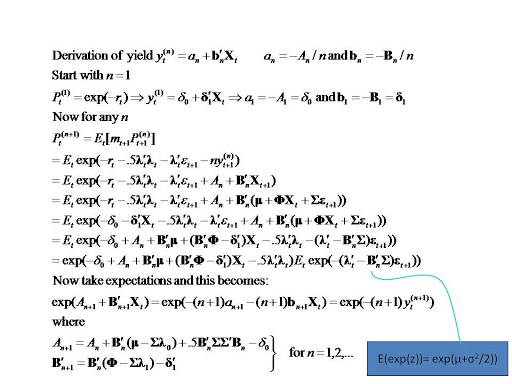
First is the math. My Ph.D. course is loaded with math—multivariate stochastic processes, differential and difference equations, inter-temporal optimization, vector auto-regressions. It is not unusual to fill several slides or blackboards with equations. Here is what you would see if you walked into my Ph.D. lecture on risk and rates of return on bonds.


In contrast my introductory course has virtually no math beyond high school algebra. The emphasis is on economic intuition, reasoning, applications, and I mainly use graphs. Here is what you would see if you walked into my introductory lecture on risk and rates of return on bonds.

People are always surprised by the amount of math used in teaching economics in graduate school, and some think it is used too much. In an interview with Milton Friedman I published several years ago, he said “I go back to what Alfred Marshall said about economics: Translate your results into English and then burn the mathematics. I think there’s too much emphasis on mathematics as such and not on mathematics as a tool in understanding economic relationships.” While I agree about the need to explain the mathematical results in simple terms, I do not agree about burning the math once translated. Mathematical methods are now used in practice in economics and finance in both the public and private sector, from auctioning the spectrum to matching medical students and residence programs. People need to have an intuitive understanding of the methods, but you also need the math (and the computer programs) to make them work.

A second difference between the introductory course and the Ph.D. course, which you would notice right away if you walked in, is the greater emphasis on entertainment (I call it surprise-side economics) in the former. This is in part because the introductory course is much larger—100s of students compared to about 25 in Ph.D. classes, but also because the Ph.D. students have already decided to become professional economists, and are usually happy to focus on the details of the subject without a constant reminder of the motivating factors.

The most interesting difference between the courses in my view is how you simplify the more complex ideas for beginning students. One of the great teachers who taught at both levels—though in physics rather than economics, Nobel Prize winner Richard Feynman wrote this about teaching at the introductory level: “Now, what should we teach first? Should we teach the correct but unfamiliar law with its strange and difficult conceptual ideas, for example the theory of relativity, four-dimensional time-space, and so on? Or should we first teach the simple “constant-mass” law, which is only approximate, but does not involve such difficult ideas? The first is more exciting, more wonderful, and more fun, but the second is easier to get at first, and is a first step to a real understanding…. This point arises again and again in teaching physics.”

It also arises again and again in teaching economics. Some ideas—like auction theory or mechanism design for matching—probably have to wait to more advanced courses. But in my view it is possible to teach many other amazing economic ideas rigorously at the intro level—for example, the efficiency of competitive markets or how a central bank controls the interbank rate—and thus give beginning students an understanding of the “more exciting, more wonderful, and more fun” parts of economics.

Which course do I enjoy teaching more? Both are challenging and rewarding, though in different ways. Not to dodge the question, but the truth is I enjoy both.
Posted in Teaching Economics | Comments Off on Teaching What Is Exciting, Wonderful, and Fun…at All Levels

Is the G20 Starting to Get Back on Track?

This past weekend’s meeting of the G20 finance ministers and central bank governors in Korea ended with a rejection of calls for more fiscal stimulus. This is a marked change from their meeting held just over a month ago in Washington. It’s a change for the better. Nowhere in this past weekend’s communiqué did the ministers and governors call on each other to stimulate aggregate demand with more expansionary fiscal policy. Instead, they said things like “Those countries with serious fiscal challenge need to accelerate the pace of consolidation. We welcome the recent announcements by some countries to reduce their deficits in 2010 and strengthen their fiscal frameworks and institutions.” At the previous meeting they were saying instead that fiscal stimulus in some countries “should be maintained until the recovery is firmly driven by the private sector and becomes more entrenched” and that this would “cushion a decline in demand” in other countries. In fact the word “demand” does not even appear in the recent G20 statement. You do not have to be an insider to know that this was a rejection of U.S. requests. A letter from Treasury Secretary Geithner to his G20 colleagues released just before the meeting was packed with calls for governments to maintain fiscal expansion in order “to reinforce the ongoing recovery in private demand.” The word demand appears 8 times in the Geithner letter and not once in the final G20 statement.

There are a number of reasons for the change. Most obvious is the serious crisis caused by the debt problems in Europe. In addition the new UK Chancellor of the Exchequer George Osborne has brought new focus to deficits. And perhaps some are beginning to wonder whether all those debt increasing stimulus packages have brought more harm than good and that policy should be put back on track as soon as possible, as I have been arguing in this blog or in opeds or interviews such as this Bloomberg TV segment from last Thursday just before the meeting: “Taylor says G20 needs to focus on debt, stimulus.”

Of course, we must wait to see if the G20 language change is a precursor of real actions. Watch to see if the G20 leaders have the same response as their finance ministers when they hear from President Obama at their meeting in Toronto next month.

Posted in International Economics | Comments Off on Is the G20 Starting to Get Back on Track?

The Fed’s Swap Loans and Libor – OIS Spread

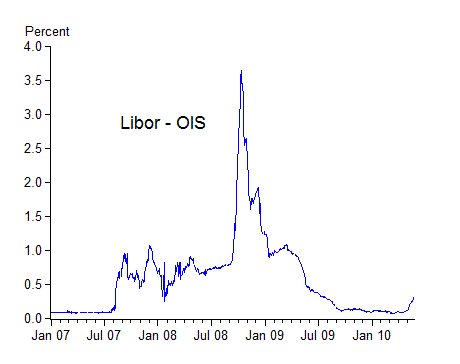
For about two years—from August 2007 to September 2009—fluctuations in the spread between dollar Libor and the overnight index swap (OIS) served as a valuable quantitative indicator of financial stress in the interbank loan market. It also served as a measure of the impact of various government interventions. The paper “A Black Swan in the Money Market” by John Williams and me focused on the unprecedented jump in that spread in August 2007 and showed that the Fed’s Term Auction Facility (TAF) was not effective in reducing the spread. As shown in the chart, the dollar Libor-OIS spread rose further during the panic in September-October 2008. It then returned to near pre-crisis levels in September 2009 and stayed there until the new crisis in Europe erupted when it started to increase again, attracting the attention of financial analysts and the financial press.

Note, however, that the recent increase—visible in the right part of the chart—is very small compared with the jumps in 2007 and 2008. Nevertheless, as part of the European rescue package, the Fed agreed to provide dollar swap loans to the ECB and other central banks so that they could provide dollar loans in the interbank market. Have these swap loans affected the spreads?

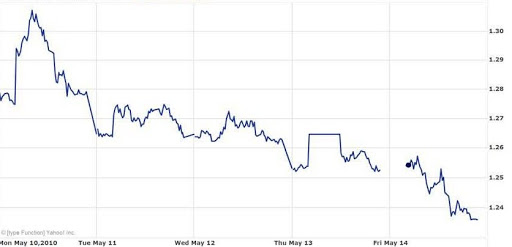
As shown in the second chart, which focuses on the Libor – OIS spread during March – May 2010, it is hard to find any effect, not even an announcement effect. On the Friday (May 7) before the announcement of the European rescue package the spread was 18 basis points. It increased on the Monday (May 10) after the announcement and then continued to increase in the two weeks since then, reaching 32 basis points on May 24. However, the size of the loans has thus far been remarkably small and has declined sharply since the start of rescue package. According to the Fed’s H.4.1 release of today, the amount of swap loans provided was $9.205 billion on Wednesday May 12, remained the same on $9.205 on Wednesday May 19, but fell to only $1.242 billion ($1.032 to the ECB and $210 to the BOJ) on Wednesday May 26. I have argued since the start of the crisis that the Fed should provide daily (not just weekly) balance sheet data so people outside the Fed can evaluate the impacts of its programs on the markets, but this is all we have. It is not clear why the loans have declined so rapidly. Perhaps criticism about participating in the European bailout led the Fed to discourage the use of the swap loans under the program at a time when the Fed is trying to prevent the Congress from reducing its independence. Or perhaps the interest rate (1.24 percent) was simply too high.
Posted in Monetary Policy | Comments Off on The Fed’s Swap Loans and Libor – OIS Spread

The Administration and the IMF on the Multiplier

In a soon to be published paper, several economists at the International Monetary Fund report estimates of government spending multipliers which are much smaller than those previously reported by the U.S. Administration. In order to obtain the estimates the IMF economists use a very large complex model called the Global Integrated Monetary and Fiscal (GIMF) Model developed by Douglas Laxton and his colleagues at the IMF . The paper is quite technical, but the bottom line summary is that a one percent increase in government purchases (as a share of GDP) increases GDP by a maximum of 0.7 percent and then fades out rapidly. This means that government spending crowds out other components of GDP (investment, consumption, net exports) immediately and by a large amount.

The IMF estimate is much less than the multiplier reported in a paper released last year by Christina Romer of the President’s Council of Economic Advisers and Jared Bernstein of the Vice President’s Office. The attached graph shows how huge the difference is. It shows the impact on GDP of a one percentage point permanent increase in government purchases as a share of GDP reported in the IMF paper (labeled GIMF) and in the Administration paper (labeled Romer-Bernstein).

John Cogan, Volker Wieland, Tobias Cwik and I raised questions about Romer-Bernstein paper soon after it was released last year because the estimates seemed to be much different from comparable estimates based on more modern new Keynesian models. We classified the Romer-Bernstein estimates as old Keynesian. Since then many technical papers have been written on this subject, of which a recent paper by Michael Woodford is the most comprehensive in my view. The IMF model is of the new Keynesian variety and adds more evidence of the huge policy differences between new Keynesian and old Keynesian models.
Posted in Fiscal Policy and Reforms | Comments Off on The Administration and the IMF on the Multiplier

The Euro’s Post-Package Slide

In a column Central Banks are Losing Credibility published in the Financial Times last Tuesday, just after the announcement of the European rescue plan, I noted that the euro’s quick set-back hours after its initial boost was a harbinger of negative consequences. The euro’s continued decline throughout last week (see chart) shows that this set-back was not only a harbinger, but also the first in sequence of negative market reactions. Much commentary during the week supports this view.

Harald Uhlig, in an article “Die Trichetisierung des Euro” in Handelsblatt on Wednesday, raises more credibility concerns about the ECB as does Simon Nixon, in his Friday Wall Street Journal article “Central Banks, Politics Don’t Mix” (adding criticism of the Bank of England’s endorsement of the new British government’s budget plan). Yesterday Mohamed El-Erian warns in an FT.com guest post of the possibility that governments will “do more of the same” and that the US will “press Europe to do more of the same” which is a real concern. Recall that when it was clear that the 787 billion dollar stimulus package passed in the United States in February 2009 was not helping the recovery, some argued that it was not big enough, and they may be soon arguing that the near 750 billion euro package is not big enough. Indeed, that might have been an argument heard on the G7 finance ministers conference call late last week.
But the evidence is that a larger package could easily make things worse. As we learned in the U.S. financial crisis starting in August 2007, more liquidity will not solve a basic solvency problem. As Mohamed El-Erian points out “it is not easy to change track,” but last week reminds us how important it is to at least start getting back on track, the title of my article in the current issue of the St. Louis Fed Review.
Posted in International Economics | Comments Off on The Euro’s Post-Package Slide