Lessons Learned from Ben Bernanke’s Policy Rule Discussion at the Senate

At yesterday’s hearing before the Senate Banking Committee, Fed Chairman Ben Bernanke talked about monetary policy rules in response to a series of questions by Senator Pat Toomey. First, the Chairman stated that the Taylor Rule calls for interest rates “way below zero” and that this justifies methods such as quantitative easing. This is puzzling because I have reported for months that the Taylor Rule (see 1993 paper) does not call for an interest rate below zero. Second, when Senator Toomey then asked if Taylor believed the Taylor Rule called for rates below zero, Chairman Bernanke didn’t answer directly, but instead claimed that in 1999 I preferred a different rule to the one I published in 1993; he then said that the 1999 rule gives a much different rate. Senator Toomey then pressed on and specifically said the Taylor Rule called for rates higher than we have now, at which point Chairman Bernanke changed tack and argued that there were other policy rules that call for below-zero interest rates. Here is the relevant part of the transcript.

MR. BERNANKE: … The Taylor Rule suggests that we should be, in some sense, way below zero in our interest rate, and therefore we need some method other than just normal interest rate changes to —
SEN. TOOMEY: Do you know if Mr. Taylor believes that?
MR. BERNANKE: Well, there are different versions of the Taylor Rule, and there’s no particular reason to pick the one that he picked in 1993. In fact, he preferred a different one in 1999 which, if you use that one, gives you a much different answer.
SEN. TOOMEY: My understanding is that his view of his own rule is that it would call for a higher Fed funds rate than what we have now.
MR. BERNANKE: There are, again, many ways of looking at that rule, and I think that ones that look at history, ones that are justified by modeling analysis, many of them suggest that we should be well below zero. And I just would disagree that that’s the only way to look at it.
But anyway, so I think there are some — there is some basis for doing that.

There are several issues raised by this back-and-forth exchange.

Most important, at least from my perspective, is that contrary to what was claimed in the hearing, I did not say that I preferred a different policy rule in 1999 rather than the rule I originally published in 1993. I am not sure where this idea of my preferring another rule came from; I went back and looked at the academic papers I published in 1999 (here is a list); the paper on this list that Chairman Bernanke may have been referring to is A Historical Analysis of Monetary Policy Rules where I looked at two different policy rules during different periods of U.S. history. However, as I said in that paper (page 325), one rule was the “policy rule I suggested” and the other one was what “others have suggested.” The “others” were people at the Federal Reserve so for completeness I included that rule in the historical comparison. I did not propose or prefer an alternative rule in that 1999 paper, and it is hard to see how one could interpret the paper that way. This is not just a matter of academic niceties and citations; it is important to correct the record because the “others have suggested” rule has a much larger coefficient on the GDP gap and is therefore more likely to generate negative interest rates and be used to rationalize discretionary actions such as quantitative easing.

Second, the exchange between Chairman Bernanke and Senator Toomey suggests that the Fed is unclear about what monetary policy strategy it is using for the interest rate. Is it the Taylor Rule, as in the first response? Is it the rule incorrectly attributed to me in 1999, as in the second response? Is it some estimated rule, as in the third response? Or is it something else? It would be useful to know what the strategy is. Greater transparency about the strategy would add greatly to predictability and would help markets understand whether quantitative easing will be extended or when the interest rate will break out of the 0-.25 percent range.

For example if the strategy was reasonably well described by the Taylor Rule the interest rate would equal about 1.5 times the inflation rate plus .5 times the GDP gap plus 1. The most recent quarterly data (through the 4th quarter of 2010, released by Bureau of Economic Analysis on February 25, 2011) show that the inflation rate is about 1.4 percent (change in GDP deflator over the last four quarters). According to the average of the most recent survey by the Federal Reserve Bank of San Francisco, (January 28, 2011, Williams-Weidner) the GDP gap is about 4.4 percent. This implies an interest rate of 1.5 X1.4 + .5X(-4.4) + 1 = 2.1 + -2.2 +1 = 0.9 percent, or about 1 percent, which suggests that the Fed should be raising the rate sometime soon, perhaps before the end of this year. But if it is one of the other rules mentioned by the Chairman we might have to wait longer.

Third, the exchange shows how it would be quite feasible and useful to restore some of the reporting and accountability requirements which were removed from the Federal Reserve Act in 2000. As I have proposed, with such requirements the Fed would establish and report to Congress its strategy or policy rule for monetary decision making. If it later deviated from that strategy it would have to provide an explanation to Congress in writing and at a public congressional hearing. With such a reporting requirement, the testimony at such a hearing would be like this exchange between Chairman Bernanke and Senator Toomey with the very important exception that the Congress and the American people would have some idea of what the Fed’s basic strategy was.
Posted in Monetary Policy | Comments Off on Lessons Learned from Ben Bernanke’s Policy Rule Discussion at the Senate

Goldman Sachs Wrong About Impact of House Budget Proposal

Some claim that House budget proposal H.R. 1 to reduce the growth of federal government spending will cause a slowdown in the economy and even increase unemployment. Consider, for example, a recent report by Alec Phillips of Goldman Sachs which claims that the House proposal would reduce economic growth in the second and third quarters of this year by 1.5 to 2 percent if enacted into law next month. Nothing could be more contrary to basic economics, experience and facts. Unfortunately, the report has been widely cited by those wanting to hold back on this first step to restore sound fiscal policy. And the Washington Post reports this morning that Mark Zandi of Moody’s is starting to make similar claims, which should be questioned for the same reasons.

There are several things wrong with the analysis used in Goldman Sachs report. First, it does not take account of the beneficial effects of starting now on a credible plan to reduce the deficit. Basic economic models in which incentives and expectations of future policy matter show that a credible plan to reduce gradually the deficit will increase economic growth and reduce unemployment by removing uncertainty and lowering the chances of large tax increases in the future. The high unemployment we are experiencing now is due to low private investment rather than low government spending. By reducing some uncertainty and the threats of exploding debt, the House spending proposal will encourage private investment.

The analysis in this Goldman-Sachs report is based on the same type of “large multiplier” theory that predicted that the stimulus package of 2009 would stimulate economic growth. Research by me and my colleague John Cogan finds that more up-to-date theories, which bring important incentive and expectations effects into account, show far smaller multipliers. In these models a reduction in the growth of spending will immediately crowd in private investment. Moreover, by following the stimulus money, we found that in actuality the stimulus package of 2009 had no material positive effect on economic growth or employment. The same economic theory which said the stimulus would increase economic growth in the past two years, says that reversing that spending will reduce growth now. It was wrong in the past and it is highly likely to be wrong again.

The report also confuses budget authority, which is what H.R. 1 is proposing, with budget outlays, which is what is actually spent. Changes in budget authority do not immediately translate into spending; rather such changes gradually impact spending over time. Last Friday the CBO released its analysis of H.R.1 and found that discretionary outlays for 2011 would be $1,356 billion, which is only $19 billion below the CBO baseline of $1,375 billion published on January 26 (Table 3-1). This is less than 1/3 of the $60 billion cut which the Goldman Sachs report assumes in evaluating H.R. 1. Thus the cut in budget authority does not reduce spending “abruptly,” as the report assumes. Rather it is a quite gradual effect. Even if one used the flawed Keynesian multipliers implied by the report, the impact would be less than one-third what the report claims.

In fact, under H.R. 1, total 2011 discretionary outlays would be above 2010 discretionary outlays, which totaled $1,349 billion. And, of course, discretionary outlays are only part of the budget. Total budget outlays will increase by 6.7 percent from 2010 to 2011 under H.R. 1. This is less than the 7.3 percent increase in government spending under the CBO baseline, but it strains credibility to say that the large increase in government spending which still takes place under H.R 1 is too draconian for the economy. Indeed, doing anything less than H.R. 1 should be viewed as a completely non-serious step toward dealing with the debt problem and restoring sound fiscal policy.

As I have written before, the old-style Keynesian approach used by Zandi has many of the same flaws that are found in the Goldman Sachs approach: excessively large multipliers, inaccurate predictions of the effect of the 2009 stimulus, failure to recognize that reducing uncertainty about the debt can have positive effects, especially if it is done in a credible way by reducing spending growth now, not postponing it to a date uncertain in the future. After stating that “too much cutting too soon would be counterproductive,” Zandi claims that this is what the “House Republicans want” and what their budget does. But it’s simply not credible to say that a budget that has government spending increasing at 6.7 percent per year cuts spending too much too soon.

In sum, there is no convincing evidence that H.R. 1 will reduce economic growth or total employment. To the contrary, there is more reason to expect that it will increase economic growth and employment as the federal government begins to put its fiscal house in order and encourage job-producing private sector investment.

Posted in Budget & Debt | Comments Off on Goldman Sachs Wrong About Impact of House Budget Proposal

2011 is the New 2008 in Federal Budget Debate

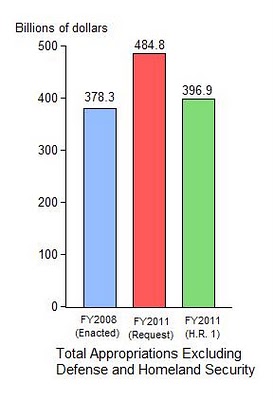
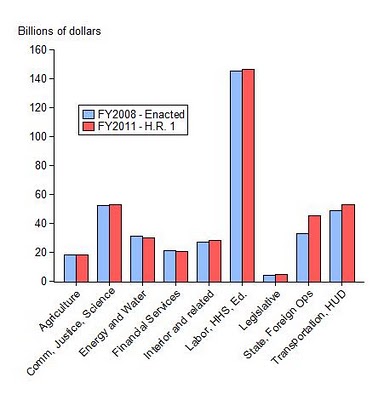
If history is any guide, we are about to hear scores of scare stories about the harm caused by the spending reductions in the 2011 budget resolution (H.R.1) passed by the House early this morning. Maybe you’ve already heard how the budget threatens the “daily operations of National Weather Service.” In assessing these claims, it is very important to recognize and to emphasize that in 2009-10 we had an unprecedented binge of federal spending. The simplest way to understand the proposed budget is that it largely (not completely) undoes this two-year binge and brings spending back to about what agencies had to spend in 2008. If the government budget was enough for federal agencies—such as the Weather Service—to operate in 2008, then how can one claim that they cannot operate with roughly the same budget now?

The two charts help illustrate this. They focus on the non-defense non-security discretionary part of the budget, which has been the focus of the 2011 budget debate so far. Of course the other parts of the budget must be addressed starting with the 2012 budget, but if we cannot have a fact-based principles-based discussion of the 2011 budget, it will be virtually impossible to resolve the longer term issues.

The first chart compares the 2011 House budget appropriations (passed the House this morning) with appropriated spending in the 2008 budget enacted in December 2007. Note how the proposed 2011 levels are close to but slightly higher than the enacted 2008 levels. In fact they are about 5 percent higher which is more than enough to keep up with inflation during this period. The chart also illustrates the recent spending binge with the 2011 levels proposed in the Administration’s fiscal year 2011 budget. Clearly the House budget proposal represents cuts from the binge but not relative to right before the binge. The second chart divides the appropriated spending into nine budget categories (other than defense, homeland security, and military construction). The chart shows how close the 2011 proposal is to 2008 for each category, with some higher and others lower. Of course there will be understandable disagreement between Republicans and Democrats about the composition of spending between and within these budget categories, and this will be a reasonable subject for debate with the Senate and the President. But I think these data show that a reasonable compromise would be to keep the overall totals as in the House proposal and thus take a first important step toward restoring fiscal sanity.
Posted in Budget & Debt | Comments Off on 2011 is the New 2008 in Federal Budget Debate

The Empty Chairs at the ARRA Hearing

Two years ago this week the 2009 stimulus package was enacted into law, and, to examine its effects, the House Committee on Oversight—Subcommittee on Regulatory Affairs held a hearing chaired by Jim Jordan of Ohio and ranking Member Dennis Kucinich also of Ohio. The first panel of witnesses consisted of Russ Roberts, J.D. Foster and me. All three of us testified that the 2009 package did little if anything to stimulate the economy. (There was also a second panel which I unfortunately missed.)

My testimony focused on the eight quarters of data since the start of the stimulus which have now been made available by the Department of Commerce, updating a recent study by John Cogan and me. The most striking finding of that data is that only .04 percent of GDP in the large $862 billion package went to federal infrastructure spending, and the large amounts of funds sent to the states for infrastructure spending have not resulted in an increase in infrastructure spending. Raul Labrador of Idaho asked me if the stimulus package would have worked better if there had been more infrastructure spending, but the lesson is that it’s not really feasible to start large government infrastructure projects in a timely enough manner to affect the economy in a recession. There is no such thing as “shovel ready.” In my view we learned that from the 1970s stimulus packages, and indeed it is part of the reason that many of us teach in elementary economics that such discretionary stimulus packages are ineffective.

There were also two missing chairs on the witness panel, which reminded me of an op-ed I wrote for the Washington Post several years ago called “The Empty Chair at the Iraq Hearings.” The name plate on the desk in front of one of the missing chairs said “Dr. Christina Romer” and the other said “Dr. Jared Bernstein.” Of course, Christina Romer and Jared Bernstein were the authors of the influential economic white paper on the stimulus package back in January 2009. They were invited to testify and give their views as the authors of that paper, but they declined. So the Committee decided to set up empty chairs, making a point similar to my earlier op-ed though on a different topic. To be sure, a broader discussion would be welcome.

Posted in Stimulus Impact | Comments Off on The Empty Chairs at the ARRA Hearing

Is the House on Track to Reverse the Spending Binge?

The goal of the new House leadership is to reverse the spending binge of the past three years. They have already laid out the first step: the House Appropriations Committee has agreed to spending levels for nondefense discretionary spending for fiscal year 2011. However, because the previous Congress did not pass a budget for 2011, the year will be nearly half over before the new budget is passed and this is causing confusion about what the agreed spending levels mean, as illustrated by today’s Wall Street Journal news story headlined: “Republicans Splintering on Size of Cuts.” It is also causing confusion for Economics 1 students and their teachers trying to apply the principles learned in their economics textbook to current events.

A graph might help to see what’s going on. To keep it simple consider the Congressional Budget Office’s data on nondefense domestic discretionary outlays in the past few fiscal years:

2007 $459 billion
2008 $485 billion
2009 $538 billion
2010 $614 billion

(You can find these numbers in the supplemental material “Historical Budget Data” Table E7, Economic and Budget Outlook: Fiscal Years 2011 to 2021, January 27.)

The Continuing Resolution (which passed last December 21) put spending for fiscal year 2011 through March 4 at approximately 2010 levels, or $614 billion. The period from the start of the fiscal year through March 4 represents approximately 5/12 of the year. The House leadership said it wants to bring spending to 2008 levels. If the 2011 budget set spending to 2008 levels for the part of the fiscal year following March 4, it would have an actual spending of
614 X (5/12) + 485 X (7/12) = 539,
which is very close to the $537 billion in budget authority which the House Appropriation Committee agreed to. So in this sense the House has taken spending down to 2008 levels for what is remaining of 2011, and thus it begins to fulfill the goal of reversing the spending binge, as illustrated in the graph below. The graph shows the size of the budget from 2006 to 2011 with the 2011 budget interpreted as a blend of two levels.

But a very important question going forward is what will be the base for discussing budget proposals in 2012. If one keeps to the logic of the House leadership, then the base to reduce from should be $485B, not $537B, as shown by the dashed line. To complete the reversal of the spending binge, 2012 spending would be brought down to 2007 levels of $459B, which would be a 5 percent reduction from the appropriate 2011 base.
Of course much still depends on whether the House Appropriations bill for FY 2011 passes the Senate and is signed by the President. And we will see on Monday if the President’s budget for FY2012 comes close the goal of reversing the binge.

Posted in Budget & Debt | Comments Off on Is the House on Track to Reverse the Spending Binge?

The Monetary Reform Debate is Joined

The Atlanta Fed, through its “macroblog,” has joined the discussion about reform of the Federal Reserve. It’s a good discussion to have. David Altig, Senior Vice President of the Federal Reserve Bank of Atlanta and main blogger, wrote the latest entry on my Wall Street Journal article of last week which offered proposals to return to sound fiscal and sound monetary policy. Macroblog has no quarrel with the proposals for sound fiscal policy but, as in past posts, disagrees with the analysis of monetary policy.

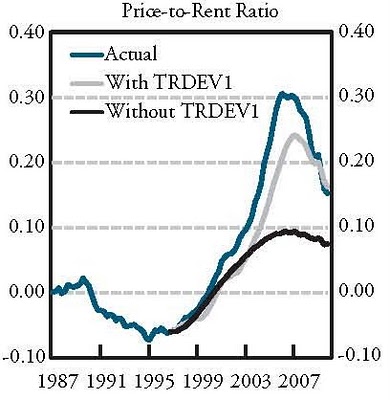
The latest macroblog entry starts by appealing to a paper from New Zealand which shows that an “estimated” Taylor rule indicates that interest rates were not too low for too long in 2003-05 as I have argued. But the “estimated” policy rule in that paper doesn’t looks anything like what I proposed and given that there are already scores of existing models I fail to see the advantages of another model from New Zealand. For example, at the Federal Reserve Bank of Kansas City, George Kahn shows that deviations from a policy rule were a major reason for the housing price boom and bust. A chart from his paper which I copy below shows clearly that policy without the Taylor Rule deviation (TRDEV1) would have avoided the boom and bust.

The Atlanta Fed’s macroblog post also argues that the Fed has already laid out an exit strategy for reducing its balance sheet, and it gives a link to minutes of the FOMC with a list of tools. However, as I explained in testimony to Congress last year, a list of tools is not a strategy. A strategy is a path or contingency plan for the balance sheet over time. I gave an example in the tesimony. If it is good to lay out a path to reduce the federal debt as a share of GDP, then why not lay out a contingency path to reduce the Fed’s balance sheet?

Regarding my proposals to restore the Fed’s reporting and accountability requirements removed in 2000, I think macroblog post’s reference to Ben Bernanke’s speech at the American Economic Association last January supports my point rather than refutes it. If there had been such reporting requirements in place in 2003-05, then the Fed would have been required to report the strategy at the time in Congress, not 7 years later at the AEA. Also if you look back at the FOMC transcripts at the time you will see that the Fed was intentionally holding rates extra low for an “extended period” and only increasing them at “measured pace,” which does not seem consistent with policy as usual. In my view if the Fed had laid out its strategy at the time, then there would have been a more informed public discussion.

Then there is the question of the Fed’s multiple mandate. The record shows that explicit mention of the term “maximum employment” entered the FOMC Statement for the first time only last fall, after more than thirty years of no such mention since the mandate was put into legislation way back in 1977. So the connection between the mandate and QE2 seems most evident based on the record. In my view, the rate of inflation and the level of GDP last year justified an interest rate near zero, but not QE2. The Atlanta Fed macroblog post argues that QE2 was effective. But any connection between QE2 and its purported effects is tenuous when long-term Treasury securities, which the Fed has been purchasing, have declined in price, gone in the wrong direction.

The recent post by David Altig ends by referring to the Financial Crisis Inquiry Commission, which seems to have chosen a “perfect storm” explanation of the crisis where everyone shares some blame. In that report, the Fed shares blame, but mainly because of a failure to enforce existing regulations. The debate over interest rates seems to have ended in a draw in the Commission with short reviews of arguments made by Ben Bernanke, Alan Greenspan, and me. The conclusion of the minority that U.S. monetary policy may have contributed to the credit bubble is about as far as one could expect from such a commission and should be enough incentive to look for policy reforms to improve monetary policy in the future.

Posted in Monetary Policy | Comments Off on The Monetary Reform Debate is Joined

Learning From Monetary Mistakes and Doritonomics

Following the financial crisis, it is understandable that central bankers want better advice from economists and their economic theories, as Mojmir Hampl of the Czech central bank writes this week in the European Opinion section of the Wall Street Journal. But Princeton economist and recent president of the American Economic Association put it best when he said “economic theory came out of this better than policy practice did.”

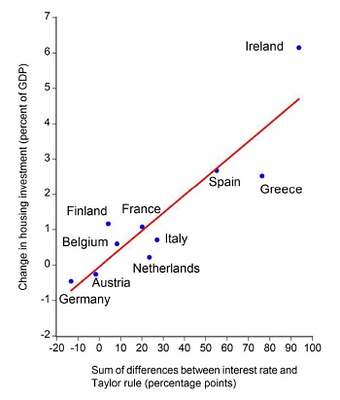
The lesson for central bankers from the financial crisis is straightforward: do not deviate from policies like the ones that worked well during much of the 1980s and 1990s. It was such a deviation–in the form of low interest rates compared with what good existing policy practice suggested–that was behind the excessive risk taking and housing booms in many countries as OECD research has shown. The chart below was published by the OECD before the problems in Greece, Ireland and Spain became so evident. I used it in my book Getting Off Track published two years ago. It predicts amazingly well which countries would suffer most from the low interest rate policy. That’s the message of several talks I am giving in Europe this week.

But the message is simpler and more entertaining in DORITONOMICS from the Crash the Super Bowl contest.

Posted in Monetary Policy | Comments Off on Learning From Monetary Mistakes and Doritonomics

Clarifying the Debt Limit Issues

Last Friday I spoke at a conference at the Reagan Presidential library where over 50 currently serving members of Congress–including many new members–met to discuss the future. One of the big issues was the debt limit, which has already been the subject of partisan discussion and is now viewed as a key mechanism for the overall effort to reduce spending. Here is the best summary of the issue , prepared by J.D. Foster of the Heritage Foundation. It is short and very clear. Well worth reading.

Posted in Budget & Debt | Comments Off on Clarifying the Debt Limit Issues

More on a Two-Track Plan to Restore Growth

The Wall Street Journal’s choice of a headline for my op-ed last Friday “A Two-Track Plan to Restore Growth,” was a great way to pair the proposed fiscal reform with the proposed monetary reform. The Congress and the President would lay out the fiscal track to reduce the exploding debt and then nail down the track with the golden spike of entitlement reform. In parallel the Fed would lay out the monetary track to reduce its exploding balance sheet and then nail down the track with the golden spike of reporting and accountability reform. In each case reform is needed: for fiscal policy entitlement reform is needed to provide incentives to control spending growth and improve the quality of services; for monetary policy, reform is needed to provide incentives to follow more rules-based policies.

Hearings at the House Financial Services Committee last Wednesday covered many of these same issues in detail with new members of Congress asking good questions. Witnesses were Don Kohn (former vice chair of the Fed) and I who focused on monetary policy, as well as Bill Poole and Hal Scott who focused on fiscal policy and regulatory policy, respectively. There was also a good second panel with witnesses from the private business sector.

Somewhat surprisingly, Don Kohn agreed that reporting and accountability about monetary policy decisions could be improved, as I had argued in my testimony and in the op-ed, though he was not sure whether legislation was needed. In my view Congress should restore the Fed’s reporting requirements which it removed in the year 2000 in a little-known section of the American Homeownership and Economic Opportunity Act of 2000. Don emphasized that the congressional committees could ask better questions and thereby hold the Fed more accountable even without restoring the former type of requirement.

Two other related policy matters from last week:

Bob Heller (like Kohn and Poole, a former member of the FOMC) spoke out forcefully against recent Fed policies. According to Bloomberg News: “While most critics of the Federal Reserve are investors and market pundits, one noteworthy individual was a former member of the U.S. central bank. Robert Heller, Federal Reserve Governor from 1986-1989, described the Fed’s second round of quantitative easing, QE2, as ‘dangerous’ and ‘misguided’ in a Bloomberg interview.”

Ron Paul reintroduced a bill to repeal the law (31 USC 714(b)) which now prevents GAO from auditing certain monetary policy activities at the Fed. The Bill would delete the following language “Audits of the [Federal Reserve] Board and Federal Reserve banks may not include— (1) transactions for or with a foreign central bank, government of a foreign country, or nonprivate international financing organization; (2) deliberations, decisions, or actions on monetary policy matters, including discount window operations, reserves of member banks, securities credit, interest on deposits, and open market operations; (3) transactions made under the direction of the Federal Open Market Committee; or (4) a part of a discussion or communication among or between members of the Board and officers and employees of the Federal Reserve System related to clauses (1)–(3) of this subsection.” Other legislation related to the Fed is likely on the way.

Posted in Monetary Policy | Comments Off on More on a Two-Track Plan to Restore Growth

A Law Might Speed Up the Taylor Cycle

The phrase in the headline above concludes Amity Shlaes’s “amazingly thorough” article (quoting AEA President Orley Ashenfelter here) on the long cyclical swings between rules and discretion which I documented in a speech at the annual AEA-AFA luncheon in Denver on January 7. Given that the previous period of discretion (in the 1960s and 1970s) lasted nearly two decades, a continuation of the normal cycle means that it might take another dozen years to get back to more stable rules-based monetary and fiscal policies, which is the length of time Amity Shlaes suggests. She also suggests that a law could move the balance back toward rules much sooner. I think that’s why we are beginning to see renewed interest in legislation to modify the Federal Reserve’s mandate and add reporting requirements and accountability for its monetary strategy.

Posted in Monetary Policy | Comments Off on A Law Might Speed Up the Taylor Cycle