Beware of a Revival of Misleading Economic Claims

As the 2012 campaign season gains steam we are beginning to hear the same economic claims we heard two years ago during the mid-term election. In 2010 much of the debate was about (1) whether the 2009 stimulus package was a success or a failure, and (2) whether the large deficit and rapidly growing federal debt were nothing to worry about or a serious danger. At least as indicated by the outcome of the 2010 election, those who argued the failure and danger side carried the day, with increased stimulus spending, growing debt and a slow economy at the top of voters’ concerns, which resulted in an unprecedented political shift in Congress. In my view, the economic facts were also consistent with the failure and danger position, and are even more so today.

Nevertheless, the same old claims that the debt-increasing stimulus was a success are being made again. In my view they should still be challenged and debated. An example was on yesterday’s ABC’s This Week, where Steve Rattner claimed that there is a bipartisan consensus of economists that the 2009 stimulus was a success, referring to a 2010 working paper by Mark Zandi and Alan Blinder as evidence. Rattner’s claim went unchallenged on the show, but it should have been challenged because it is false.

First, there is certainly no consensus that the stimulus was effective, as evidenced, for example, in debates I had with Zandi and Blinder back in 2010. The main points of refutation, which I summarized on this July 29, 2010 blog, are still valid.Second, the Zandi-Blinder paper is not really bipartisan, certainly not in a Democrat versus Republican sense. Mark Zandi is on the record as saying “I’m a registered Democrat” in a Washington Post interview, and Alan Blinder is certainly not a Republican. Moreover, both were active advocates of the 2009 stimulus package before it was passed. Sometimes people say Zandi was an adviser to John McCain, but that is not true. McCain Campaign Adviser Doug Holtz-Eakin did ask Zandi and many other economists for their forecasts during the 2008 campaign, but Zandi did not advise McCain on policy.
Posted in Slow Recovery | Comments Off on Beware of a Revival of Misleading Economic Claims

Gross Capital Flows Grow in Importance

My Wall Street Journal article yesterday Monetary Policy and the Next Crisis touches on a growing research area in international finance that focusses on gross capital flows as distinct from the current account. For example, in his Ely Lecture at the American Economic Association Meetings this year, Maury Obstfeld argues that “large gross financial flows entail potential stability risks that may be only distantly related, if related at all, to the global configuration of saving-investment discrepancies.” And in a recent Princeton working paper, Valentina Bruno and Hyun Shin write that “Current account gaps have traditionally been considered as the drivers of cross-border capital flows. However, the most notable feature of international finance in recent decades has been the dramatic increase in gross capital flows that dwarf current account gaps.”
One obvious policy implication is that international economic policy groups such as the G20 should pay more attention in their “Mutual Assessment Process” to gross international capital flows rather than focus entirely on current account imbalances.
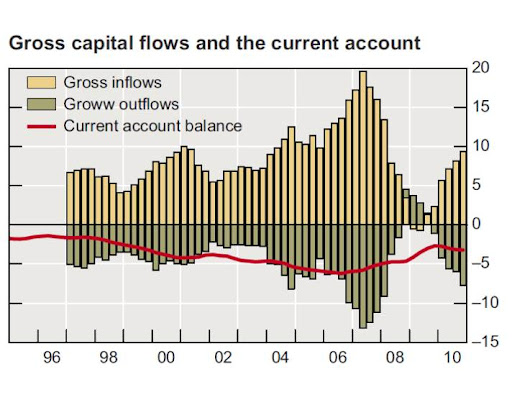
So far, however, the research (including Obstfeld’s Ely Lecture) has not dealt much with the impact of monetary policy on these flows, and that was the main purpose of my Wall Street Journal piece. The paper by Claudio Borio and Piti Disyatat Global Imbalances and the Financial Crisis: Link or No Link? shows that these flows rather than the current account or a global saving glut were the key international factors in the recent crisis. This chart of the U.S. balance of payments is from their paper. It nicely illustrates the importance of gross flows in comparison with the current account.  
Posted in International Economics | Comments Off on Gross Capital Flows Grow in Importance

Debt Fireworks Continue On This Independence Day

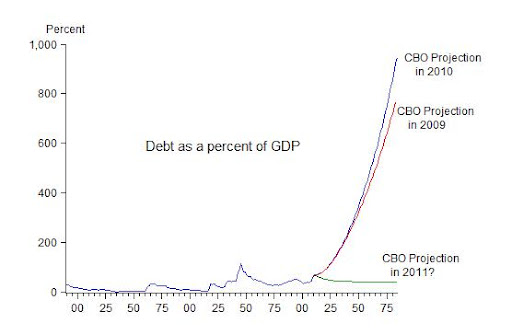
On Independence Day two years ago I wrote a piece comparing America’s exploding debt projection (from the 2009 and 2010 Congressional Budget Office’s Long Term Budget Outlook) with the fireworks on the 4th of July. As I later put it in First Principles (p. 101) the debt projection’s “soaring upward climb resembles the fireworks on America’s Independence Day. But rather than remind us of America’s founding, it portends America’s ending.” Here is the chart I was referring to, hoping that the Congress and the Administration would get their act together so CBO would be able to project something more responsible in 2011.
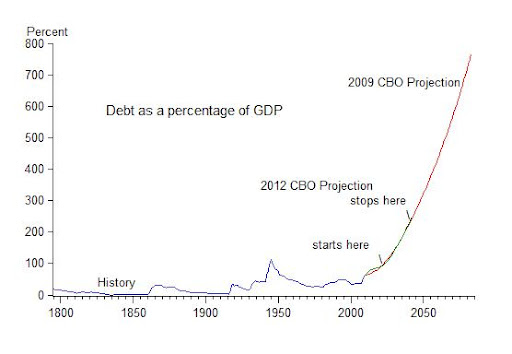
Well, after two more years of Long Term Budget Outlooks (2011 and 2012) the CBO projections unfortunately look virtually the same. The problem has not been fixed as my grand daughter requested in my Economics 1 class at Stanford nearly three years ago. In fact, only one thing has really changed. CBO put a ceiling on its projections. They now stop reporting the debt to GDP ratio once it hits 250% or more, as if Congress finally voted for such a debt ceiling in a binding way. CBO used to go out 75 years, but now they just stop when things look really bad. So, as shown below, the latest projection (in green) now stops in 2042 when the debt hits 247 percent of GDP.

Of course, stopping the projection like this does not change anything of substance, and it certainly is not a way to fix the problem.

Posted in Budget & Debt | Comments Off on Debt Fireworks Continue On This Independence Day

How Departures From Economic Freedom Can Affect Freedom In General

In a recent speech at Stanford (video here) former Wells Fargo Chairman and CEO Dick Kovacevich told the full story of how he was forced to take TARP funds even though Wells Fargo did not need or want the funds. The forcing event took place in October 2008 at a now well-known meeting at the U.S. Treasury with Hank Paulson, Ben Bernanke, as well as several other heads of major financial institutions.

In his speech, Kovacevich first described how he and the other bankers were told at that meeting that they had to accept the funds. He then paused and said to the Stanford audience: “You might ask why didn’t I just say no, and not accept TARP funds.” He then explained: “As my comments were heading in that direction, Hank Paulson turned to Chairman Bernanke, who was sitting next to him and said ‘Your primary regulator is sitting right here. If you refuse to accept these TARP funds, he will declare you capital deficient Monday morning.’ This was being said when we were a triple A rated bank. ‘Is this America?’ I said to myself.”

At that time Wells Fargo was in process of acquiring Wachovia and such a declaration would have killed the deal. According to Kovacevich: “It was truly a godfather moment. They made us an offer we couldn’t refuse.” It was also truly a deviation from the principles of economic freedom, such as those I have highlighted in my book First Principles—predicable policy, rule of law, reliance on markets, limited scope for government. One can debate whether those deviations were appropriate, but they were clearly deviations.

During the question and answer period after his talk, I asked Dick Kovacevich why more business people were not speaking out on this important issue. He explained how he had in fact waited a long time after he left Wells Fargo before speaking out because he did not want to risk some kind of retribution. He said he thought many others had a “fear” of speaking out.”

In their book Free to Choose Milton and Rose Friedman wrote about this problem: “Restrictions on economic freedom inevitably affect freedom in general, even such areas as freedom of speech and press.” (p. 67) They quoted from a letter they received from business executive Lee Grace. I was reminded of this letter when I heard Dick Kovacevich answer my question. In the letter Grace had said “We grow timid against speaking out for truth…government harassment is a powerful weapon against freedom of speech.”

Posted in Regulatory Policy | Comments Off on How Departures From Economic Freedom Can Affect Freedom In General

The BIS on “The Limits of Monetary Policy”

Each year the Bank for International Settlements (BIS) hosts the world’s central bankers–the BIS shareholders–at their Annual General Meeting in Basel, Switzerland. At the meeting held today, the BIS issued their Annual Report which addresses key monetary policy issues. BIS analyses often contain useful warnings, including their prescient warning in the years around 2003-2005 that monetary policy was too easy, which turned out to be largely correct, as the boom and the subsequent bust made so clear. So the Annual Report is always worth reading.

This is especially true of the Annual Report released today because it devotes a whole chapter to serious concerns about the harmful “side effects” of the current highly accommodative monetary policies “in the major advanced economies” where “policy rates remain very low and central bank balance sheets continue to expand.” Of course these are the policies now conducted at the Fed, the ECB, the Bank of Japan, and the Bank of England. The Report points out several side effects:

  • First, the policies “may delay the return to a self-sustaining recovery.” In other words, rather than stimulating recovery as intended, the policies may be delaying recovery.
  • Second, the policies “may create risks for financial and price stability globally.”
  • Third, the policies create “longer-term risks to [central banks’] credibility and operational independence.”
  • Fourth, the policies “have blurred the line between monetary and fiscal policies” another threat to central bank independence.
  • Fifth, the policies “have been fueling credit and asset price booms in some emerging economies,” thereby raising risks that the unwinding of these booms “would have significant negative repercussions” similar to the preceding crisis, which in turn would feed back to the advanced economies.

The BIS analysis which leads to these concerns is summarized in a series of charts and tables contained in the fascinating chapter “The Limits of Monetary Policy,” which concludes with the warning that “central banks need to beware….”

Posted in International Economics | Comments Off on The BIS on “The Limits of Monetary Policy”

The GDP Impact a U.S. Fiscal Consolidation Strategy

Three and half years ago, in February 2009, John Cogan, Volker Wieland, Tobias Cwik and I estimated what the impact of the 2009 stimulus package (ARRA) would be. Our estimates, obtained by simulating modern macroeconomic models, were much smaller than those of the Administration. Since then our estimates have been verified in research by a group of economists at central banks and international financial institutions who found that our simulations were in mid-range of their models.

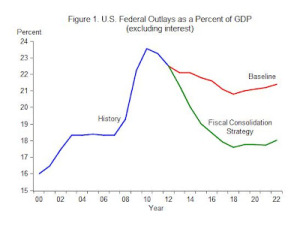
Now, Wieland, Cogan and I, joined by Maik Wolters, are simulating modern macroeconomic models to evaluate a fiscal consolidation strategy to reduce the deficit and end the explosion of the debt. We are using two models which incorporate forward looking behavior, one with price and wage rigidities and one with more classical features. We have examined a gradual, credible strategy to reduce federal spending as a share of GDP—relative to current policy as assumed in the CBO alternative fiscal scenario baseline and starting in the first quarter of 2013—as shown in this chart.

cttwfigOur initial findings, reported here, are that this strategy has a positive impact of GDP, in both the short run and the long run. The positive short run economic effects occur even in the model with price and wage rigidities for several reasons including that the lower spending (as a share of GDP) can reduce expected tax rates and raise permanent after-tax income compared to what would be expected under current policy. This stimulates consumption. The gradual nature of the government spending reduction, which allows time for private spending to adjust, avoids the negative aggregate demand effects that traditional Keynesian models emphasize

Posted in Fiscal Policy and Reforms | Comments Off on The GDP Impact a U.S. Fiscal Consolidation Strategy

Fed Bought 77% of Federal Debt Increase in 2011: The Data Source

During an interview on CNBC Squawk Box this morning and in my Wall Street Journal oped of last Friday (June 1), I mentioned that the Federal Reserve purchased 77% of the net increase in the debt by the Federal government in 2011. Several people have asked for references for that amazing percentage. The calculation is due to my colleague John Cogan, and is based on data reported in the Federal Budget, FY2013 Historical Tables, Table 7.1: Federal Debt at the End of Year: 1940–2017.

Here is how it is calculated. Table 7.1 shows that federal debt held by the public increased from $9,018,882 million at the end of fiscal year 2010 to $10,128,206 million at the end of fiscal year 2011 for an increase of $1,109,324 million during fiscal year 2011. The same table shows that Federal Reserve holdings of federal debt increased from $811,669 million to $1,664,660 million during the same period for an increase of $852,991 million, which is 77 percent of $1,109,324 million.

Posted in Monetary Policy | Comments Off on Fed Bought 77% of Federal Debt Increase in 2011: The Data Source

A Tale of Two Memos to Two President-Elects

Today the Wall Street Journal dedicated more than three-fourths of a page to publishing large excerpts from a 1980 memo to president-elect Ronald Reagan from George Shultz and other economists who had advised Reagan in the presidential campaign. In my view, that memo represents a watershed in the history of economics with great relevance today, and that is why I focused on it in my new book First Principles, where I explain why the economy prospers when policy adheres to the basic principles of economic freedom, but falters when policy deviates from those principles, as it is doing now. That original fifteen page 1980 memo was an important reason why policy veered back to the principles of economic freedom the 1980s and the 1990s. Here is how I describe the memo in First Principles:

Less than two weeks [after the 1980 election], on November 16, 1980, many of the economists who had worked together in the campaign wrote an extraordinary memo to Reagan entitled ‘Economic Strategy for the Reagan Administration.’ It began with a call for action: “Sharp change in present economic policy is an absolute necessity. The problems . . . an almost endless litany of economic ills, large and small, are severe. But they are not intractable. Having been produced by government policy, they can be redressed by a change in policy.”

The memo then outlined a set of reforms for tax policy, regulatory policy, the budget, and monetary policy. There were no temporary tax rebates, short-term public works projects, or other so-called stimulus packages. Rather there were sentences like “The need for a long-term point of view is essential to allow for the time, the coherence and the predictability so necessary for success.”

I believe it is instructive to compare the full 15-page 1980 memo to President-elect Reagan with a similarly-timed fifty-seven page 2008 memo to President-elect Obama. The 2008 memo from Larry Summers was recently posted by Ryan Lizza on the New Yorker web page generating much political and economic debate. Both were written in times of great economic difficulties, but the contrast between the overall approaches to economic policy is striking. Most important, unlike the 1980 memo to Reagan, the 2008 memo focused mainly on short-term interventions and so-called stimulus packages. The recent debate in the press has been over whether the short-term stimulus package should have been larger. In contrast the 1980 memo did not even mention such short term stimulus packages, but rather focused on more permanent long-term strategies and policy predictability.

Posted in Teaching Economics | Comments Off on A Tale of Two Memos to Two President-Elects

Big Mac and Big Macro

One of the most important things for students to learn in introductory economics is that differences in productivity are the main reason for differences in real wages over time and across countries.

In his presidential address this year before the American Economic Association, Princeton economist Orley Ashenfelter provides an interesting and novel way to calculate and compare real wages over time and across countries. He divides the nominal wage rate of McDonald’s workers ($/hour) by the price of a Big Mac ($/Big Mac) to get an estimate of Big Macs Per Hour (BMPH) which ranges from 3.09 in Japan to .35 in India. In other words it takes about 19 minutes of work at a McDonalds to earn enough buy a Big Mac in Japan and about 3 hours in India. As Ashenfelter puts it, the advantage of this approach is that “international comparisons of wages of McDonald’s crew members are free of interpretation problems stemming from differences in skill content or compensating wage differentials.” And by dividing the sample period in two–from 2000 to 2007 and from 2007 to 2011–he delves into macroeconomics and shows how devastating the financial crisis and the big recession have been to the economic prosperity of most people around the world.

Here is a terrific Big Macro video of an interview with Ashenfelter on Canadian public TV on the subject of his Big Mac studies.  He explains in simple, candid, and interesting terms what is going on and why productivity makes such a difference.

Posted in Teaching Economics | Comments Off on Big Mac and Big Macro

More Evidence on What Is Holding the Economy Back

Milton Friedman’s “plucking model” should be back in fashion now because it reminds us of the historical fact that throughout American history—until now—the deeper the recession, the faster the recovery. I like to bring a guitar to talks and lectures to illustrate this: Like a guitar string, when the economy is “plucked” down or pulled down, the “string” or the economy always springs back up. The more the economy is “plucked” down, the faster it springs back up. This has been true throughout recorded American history, and it holds whether or not there has been a financial crisis. Here is a link where you can find Hoover Institution Working Paper E-88-48 in which Friedman described the model. (He also envisioned a board on top of the guitar string to prevent a reverse action on the upside, which he argued was not in the data).

Of course something is now interfering with the usual economic response, because our current recovery is certainly not springing back to normal. I have argued that economic policy is holding the economy back, and I think recent research by Ellen McGrattan and Ed Prescott (on increased regulations) and by Scott Baker, Nick Bloom, and Steve Davis (on policy uncertainty) supports this view. Their work is part of a forthcoming book (Government Policy and the Delayed Economic Recovery) edited by Lee Ohanian, Ian Wright and me.

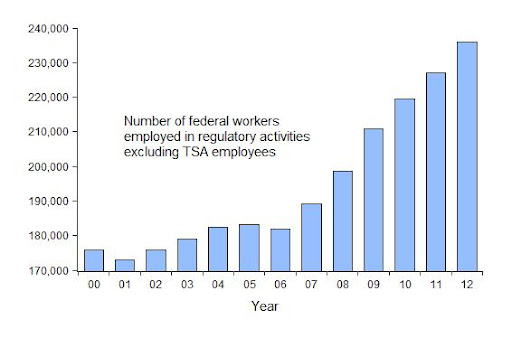
Here are two charts which show why both increased regulation and policy uncertainty are very significant. The first chart uses data from research by Susan Dudley and Melinda Warren. It takes their series on the number of “full time equivalent” federal employees in regulatory activities and subtracts out the number of Transportation Safety Administration (TSA) workers. (I interpolated the years 2002 and 2003 when TSA was expanding and moving from DOT to DHS). There has been a 25 percent increase just since 2007. And these data barely reflect the increased regulations from the health care and financial reform legislation.

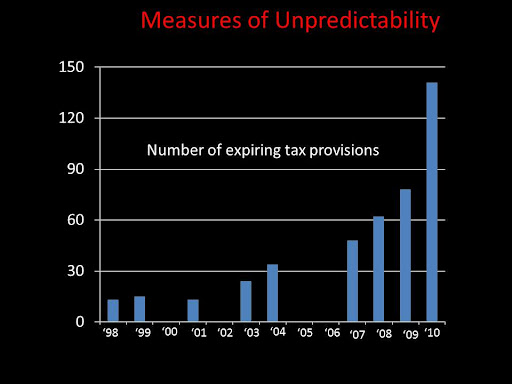
The second chart shows the number of provisions in the tax code that are expiring each year. This is part of an index used by Baker, Bloom, and Davis. It shows a substantial increase in the past few years in policy uncertainty.

Posted in Slow Recovery | Comments Off on More Evidence on What Is Holding the Economy Back