A Simple Rule for Monetary Policy After 20 Years

It was 20 years ago today at a conference in Pittsburgh that I first presented what is now called the Taylor rule. Here’s the November 1992 Stanford working paper. It’s nearly impossible to predict which ideas will be picked up by policy makers and which won’t, and I certainly didn’t predict in 1992 that the Fed and other central bankers would still be referring to the idea in 2012.

Last week, for example, the Taylor rule served as a reference point for two very different talks by two members of the FOMC. In a speech in Berkeley, Vice Chair Janet Yellen talked about forward guidance. She argued that the federal funds rate should stay below the Taylor rule for a while longer and even below a “Modified Taylor rule” with a higher response to the output gap. She said that “times are by no means normal now, and the simple rules that perform well under ordinary circumstances just won’t perform well with persistently strong headwinds restraining recovery and with the federal funds rate constrained by the zero bound.” So that means more discretion, and, in my view, more drag on the economy.

Philadelphia Fed President Charles Plosser also spoke about forward guidance last week, but he saw no reason not to use a policy rule under current circumstances, and he recommended setting interest rates according to one of those policy rules. That would bring a more rules-based policy, which experience over the past 30 years shows would be better for the economy, as I argued in a talk at the same conference where Charlie spoke.

New research by Kansas City Fed economist George Kahn provides highly relevant econometric evidence on the issue. In an article forthcoming in the Kansas City Fed’s Economic Review, he estimates simple policy rules over relatively well-performing periods. He finds that the estimated parameters over these periods are very close to those of the rule I proposed 20 years ago, though with a different constant term implying a higher equilibrium federal funds rate.

Posted in Monetary Policy | Comments Off on A Simple Rule for Monetary Policy After 20 Years

Milton Friedman and the Power of Monetary Ideas

Last Friday the University of Chicago hosted a wonderful Centennial Celebration of Milton Friedman and the Power of Ideas. All of the speakers, especially Jim Heckman, Kevin Murphy, Bob Lucas, and Gary Becker chose to focus on how amazingly well Milton integrated data, theory, and policy in inseparable ways in his research and writings, and that this was the key to the power of his ideas.

That well-documented facts and sound economic theory informed his policy views in practice is very evident in the case of monetary policy, which was the focus of the session where Bob Lucas, Allan Meltzer and I spoke and Lars Hansen moderated.

Lars asked me to address these two questions in my remarks for the session
— How do you see Fed behavior at this juncture?
— To what extent has monetary policy alone run out of gas in nurturing a more healthy macroeconomic recovery?

Because I had given the opening talk at Milton Friedman’s 90th birthday conference in Chicago exactly ten years ago in November 2002, I found that the best way for me to answer these questions was to begin my presentation at the Centennial by returning to that 2002 talk and bringing back some of the charts

From the vantage point of 2002 I was very positive about Fed behavior because of its greater reliance on steady rule like behavior in the 1980s and 1990s, and I gave credit to Milton for that change at the 90th birthday. The result was solid economic performance especially in comparison with the economic mess of the 1970s when discretion dominated.

But the steadier monetary policy and good economic performance did not last. Little did I know in November 2002 that the Fed would soon do it again. It went back to the types of discretionary actions it had used in the past. The results have not been good.

The obvious implication is that a change in policy would lead to improved economic performance. In this sense, I do not think it is correct to say that monetary policy has run out of gas: A return—a steady gradual return—to the type of steady-as-you-go policies we had in the 1980s and 1990s and until recently would be as big a positive for the economy as it was in those decades.

Posted in Monetary Policy | Comments Off on Milton Friedman and the Power of Monetary Ideas

Strengthening of America

Many have been asking me to write more about the fiscal cliff.  As we watch the election returns today, I would keep two straightforward things in mind.

First, the fiscal cliff was not created by aliens from outerspace.  It is another poor government economic policy created in Washington. But the good news is that, like other bad economic policies in recent years, it can be fixed by a change in government policy.

Second, it will take a bipartisan policy effort, but the policy ingredients are ready.  One of the best examples is the work of former Senator Sam Nunn and Pete Domenici who have created a bipartisan group of former members of Congress who have had a series of hearings with economists and other experts. The initiative is called the Strengthening of America–Our Children’s Future and is supported by these organizations and think tanks:

The Concord Coalition
The Bipartisan Policy Center
The Center for Strategic and Interantional Studies
The American Business Conference
The James A. Baker III Institute for Public Policy at Rice University.
The Hoover Institution at Stanford
Harvard’s Belfer Center for Science and International Affairs
Woodrow Wilson International Center for Scholars

I had the opportunity to be on a policy panel with Alice Rivlin. There were also panels with Martin Feldstein and Lawrence Summers and with Robert Rubin and James Baker.

Posted in Fiscal Policy and Reforms | Comments Off on Strengthening of America

Stagnation or Real Progress?

As the presidential election campaign reaches its final crucial hours, the main issue remains the economy—unemployment, jobs, growth—and what the economic policy can do about it. Campaigning in Ohio and other swing states, President Obama says his policies have meant “real progress” and wants to stick with them, while Governor Romney says they have meant “stagnation” and wants to change them. If you have been monitoring this blog since it started three plus years ago—long before the political season began—you probably know that my view is that it’s “stagnation,” not “real progress,” and that policy is the problem.

The High Unemployment is a Tragedy

This “stagnation versus real progress” debate came up in several TV shows I did on Friday, and in each case the networks chose headlines that reflect my view well:

Our Unemployment Number is a Tragedy, Bloomberg TV
(30 second video pull quote) Unemployment a Tragedy, We Can Do Better
We Could Be Doing Better, CNN
Slow Growth Is Biggest Economic Challenge Facing Incoming President, (paired up with Austan Goolsbee), PBS NewsHour

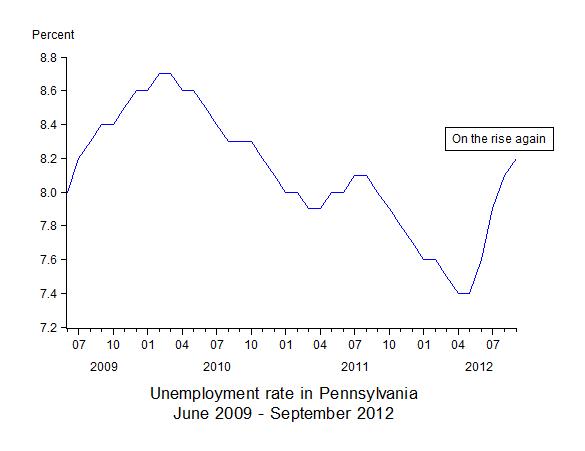
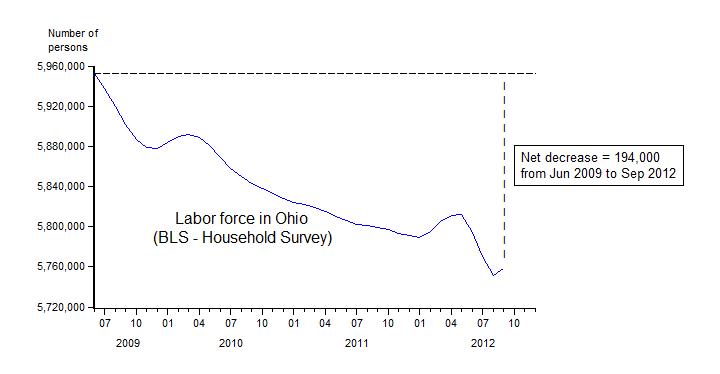
Jeffrey Brown was the interviewer on Newshour and asked at the opening: “What is the problem that most needs to be addressed by whoever is the next president?” I answered: “That unemployment rate. It’s too high. It shouldn’t be this high. And it has increased a bit. But it’s increased even more in states like — I think Pennsylvania went up from 7.4 to 8.2 over the last few months. And the reason is the weak economy. We shouldn’t be growing this slowly. We have an economy which can do much better. It’s done better in similar periods in the past. And with the right policies, it can do much better, get the unemployment down much further. And there’s also people dropping out of the labor force. You know, in Ohio, since the recovery began, 194,000 people just dropped out of the labor force, stopped looking for work. That’s another bad sign that I think people should be very concerned about. It’s really depressing what’s happening with respect to the labor market right now in this country.”

In my view, it’s also a concern that some people have begun talking as if the unemployment problem does not exist. I know this is hard to believe, but if you search, for example, the 20 page glossy brochure on the economy recently distributed by the Administration, you will not find the word “unemployment.” If one does not discuss a problem—its magnitude, its causes—how is one ever going to fix it?

Now consider what is happening in the Swing States

Ohio

Yesterday, The New York Times argued that “Mr. Obama was right when he talked about ‘real progress’ in the economy during a campaign swing in Ohio, where the state unemployment rate has declined from 8.6 percent a year ago to 7 percent recently.”

But the Times skips over the reason why unemployment fell in Ohio, and it’s “stagnation,” not real progress: Virtually all of the decrease in unemployment in Ohio has been caused by unemployed people dropping out of the labor force—discouraged not to find a job after many months of search. There has been virtually no increase in the number of jobs during the recovery. Worse, 33,000 jobs have been lost in the past four months.

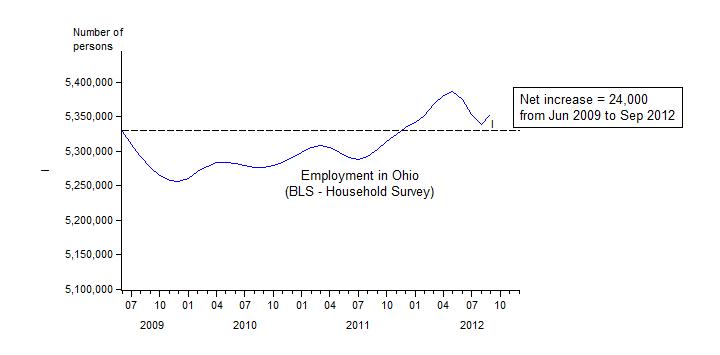
By the official definition of the Bureau of Labor Statistics, unemployment in Ohio fell by 218,000 persons since the national recession ended and so-called recovery began in June 2009. But the vast amount of the decrease in unemployed was due to 194,000 persons leaving the labor force. There were only 24,000 additional jobs. In other words, 9 of 10 workers who had been counted as unemployed are no longer counted as unemployed simply because they are no longer looking for work. Were it not for this decline in the labor force, the unemployment rate would be around 10% rather than the 7% mentioned by the Times.

The two charts below tell the tragic story: With few jobs, people are dropping out of the labor force and are no longer even looking for work. Here is a picture of how employment has actually declined in Ohio.

Iowa

In an oped in the Cedar Rapids Gazette today, Tad Lipsky and I wrote about why there was employment stagnation in Iowa, and even worse than in Ohio. The chart below shows that employment is actually lower than at the start of the recovery or the day the Obama Administration began.

Colorado, New Hampshire, and Wisconsin

The recent employment drop off in Ohio and Iowa is also occurring in Colorado, New Hampshire, and Wisconsin. In Colorado, the number of people employed has fallen by over 17,000 since March. In New Hampshire, the number of people employed has fallen by nearly 8,000 since April. And in Wisconsin, the number of people employed has fallen by over 30,000 since May.

Pennsylvania

This post is already too long. I conclude with chart of the unemployment rate in Pennsylvania which speaks for itself.
Posted in Slow Recovery | Comments Off on Stagnation or Real Progress?

A Slow and Declining Growth Rate Delays Prosperity

In his article “A Slow but Steady Climb to Prosperity” in today’s Wall Street Journal, Alan Blinder argues that “The U.S. economy is improving.” I wish he were right, but the data—even much of the data he mentions—do not support that view.

First, he admits that real GDP growth—the most comprehensive measure we have of the state of the economy—is declining; that’s not an improvement.

Second, he admits that, according to the payroll survey, job growth isn’t faster in 2012 than 2011; that’s not an improvement either.

Third, he mentions that the household survey shows employment growth is faster, but that growth must be measured relative to a growing population. If you look at the employment to population ratio, it is the same (58.5%) in the 12 month period starting in October 2009 (the month he chooses as the low point) as in the past 12 months. That’s not an improvement.

Fourth, he shows that the unemployment rate is coming down. But much of that improvement is due to the decline in the labor force participation rate as people drop out of the labor force. According to the CBO, unemployment would be 9 percent if that unusual and distressing decline–certainly not an improvement–had not occurred.

He then goes on to consider forecasts, saying that there are promising signs, such as the housing market. The problem here, however, is that growth is weakening even as housing is less of a drag, because other components of GDP are flagging.

If you want to look at forecasts, consider this chart of the Fed’s (Federal Open Market Committee’s) forecast for real GDP growth in 2012. It is a depressing picture of a worsening outlook, meeting after meeting, not an improving outlook.


Posted in Slow Recovery | Comments Off on A Slow and Declining Growth Rate Delays Prosperity

Updated White Paper on the Romney Program

It has been three months since the August 2 white paper was released on the growth and employment impacts of Governor Romney’s economic program in comparison with President Obama’s program.

Much has happened since then, so an update of the white paper was released today, mentioning the 650 other economists who have signed on to support the Romney plan, the deterioration of the economy and the outlook, the greater robustness of the 12 million jobs estimate, and the release of the booklet on the Obama program.

Posted in Regulatory Policy | Comments Off on Updated White Paper on the Romney Program

A Monetary Historian’s Delight

A fascinating and useful new e-book, The Bretton Woods Transcripts, has just been published by the Center for Financial Stability (CFS). It is the first publication of the transcripts of the famous international meeting that took place nearly 70 years ago in Bretton Woods, New Hampshire and founded the International Monetary Fund and the World Bank. The transcripts include important commentary by John Maynard Keynes, Harry Dexter White and other representatives from 44 countries, many of whom went on to be key economic leaders in the early post war period.

While an 822 page “transcript” might turn off all but the most serious monetary scholars, Kurt Schuler, who discovered the transcripts in the Treasury, and his coeditor Andrew Rosenberg have done a remarkable job of making the book user friendly by editing, creating summaries, and providing a road map to guide the reader. Their own commentary, with lines such as “Keynes proceeded with lightning speed, hop-scotching across the provisions of the draft World Bank agreement, because he was able to hold all of its provisions in his mind in a way that probably no other delegate could,” are fascinating on their own right. Moreover, standard search engines allow one to easily scan through the document looking for topics or participants.

In reading through various passages, I was most impressed by the foresight of the participants at the conference and their spirit of international cooperation, as they hammered out the agreements. Coincidently, at this past summer’s Jackson Hole Conference, Jaime Caruana—the head of the Bank for International Settlements—argued in a speech that there is now a need for more international cooperation in monetary policy. There was pushback from several central bankers at the meeting, but if they change their minds (I hope they do) and move in Caruana’s direction, then a careful examination of these transcripts is the place to begin.

Posted in International Economics | Comments Off on A Monetary Historian’s Delight

Disappointing Labor Markets in the Nation and in Key States

Earlier this year the CBO Budget and Economic Outlook (p 36-37) pointed out that much of recent decline in the national unemployment rate has been due to an unusually large decline in the labor force participation rate. Of course, people who drop out of the labor force—even if they give up looking for a job because they could not find one—are not counted as unemployed. Were it not for the unusual labor force decline (that is, the decline beyond what is due to the aging of the baby boomers and the downturn in the business cycle), the unemployment rate would be “about 1¼ percentage points higher than the actual rate” according to the CBO. This means that the current 7.8 percent is actually 9.1 percent.

Of course, the same phenomenon is occurring at the state level, and affects voters’ views in the battleground states about the effectiveness or ineffectiveness of economic policy. It is difficult to estimate aging and business cycle effects on the labor force at the state level, but an examination of employment can give a pretty clear picture of what is going on.

Consider Iowa for example. Many have noted that the unemployment rate is lower in Iowa than the national average, but that has been the case for decades. What is less well known is that employment has recently been declining in Iowa. In fact, employment is now lower in Iowa than at the start of the recent recovery, meaning that in Iowa the recovery is even weaker than the United States as a whole.

The following chart tells the story. It shows that employment is lower than at the start of the recession, or than at the start of the Obama administration, or than at end of the recession. It also shows a worrisome sharp decline in the past few months. Since May of this year, 26,000 jobs have been lost in Iowa according to the household survey reported by the Bureau of Labor Statistics. The pace of decline is sharper than in the recession.

The reason that unemployment has declined in Iowa even though employment fell is, of course, due to the decline in the labor force. In fact, the sharp decline in employment since May was matched by a 25,000 person decline in the labor force. This sharp decline could not be due to the more gradual aging of the population nor to the business cycle, unless there is double dip in Iowa.

Posted in Slow Recovery | Comments Off on Disappointing Labor Markets in the Nation and in Key States

Exploding Debt Still Threatens America

Back in May 2009 I wrote “Exploding Debt Threatens America” in the Financial Times. Unfortunately the federal debt is still exploding, but fortunately we are learning more about the threat thanks to research reported and carefully explained in a new piece by my colleague Michael Boskin.

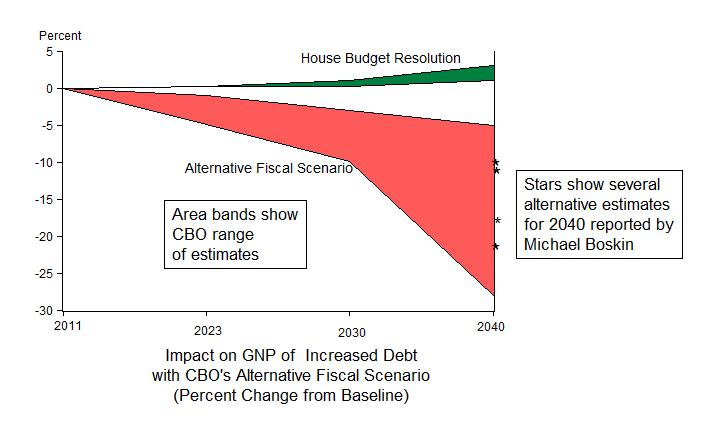
The following chart is a quick summary of his amazing findings. It shows the enormous decline in American income (measured by GNP) if fiscal policy follows the path we are now on as estimated by the Congressional Budget Office. The stars represent several different estimates for the year 2040 reported in Michael’s paper. The ranges show CBO estimates under current policy or under the House Budget resolution of last spring.

Posted in Budget & Debt | Comments Off on Exploding Debt Still Threatens America

An Unusually Weak Recovery as Usually Defined

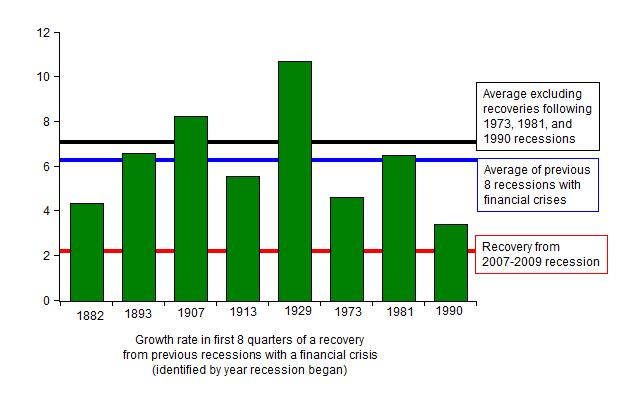
The view that the current U.S. recovery is unusually weak compared to past U.S. recoveries from recessions with financial crises is gaining more and more support.

Economists David Papell and Ruxandra Prodan in an article posted on Jim Hamilton and Menzie Chen’s blog Econbrowser examine an alternative measure of growth during recoveries following recession troughs, and they too come to the conclusion “that the current recovery for the U.S. has been slower than the typical recovery from severe recessions associated with financial crises.” Michael Bordo’s rejoinder to Carmen Reinhart and Ken Rogoff shows that his finding with Joe Haubrich that this recovery is relatively weak is robust to the Reinhart-Rogoff criticism about how one defines financial crises. Clive Crook rightly points out along with Bordo that when you define recovery  as starting from the trough (the standard way), this U.S. recovery is relatively weak compared to recoveries from past deep recessions with financial crises.

For the record, recovery is defined in this standard way in my Principles of Economics text as “the early part of an economic expansion, immediately after the trough of a recession” with the following schematic illustration, which has appeared in every edition from the first in 1995 to the current seventh.

Martin Wolf in the Financial Times weighed in on the other side of this debate yesterday. First, he takes issue with my comparison chart (included in his article) saying that I should not have included the recoveries in the “mid-1970s, early 1980s and early 1990s” because “the precursors and results of the recent crisis were quite different.” But if you exclude those three periods from the average my finding is even stronger as the top line in the chart below makes clear.

Second, he questions my definition of recovery, but as Bordo points out that definition has been used productively by monetary historians for decades. Third, Wolf argues that other countries experiences are important too, but Bordo, who has written over 250 papers on economic history, and other historians question lumping countries together in this way. In any case, all I have said is that this recovery is weak compared to previous US recoveries following financial crises, so as a logical matter brining in other countries does not show I am wrong about what I wrote, as Wolf claims. Finally, Wolf argues toward the end of his article that the fact that the recent recession was not as severe as the Great Depression and earlier recessions following financial crises means recent policy was successful. But the argument that the recession “could have been worse” has been made before and disputed here and here for example. In fact, I have argued that government policy prior to 2009 was largely responsible for the crisis and the deep recession.

In his column Clive Crook also makes a good point that we should be spending more time debating which economic plan is best for economic growth and job growth going forward. I completely agree, and here it should be noted that more than 650 economists have chosen to support the Romney economic plan rather than the Obama economic plan because of its positive effects on growth and job creation.

Posted in Slow Recovery | Comments Off on An Unusually Weak Recovery as Usually Defined