MacroMania on Nominal GDP Targeting and the Taylor Rule

David Andolfatto has a interesting technical piece on MacroMania called “Nominal GDP Targeting and the Taylor Rule” in which he derives a relationship between the two, following up on a point by Chris Waller, director of research at the St. Louis Fed.  David starts off with a specific algebraic proposal for NGDP targeting in which the interest rate is on the left-hand side and the difference between NGDP and a target value for NGDP is on the right hand side with a reaction coefficient of 1.   After some algebraic manipulations, he shows that this policy rule is equivalent to a version of the Taylor Rule, though with different reaction coefficients than I originally proposed (here).

While NGDP targeting can certainly be described in the way that David does—with a specific policy instrument and a specific reaction coefficient—it frequently is not specified that way. In fact, sometimes the policy instrument or the reaction coefficient is left unspecified. And in a new research paper, Scott Sumner suggests another way that Fed policy makers might conduct policy in which the monetary base or the interest rate is determined in an iterative manner based on nominal GDP futures without mentioning a reaction coefficient. In all these cases, the comparison with the Taylor Rule is less straightforward. Evan Koenig’s nice All in the Family paper also delves into the relationship between nominal GDP targeting and the Taylor Rule.

In these cases, a good way to compare and evaluate different monetary proposals and rules—and they should be compared and evaluated—is to simulate them in macro models—hopefully dynamic stochastic models.  Because, as Scott Sumner says in his paper, “economists do not agree which models are best,” they should try them out in a host of different models including some of the 50 empirical models in Volker Wieland’s amazing easy-to-use model data base, or with other models if those 50 are not enough. Volker’s aim is to help researchers design better and more robust monetary policy rules.  Of course, there are other evaluation methods including using monetary history and basic monetary theory. But because the dynamics are so important and so hard to work through intuitively, empirical models can help a lot.

In his paper at the recent Jackson Hole conference, Bob Hall criticized nominal GDP targeting, citing his 1994 paper with Greg Mankiw. Bob argues that “A policy of stabilizing nominal GDP growth would require contractionary policies to lower inflation when productivity growth is unusually high. Such a policy might easily trigger a spell at the zero lower bound.” No one at the conference objected to this statement, and I do not recall nominal GDP targeting being mentioned at the conference, though policy rules were mentioned quite a bit. This suggests that more policy evaluation research on the new and different proposals is needed to inform the policy discussion, and it is certainly welcome in my view.

Posted in Monetary Policy | Leave a comment

Toward Free Exchange Rather Than Capital Controls

In Capital Controls: Against the Tide, the Economist’s Free Exchange (R.A.) described this week how macroeconomists are getting more and more comfortable with the idea of capital controls.

Unfortunately, it’s true.

One sign of this trend is that capital controls have been given a euphemistic name: macro prudential financial regulation, which sounds less threatening.  Another is the change in tone at the IMF: Instead of arguing in favor of gradually reducing capital controls over time, as has been its traditional orientation since its founding, it has been arguing in favor of increasing capital controls at least in some situations. Even Fed chair Ben Bernanke suggests increasing capital controls despite their harmful effects, channeling the IMF in a speech last March saying “the International Monetary Fund has suggested that, in carefully circumscribed circumstances, capital controls may be a useful tool.” Yet another example is that few of the economists at the recent Jackson Hole conference objected when capital controls were suggested as a way to deal with the international monetary and financial spillovers documented in Helene Rey’s paper.

I wish the Economist would exercise its traditional free exchange principles and argue against that tide of opinion.  The term “capital controls” itself is a euphemism for government officials restricting where and in what form people or firms can borrow or lend or invest or save in exchanges with other people or firms, mainly in other countries.  It’s not free exchange!

As with any other government restriction on trade, capital controls create market distortions and lead to instability as borrowers and lenders try to circumvent them and policy makers seek even more controls to prevent the circumvention.  Capital controls also conflict with the goal of a more integrated global economy and higher long-term economic growth. As Kristen Forbes has shown in a recent paper with many convincing examples, “evidence on capital controls suggests that they have pervasive effects and often generate unexpected costs. Capital controls are no free lunch.”

Getting back to Helene Rey’s Jackson Hole paper, she finds increasingly large and volatile international capital flows in recent years. But she also finds that monetary policy is a significant factor in these flows across borders. For example, she shows that large swings of the federal funds interest rate are associated with large swings in the VIX. For example, in 2003-05 both the funds rate and the VIX were very low. (I summarized other evidence here.) She also finds, as she states in the paper, that “Low values of the VIX, in particular for long periods of time, are associated with a build up of the global financial cycle.”

The recent unconventional monetary policy (UMP) likely creates similar effects, as I discussed at the annual BIS meetings this year.  Indeed, capital has flowed into emerging markets during the past several years and is now is flowing back out with expectation of an end or slowing of UMP.

Thus, an attractive alternative to capital controls would simply be to adopt monetary policies which avoid these large swings, a point I made at Jackson Hole. Whether this takes international coordination or not, I think it is a more sensible way to combat the spillover issue than harmful government prohibitions or restrictions, and the monetary policy would be more effective in stabilizing the economy anyway.

Posted in International Economics | Leave a comment

Detecting the Source of Our Recent Poor Economic Performance

I have been arguing that highly discretionary (versus rules-based) macro policy provides the best explanation for generally poor macroeconomic performance, such as recent years, in comparison with periods of good performance, such as the 1980s and 1990s.  This was the theme of my recent Journal of Money Credit and Banking (JMCB) lecture “Monetary Policy Rules Work and Discretion Doesn’t: A Tale of Two Eras,”  which was essentially an update of Milton Friedman’s JMCB lecture 30 years earlier.

Using charts and other simple representations of rules-based policy, I identified the late 1960s and 1970s as a heavily discretionary period, the years from 1985 to 2003 as more rules-based, and the period from 2003 through the present as another discretionary period.  Clearly average economic performance in the discretionary policy periods, such as the past few years, has been much worse than during the rules-based period, and the timing helps support the idea that this is causal from policy to performance.

But as Alex Nikolsko-Rzhevskyy, David Papell, and Ruxandra Prodan pointed out in a recent paper and guest blog post on Econbrowser, there is a danger with this approach.  The procedure for choosing and defining rules-based policy periods and discretionary periods, if not done sufficiently objectively and rigorously, can be affected by the performance.

But Nikolsko-Rzhevskyy, Papell, and Prodan did not stop at criticism; they went ahead and applied more objective statistical methods to the problem.  They set out to find and detect, using these methods, which periods were rules-based and which were not. As they explain in their Econbrowser post, their “structural change tests” detected a monetary policy that was largely discretionary from 1974 to 1984, rules-based from 1985 to 2000, and discretionary from 2001 to 2008.  These periods are quite close, though not exactly the same, as the less formal approach I used.  They also examined a Markov switching model with roughly similar results.

As the authors put it “These results both accord with and reinforce previous work that identifies monetary policy eras less formally, although our dating the start of the most recent extended discretionary era in 2001 is earlier than most accounts. In contrast to previous work, however, our results are not subject to the criticism that the choice of eras was influenced by subsequent outcomes. They therefore provide a better basis to evaluate whether ‘monetary policy rules work and discretion doesn’t.’”

Posted in Financial Crisis, Monetary Policy, Slow Recovery | Leave a comment

Teaching about Ronald Coase and Private Remedies in Economics 1

While reading articles today (NYT, WSJ,…) about Ronald Coase, who died yesterday at the age of 102, I am reminded about how much I have enjoyed over the years explaining his famous ideas to beginning students in my Economics 1 lectures. To explain his ideas about how private remedies can resolve externalities,  I usually use a skit. It’s kind of gimmicky, but it works, and students remember it.

Here is how it goes. In the middle of a lecture on externalities, the lecture hall is suddenly jolted by the loud blasts of a rock music coming through the overhead sound system. I act as surprised as the students, and, with the music still blasting, I walk off- stage and out the door to investigate. Then, while I’m still off-stage and out of sight, the music stops, and I can be heard having a heated conversation with someone.

I then come back on stage to explain to the class what is going on. I say that there is a music appreciation class in the same building—on the History of Rock and Roll—and the music professor needs to play the music very loud, spilling over to our auditorium.  Yes, it’s an externality—sound pollution.  The music class must listen to the music but that interferes with our lecture.

What can we do?  Using “centralized command and control methods” you might want me to ask the president of the university to prohibit loud noise during class time. But that would severely impinge on the music class, and the president of the university could instead say, “Too bad, Taylor, rock music is no less important than economics,” and tell us to move to an inconvenient remote location.

But then I say I have worked out a better solution—a “private remedy.” I explain that the music professor and I have worked out a deal.  The music class will only play loud music at the start and end of the class period. That way we can walk (or dance!) in and out of the class each day to the music with the understanding that we can have the lecture time largely uninterrupted.  I then explain, mentioning the music class teacher’s rights to use the room, that in order to get this deal I had to promise the music teacher $500 per day. I did not think that would be a problem because with 500 students in our class that is only $1 a day from each student.  I then ask for a show of hands of those willing pay $1 a day. Usually only a few students agree. Perhaps the others are expecting a free ride, but in any case we are beginning to see some problems that private remedy needs to overcome.

By this time everybody gets the point of the silly skit, and there is time to talk more seriously about the issues, including the issue of property rights which determine who has the right to pollute or infringe on whom. Does the music class have the right to use loud music, or does the economics class have the right to peace and quiet? The property rights will determine who actually pays for the adjustment that remedies the externality.

And even if property rights are well defined, for a private agreement like this, transaction costs associated with the agreement must be small compared to the costs of the externality itself. As Coase put it,

in order to carry out a market transaction, it is necessary to discover who it is that one wishes to deal with, to inform people that one wishes to deal and on what terms, to conduct negotiations leading up to a bargain, to draw up the contract, to undertake the inspection needed to make sure that the terms of the contract are being observed, and so on. These operations are often extremely costly.

And as the class vote suggests, free-rider problems can also prevent a private agreement from taking place.

So when transaction costs are high or free-rider problems exist, a private remedy may not work. Then, as Coase put it,

Instead of instituting a legal system of rights which can be modified by transactions on the market, the government may impose regulations which state what people must or must not do and which have to be obeyed.

Posted in Regulatory Policy | Leave a comment

Education Performance for Minorities: California vs. Texas and Elsewhere

I have heard more people talk about leaving California this year than at any other time in the past three decades, and I know quite a few who have already left, several for the second biggest population state, Texas, but also for Florida and Wyoming. It’s not so surprising. For many, the tax increase voted in last November in California was the last straw.  California is now the state with the highest top marginal tax rate. The 9.3% bracket is now 10.3%, and the old 10.3% is now 13.3%.   Texas has no income tax. Incentives matter.

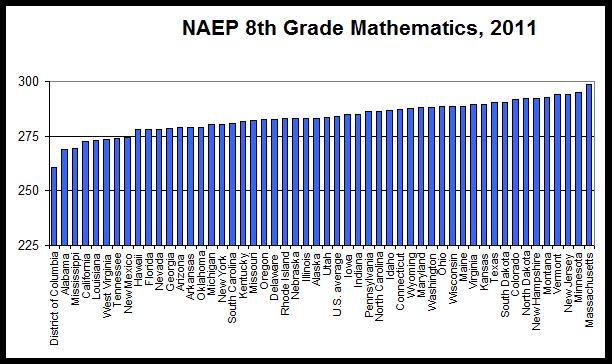
But there’s another problem that also weighs on people’s minds and can affect migration decisions–education quality, and my colleague Rick Hanushek has created three illustrative bar charts which enable a comparison between California and other states. Let’s focus on Texas.

The first chart shows test scores in math for eighth graders using the National Assessment of Educational Progress (NAEP). California ranks 48th. Texas ranks 10th. So there’s another incentive effect

H Ed 8 Total

The next two charts are even more striking.  The chart below shows 8th grade math scores for Hispanics.  California now ranks a bit worse at 49th. But Texas ranks much higher, in 2nd place. The percentage of the population that is Hispanic is about the same in California and Texas.

H Ed 8 Hispanic

The third chart shows 8th grade math scores for blacks. Again California is near the bottom.  And again Texas ranks 2nd.

H Ed 8 Black 

Posted in Uncategorized | Leave a comment

A Crisis May Be Worst Time to Deviate from Rules

In the Money interview with me which Melissa Francis posted yesterday she delved into two of my First Principles—the importance of the rule of law and rules-based policy—pointing out that many people argue that in an economic crisis we need to suspend the rules and resort to discretion.  

It’s an important issue, but as I said in the Hayek lecture of last year (and touched on in the interview) “a crisis is sometimes the worst time to deviate from rules. In a crisis, clarity about the strategy rather than more unpredictability is needed. This was very clear following the first bailout of the recent crisis—the Bear Stearns intervention, after which few knew what to expect the next time because no strategy was put forth. The sooner people can make their decisions with knowledge of the rules, the sooner recovery will come.”

Todd Zywicki wrote a beautiful essay on this issue last year entitled “Upholding the Rule of Law, in Season and Out of Season.”  He gave several reasons why trying to stick to a set of rules or a strategy is so important in a crisis, noting that:

“During periods of economic dislocation…variables of the economic system are in even greater flux than usual” so “adherence to the bedrock predictability of the rule of law takes on special institutional significance.”

In a crisis, “the problem is one of reestablishing decentralized coordination rather than centralized prevention of threats.  Political uncertainty about the integrity of contracts and regulatory policy undermines investor confidence and raises interest rates.”

In a crisis it is “necessary to restrain the opportunism of politicians and special interests that use the opportunity presented by the crisis to piggyback their own narrow interests, often with no relationship to the real problems.”

“Once discretion is unleashed during the crisis history tells us that the dissipation of the crisis does not promote a return to the rule of law—in fact, there is a ‘ratchet effect’ of government discretion as the post-crisis period brings about a consolidation of governmental discretion rather than new limits on it.”

And finally, “the mere potential for discretionary action promotes moral hazard, thereby creating the conditions for still further rounds of intervention.”

It is of course very hard for policymakers under extreme pressure in a crisis to remember these advantages and stick to a rules-based strategy. That is why, as Melissa Francis pointed out, resorting to discretion is unfortunately so common.

MONEY

Posted in Financial Crisis | Leave a comment

Say No To Macro-Prudential Fine-Tuning

In an article in the Wall Street Journal John Cochrane raises serious doubts about  recent “macro-prudential” policy proposals.   I hope the Fed listens. The Bank of England has already started in this direction with its new Financial Policy Committee planning to change capital requirements cyclically as its Monetary Policy Committee sets monetary policy.

The rationale for counter-cyclical macro-prudential policy, proponents argue, is that monetary policy alone is incapable of moderating booms without inflicting severe damage on the economy.   Thus, the central bank would also vary capital requirements cyclically, requiring financial institutions to increase their capital ratio during booms and relax them during slumps.

But the evidence that monetary policy cannot contain excesses without inflicting severe damage is questionable.  Many cite the 2003-2005 housing boom.  But during this period the federal funds rate was too low compared to what worked well in the 1980s and 1990s. Raising it would have help contain the boom with little cost to the overall economy and would have avoided the bust.

Moreover, policymakers need a great deal of discretion to implement such a policy.  Little is known about the dynamic impact of a temporary change in capital requirements and there are policy lags which can create unintended consequences. The policy will likely bring the central bank into political controversy, especially if the instrument affects sensitive sectors like housing.

Rather than attempting to “fine-tune” prudential policy by manipulating capital buffers, central banks should simply to set the required capital ratios at an appropriate level on a permanent basis and keep them there as I explained in this dinner speech at the Atlanta Fed last spring.

Posted in Regulatory Policy | Leave a comment

Jackson Hole: Then and Now

Quite a few people expressed interest in my tweet on the very high ratio of men to women at the 1982 Jackson Hole conference: 23 to 1.  A CNN Money story and Justin  Wolfers tweet reported 6 to 1 this year. Some other differences between the 1982 meeting and 2013 meeting might also be of interest:

Only 2 foreign central banks were represented in 1982: Bank of Canada and Bundesbank. This year policymakers from 35 foreign central banks were in attendance.

There were only 3 media attendees (NYT, WSJ, Washington Post) in 1982. This year there were 13 media attendees on the list and that does not include many more (perhaps 20) who reported from outside the conference room.

Fed Chair Volcker attended in 1982, and every year since a Fed chair attended, until this year.

There were only 3 people at both the 1982 and the 2013 meeting: Alan Blinder, Allan Meltzer, and me. Blinder and I gave papers. Allan discussed a paper by Ben Friedman.

Blinder’s 1982 paper was on fiscal and monetary coordination and the idea that a tighter fiscal policy and an easier monetary policy would be appropriate for the United States at that time.  At this year’s conference, some mentioned that such a policy mix at emerging market countries over the past four years might have avoided the impact of QE on them.

My 1982 paper made a pitch for a new type of macro model.  I argued that monetary policy would benefit if the Fed replaced its Keynesian models with this new type.  The model was different from either new classical or Keynesian models: it combined staggered wages-prices and rational expectations—essentially a New Keynesian model.  Neither the Fed nor other central banks used such models then. Now they all do, adopting them over time. The label New Keynesian had not been coined then, so discussant Bob Gordon labeled it the Taylorian Approach in his comments.

Posted in Monetary Policy, Teaching Economics | Leave a comment

Forward Guidance as an Incipient Policy Rule at the BoE and ECB

At the Jackson Hole conference this weekend, Charlie Bean, deputy governor of the Bank of England, and Frank Smets, head of economic research at the European Central Bank both offered important and newsworthy clarifications of what their respective central banks mean by “forward guidance.”

Bean put it simply: Forward guidance “is intended primarily to clarify our reaction function.” By reaction function he meant a description of how the policy interest rate will react to economic variables; in other words, it’s a monetary policy rule.  Bean further clarified that forward guidance at the BoE is not, as some have suggested, a statement that the policy interest rate will be lower in the future than would be appropriate when the future arrives. The intention is not “to inject additional stimulus by pre-committing to a time-inconsistent ‘longer for longer’ policy path,”  Bean said.

For the Jackson Hole regulars Bean emphasized that forward guidance at the Bank of England is not what Michael Woodford proposed in a paper at last year’s Jackson Hole conference. Woodford’s widely cited paper called for central banks that are at the zero lower bound for the interest rate to commit to keeping the interest rate at zero well into the future and importantly well beyond the time when economic conditions would call for a rate above zero.  Woodford argued that such a commitment on future short rates is needed to get long term interest rates down.

In a separate session at the conference, Frank Smets said essentially the same thing as Bean about the new forward guidance at the ECB, explaining that “We are just trying to be transparent about our policy intentions.”  He also emphasized the difference with the Woodford paper of last year.

At least as described by Bean and Smets, BoE and ECB forward guidance is quite different from Fed forward guidance, which has important elements of Woodford’s proposal. The Fed’s policy calls for keeping the interest rate at zero until the unemployment rate gets down to 6.5%. But by that time the best guess of the Fed’s reaction function, based on paper by Janet Yellen, would call for a rate above zero. So there’s the inconsistency that Bean said the BoE wants to avoid.

To be sure, forward guidance at the BoE and the ECB is very new and could change.  It is quite possible, however, that it could turn out to be the beginnings of a transition to a rules-based monetary policy. If you listen carefully to Bean and Smets, all their central banks are trying to do is describe a policy rule for the interest rate.  Still a long way to go, but they may be on the road out of unconventional monetary policy to a fully articulated rules-based policy.

Posted in Monetary Policy | Leave a comment

Day 1 Papers at Jackson Hole Reveal Skepticism of Fed’s Unconventional Policy

The papers presented today (Day 1) at the Jackson Hole monetary conference by academics outside the Fed revealed considerable skepticism  about the effectiveness of the Fed’s quantitative easing and forward guidance programs.  Of course Fed officials did not express the same doubts. Here is a quick summary of the papers.

The first paper was by Bob Hall, my colleague at Stanford. It argued that neither quantitative easing nor forward guidance was effective, or as he put it, “Both quantitative easing and forward guidance, as implemented by the Fed, are obviously weak instruments.” He went even further saying, in reference to the large increase in reserves to finance quantitative easing, that “An expansion of reserves contracts the economy,” in the current situation when interest is paid on reserves. He is skeptical of forward guidance because he does not think promising to deviate from a policy rule with extra low interest rates in the future is credible. It’s “hard to accomplish.”

Bob he also warned that nominal GDP targeting had serious problems, referring to his research of 20 years ago with Greg Mankiw.  And instead of raising the target for inflation, going forward he argued that central bankers should focus on requiring more capital at banks and more rigorous stress testing.  

Hyun Shin of Princeton discussed Bob  Hall’s paper. Hyun was extremely doubtful that forward guidance was effective in bringing down longer term interest rates.  His reasoning is that the expectations model of the term structure–which forms the theoretical underpinning of forward guidance–is a weak  theory to lean on.

The second paper was by Arvind Kirishnamurthy and Annette Vissing-Jorgenson. They argued that the Fed’s large scale Treasury bill purchases had little “portfolio balance” impact on other interest rates and was not in itself a macro stimulus, though they found an impact of the MBS purchases.  Their work is based on announcement effects, which may not reveal the  full effect of the policy.They also criticized the Fed for not having a clear policy rule or strategy for asset purchases.

We will see what Day 2 brings.

Posted in Monetary Policy | Leave a comment