More on Chapter 11F

My column published last Monday May 3 in the Wall Street JournalHow to Avoid a ‘Bailout Bill’” generated a lot of questions about the idea of a “Chapter 11F,” which I argued is a needed alternative to bailouts. Chapter 11F is a proposed modification or addition to Chapter 11 of the bankruptcy code. It would allow large non-bank financial firms to go through bankruptcy in an orderly and predictable way and thereby minimize disruptions to the financial markets and the economy. Currently there are several different versions of a Chapter 11F, but they all have the common theme of relying more on the bankruptcy law rather than on a new discretionary liquidation or resolution authority or on bailouts. By relying more on the rule of law, the reorganization or liquidation process would be more predictable.

The proposals differ in four main ways: (1) in the type of financial institutions to be covered—most versions do not apply to depository institutions, which would continue to be resolved by the FDIC, (2) in whether or not a regulatory agency could file an involuntary bankruptcy petition for a financial firm, (3) in whether or not the government would be able to provide debtor-in-possession financing, and (4) in whether or not derivatives and repos continue to be exempt from the automatic stay. The last of these is the trickiest of all.

One version of Chapter 11F was put forth by Tom Jackson, the bankruptcy expert from the University of Rochester, in a chapter of the book Ending Government Bailouts As We Know Them. Another version is already in legislative language as a possible amendment to the Dodd Bill filed by Senator Sessions, ranking member of the Judiciary Committee; this version would add another chapter (Chapter 14) to the bankruptcy code, analogous to Chapter 9 for municipalities. Yet another version has been put forth by the Pew Task Force on Financial Reform; it tries to combine resolution authority and bankruptcy. The most recent version is being developed by the Resolution Project, which is part of the Working Group on Economic Policy at Stanford’s Hoover Institution, in which Tom Jackson is a key participant along with other authors (including me) of Ending Government Bailouts As We Know Them.

It is very promising that so many people are now working on these important ideas. I hope that the financial reform legislation now moving through Congress incorporates at least some of the ideas before it becomes law.
Posted in Financial Crisis | Comments Off on More on Chapter 11F

Latest Data Continue To Show Little Impact of Government Stimulus on GDP

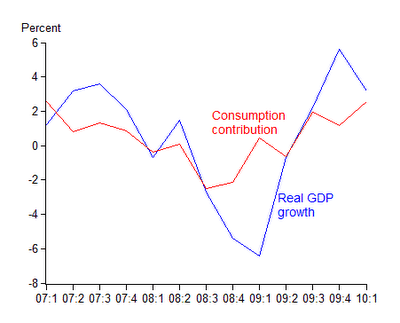
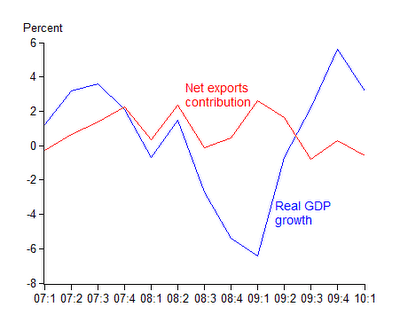
The 3.2 percent growth rate of real GDP in the first quarter (released by BEA yesterday) confirms that the recovery is looking more U-shaped than V-shaped. But it also provides further evidence that the stimulus package of 2009 has had a small contribution to the recovery. Most of the recovery has been due to investment—including inventory investment, which was positive in the first quarter after declining for all of last year—and has little to do with discretionary stimulus packages. The two charts show the percentage contribution of investment and government purchases to real GDP growth in the first quarter and in the preceding quarters since 2007. The charts clearly indicate that the changes in real GDP growth have been mostly due to changes in investment and little to changes in government purchases. In fact, government purchases have been a drag (a negative contribution to real GDP growth) in the fourth quarter of 2009 and the first quarter of 2010. I also include similar charts for the other two components of GDP, consumption and net exports. The government purchases chart looks very similar if you exclude defense spending, as I have in previous posts on this subject.

In response to these previous posts, some have argued that government spending might have declined by a larger amount without the stimulus because the stimulus package prevented state and local government from cutting spending. More research is needed to determine what would have happened in the counterfactual of “no discretionary stimulus,” but in the meantime these data at the least suggest that the simple Keynesian model frequently taught to beginning students—in which government spending shifts up the aggregate spending line to counteract an investment-induced downward shift in that line—needs to be reworked.

Posted in Stimulus Impact | Comments Off on Latest Data Continue To Show Little Impact of Government Stimulus on GDP

Iraq’s Debt Three Years Later

Three years ago, a study of low and declining prices on Iraq’s debt by Michael Greenstone of MIT helped paint a bleak picture of the effectiveness of the surge, as, for example, in this November 2007 New York Times op-ed by Austan Goolsbee “In the Bond Market, a Bleak Prognosis for Iraq.” But as reported in this week’s Boston Globe piece “Gambling on Iraq’s Slow Rise from Ruin,” a re-examination of Iraq’s debt now leads Greenstone to change his view. Greenstone now says “The market’s assessment is that the prospects for a functioning Iraqi state in the future have improved dramatically.’’ The good news in this recent story is tempered a bit, at least for Californians, by the comparable assessment Iraq’s debt and California’s debt.

Posted in International Economics | Comments Off on Iraq’s Debt Three Years Later

Quantitative Easing at the Fed and the Bank of Japan

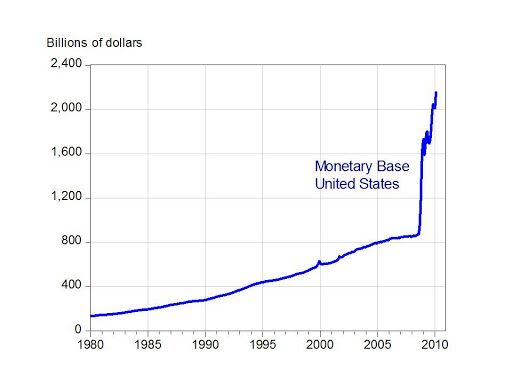
Next Thursday March 25 the House Financial Services Committee will hold a hearing on how the Fed should exit from its quantitative easing. This past week I was in Japan discussing the Japanese experience with QE with traders and experts in the financial sector and in the Bank of Japan. A simple graphical comparison between QE at the Fed and at the BOJ puts the exit strategy in a useful perspective.

The two graphs show the monetary base—currency plus bank reserves—in the United States and Japan as reported by the Fed and the Bank of Japan. (The BOJ reports units of 100 million yen; thus the monetary base in Japan is now slightly below 1,000,000 units of 100 million yen or 100 trillion yen).

The big bulges in the monetary base are measures of quantitative easing because the monetary base would have continued to grow at relatively steady pace without QE. Japan’s experience with QE was from 2001 to 2006; during those years the monetary base increased from about 65 trillion yen to 110 trillion yen, or by about 70 percent. While QE lasted for a long time it ended very quickly, and the quick exit seemed to go smoothly without volatility in the markets. Note that the post 2008 quantitative easing in Japan is very small compared to 2001-2006; thus Japan does not have an exit problem right now though it is still struggling with a deflation problem and will likely continue with its QE. Unlike the Fed, the BOJ did not think a big quantitative easing was appropriate in the recent crisis.

Moreover, the Fed’s recent QE is quite different from the BOJ’s QE in 2001-2006:

First, the monetary base in the United States increased by twice as much in percentage terms (140 percent) compared with Japan.

Second, QE came on much quicker in the United States, with most of the increase in the base concentrated in the last few months of 2008, though increases have continued since then.

Third, the Fed entered into QE when the interest rate target was 2 percent, while the BOJ started QE when the interest rate was already essentially zero at 0.1 percent.

Fourth, the Fed’s quantitative easing has largely been caused by the need to finance its purchase of mortgage backed securities, bailouts of AIG and Bear Stearns and other loans and securities purchases.

Fifth, and most important for the exit strategy issue: the BOJ exited from QE much more quickly than the Fed is now signaling its exit will be. Japan’s experience suggests that a quicker exit for the Fed might be considered.

Posted in International Economics | Comments Off on Quantitative Easing at the Fed and the Bank of Japan

Was the “Considerable Period” or the “Measured Pace” More At Fault?

In his recent review in The New York Review of Books of my book Getting Off Track, Roger Alcaly makes a very interesting point about the “too low for too long” hypothesis, according to which the Fed helped cause the housing boom. I hear that some policymakers at the Fed have been thinking the same way in recent weeks. If so, then when the Fed starts increasing the interest rate, it is likely to do so faster than in 2004-2005. But first consider Roger Alcaly’s argument.

Alcaly agrees that the Fed held the federal funds interest rate too low for too long in 2003-2005, but he emphasizes the slow measured pace at which the Fed raised the rate (once it started raising it) rather than the long considerable period during which it held the rate low at one percent. Alcaly puts it this way: “Taylor’s general contention that low rates after 2003 encouraged the housing bubble is largely persuasive, although mostly for different reasons than he provides.” Alcaly points out that “the Fed raised rates only in increments of a quarter of a percentage point…. Fourteen of these “measured” rate rises were attributable to Greenspan and three to Bernanke, who replaced him in February 2006. Raising interest rates so slowly and steadily promoted excessive risk-taking, and should have concerned Greenspan, according to his stated views.”

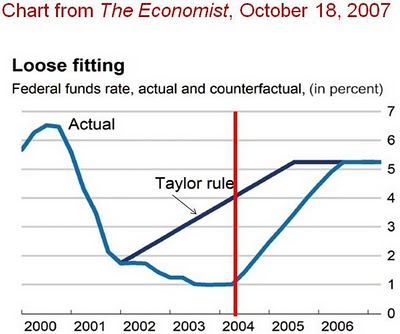
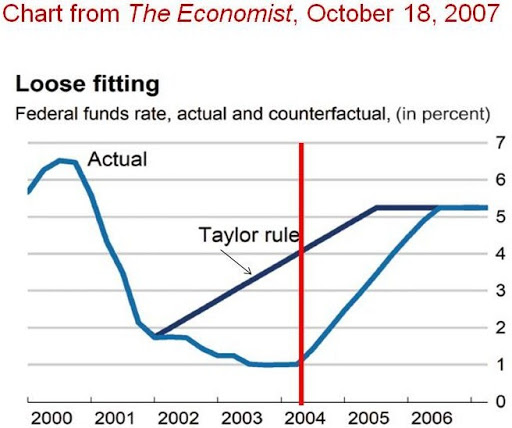
Can one assess quantitaively whether the measured pace period was more to blame than the considerable period period? In my research, I use the deviations between the actual federal funds rate and the Taylor rule to measure whether rates were “too low for too long” as shown in the chart below. This same approach provides a metric to determine whether the deviations were larger before or after the interest rate started rising, and thereby assess which period was more to blame for the “too low rates.”
I have drawn in a red line in the chart below to indicate when the Fed started increasing the funds rate. Note that there is a big gap on both sides of the line. The cumulative deviations to the right of the red line (13.9 percentage points) are indeed sizeable as Alcaly argues. However, they are slightly smaller than the cumulative deviation on the left of the red line (15.5 percentage points). So at least by this measure there is no reason to be more concerned about a repeat of the “measured pace” period as there is a repeat of the “considerable period” period.
Posted in Monetary Policy | Comments Off on Was the “Considerable Period” or the “Measured Pace” More At Fault?

Milton Friedman Had It Right All Along

The following is a reasonable summary, in my view, of the available evidence on the impacts of discretionary fiscal and monetary policy actions taken before, during, and after the recent financial crisis:

The available evidence…casts grave doubt on the possibility of producing any fine adjustments in economic activity by fine adjustments in monetary policy….and much danger that such a policy may make matters worse rather than better…The basic difficulties and limitations of monetary policy apply with equal force to fiscal policy.

Political pressures to ‘do something’ …are clearly very strong indeed in the existing state of public attitudes.

The main moral to be had from these two preceding points is that yielding to these pressures may frequently do more harm than good. There is a saying that the best is often the enemy of the good, which seems highly relevant. The attempt to do more than we can will itself be a disturbance that may increase rather than reduce instability.

But this is not actually my summary; it is Milton Friedman’s summary of the available evidence 52 years ago (as presented in testimony to the Joint Economic Committee in 1958 and quoted later in his famous debate with Walter Heller, published in Monetary vs. Fiscal Policy: A Dialogue, W.W. Norton, 1969, p. 48.)

The same issues, again and again. How little things have changed.

Posted in Teaching Economics | Comments Off on Milton Friedman Had It Right All Along

Why Did Macro Policy in Emerging Market Countries Improve?

The resilience of emerging market economies severely hit by the panic of 2008 is amazing, especially in comparison with the long emerging market crisis period of a decade ago.

I have written that the main explanation for this resilience is improved macroeconomic policy which was put in place in the years before the crisis in many of these countries: higher foreign reserves, lower inflation, reduced borrowing in foreign currencies, and a better fiscal position. But what was the underlying reason for these improvements? Certainly policy makers in the countries deserve credit, but changes in international economic “rules of the game” provided the necessary political and economic incentives.

Recall that the Mexican crisis of 1994-95 lead to large bailouts of the holders of Mexican dollar-linked government bonds by the IMF and the U.S. Treasury. At the time, many expressed concern about the moral hazard and the policy unpredictability caused by these bailouts. Expectations of such bailouts would increase risk taking on the part of investors and reduce incentives for emerging market countries to take steps to avoid circumstances that might lead to crisis. Some worried that the bailout philosophy could lead to more severe crises in the future, and they made proposals to establish a new international framework for limiting bailouts. The British and Canadian governments proposed putting limits on access to large scale loans from the IMF, but the United States resisted their proposals, so no agreement could be reached.

Without such a framework interventions were erratic. Emerging market crises got worse and continued for another eight years. There was the Asian financial crisis and the Asian contagion with Korea, Thailand, Indonesia, and Malaysia. There was the Russian crisis with global contagion to Brazil and Argentina and even the United States as the Fed cut the interest rates in response. The erratic nature of the interventions was very visible in the case of Russia. After several years of support, loans were suddenly pulled in August 1998.

But eventually a solution to the impasse was found in the creation of an alternative to IMF bailouts. The alternative was to add new clauses to the sovereign bonds—collective action clauses—which allowed for orderly workouts of sovereign debt problems between a country and its creditors. The alternative made it credible for the IMF to impose limits and abide by them.

People were skeptical that such clauses could be put into the bonds, but Mexico proved the naysayers wrong and went ahead and issued such bonds on February 26, 2003 (seven years ago last Friday) and many others countries followed Mexico. Agustin Carstens, now Finance Minister of Mexico, played a key role in the effort. As soon as these clauses were put into the bonds, the IMF and its shareholders agreed to establish a new “exceptional access framework.” Soon after the emerging markets moved into a new era of stability. Crises generated by emerging market countries diminished sharply. The countries became more resilient to shocks from abroad, as we saw in the recent crisis. It is hard to prove cause and effect in economics, but in my view these limits played a role by making large scale bailouts less likely and thereby providing incentives to emerging market countries to follow policies which would reduce the chance of crisis.

Posted in Regulatory Policy | Comments Off on Why Did Macro Policy in Emerging Market Countries Improve?

Good Policy Pays Off In Emerging Markets

“Lessons from the Financial Crisis for Monetary Policy in Emerging Markets” was the title for the 2010 L.K. Jha Lecture, which I gave this week at the Reserve Bank of India in Mumbai. Jha was one of the truly outstanding economists and public servants in Indian history, and the biennial lecture series in his honor was created by the RBI two decades ago. This week’s Jha Lecture was the first since the panic of fall 2008 which hit emerging markets severely. The previous lecture was given in November 2007 by Jean-Claude Trichet, President of the European Central Bank.

One cannot exaggerate the size and speed of the shock to emerging markets in the fall of 2008. International stock indexes fell in tandem with the S&P 500. Consumers and businesses pulled back, largely out of fear. Exports and imports fell sharply throughout the world, with production declines accelerating as firms cut their inventories. The drop in exports was an especially major hit to emerging market economies.

The big surprise, however, was the amazing resiliency of many emerging market countries, including India, in the face of these shocks. The contrast with the 1990s, when emerging markets were suffering their own crises, was stark. For countries such as Brazil and Turkey, which were in crisis as late as 2003, the difference was especially stark. Why were these emerging markets so resilient? In my view the most important reason is that they had moved toward better macroeconomic policies and they stuck to those policies during the crisis. They were careful not to borrow in foreign currencies, and here Indian regulatory policy deserves special credit in discouraging such borrowing by Indian banks. They built up their foreign reserves so they could intervene in the case of a big shock, like the one they received. They kept inflation relatively low and were more careful with public sector deficits. (The reason they moved in such a good direction will be the subject for a later post.)

The policy implications of the crisis are that those central banks which were following sounder policies—and here credit should be given to India and other emerging market countries—should continue to do so. There is no reason to change their reform efforts. There is no reason to raise inflation targets. There is no reason to start trying to burst bubbles. But those central banks which deviated from good policies (I discussed these in the lecture) should get back to what they were doing before the crisis. They need to earn back credibility and preserve their independence. Systematic monetary policies focusing on a credible goal for inflation worked well in the past and they will work well in the future.

But the crisis does reveal some potential new fault lines for emerging markets, largely related to the high degree of international connectedness between markets, so evident during the panic. These interconnections raise questions about the impact of central banks on each other. In the period leading up to the crisis there is evidence that some central banks held interest rates lower than they otherwise would have because the Fed set its interest rate so low. The reason, of course, is the exchange rate. A lower interest rate abroad would cause the exchange rate to appreciate with adverse consequences on exports.

Is there a better way? Making interest rates less erratic in the developed countries would help the emerging market countries. For the most part deviations from policy rules, such as the Taylor rule, have increased interest rate volatility, so keeping policy interest rates more on track will have the added advantage of reducing their erratic nature. Another possibility is a global target for the inflation rate. If such a target was considered in the deliberations of each central bank, then there would be less of a tendency to swing individual policy interest rates around by large amounts.

Posted in International Economics | Comments Off on Good Policy Pays Off In Emerging Markets

Macro Model Disagreements and Reality

Last Friday Macroeconomic Advisers (MA), a forecasting firm, posted a blog entry responding to empirical work by me and others on the “stimulus act” of 2009. I welcome the discussion, but unfortunately the blog seems to have missed the main points of my work along with John Cogan, Tobias Cwik, and Volker Wieland, which showed that (1) findings that the stimulus would have a large impact were not robust and (2) the data so far indicate that the actual effects on GDP or employment are not significant. Here is our working paper of a year ago and an oped.

First, we did not say or imply that “macro modelers such as MA were unaware of the ‘modern’ life-cycle (or permanent income) theory” or anything else of a personal nature. Instead, we showed that the temporary tax and transfer payments, which were a large part of the stimulus packages of 2008 and 2009, did not jump start consumption contrary to the claims of many. When you look at the evidence from 2009 (or 2008) you see that the theory holds up remarkably well. I am glad that the MA model incorporates that view.

Second, the MA blog claims that we relied on “small multipliers often found in reduced-form models” and that we used an “a-theoretical” approach. I see no way one could come to that conclusion from reading my work with Cogan, Cwik, and Wieland. Instead of reduced-form models we stressed the importance of using empirically-estimated structural models. We focused on the kind of models that have been taught in most graduate schools in economics in recent years and about which there has been a consensus in research, as emphasized by Michael Woodford of Columbia. In particular, we used a structural model estimated by Frank Smets, Director of Research at the European Central Bank, and his colleague Raf Wouters. We also looked at my own structural model, but we did not focus on that model so as to be more objective. Our structural approach predicted an impact of the stimulus which was only 1/6 what the administration claimed.

Third, the crowding out of investment and consumption by the stimulus in our analysis does not depend on the Fed increasing the interest rate in the short run. Our model simulations held the interest rate at zero for one or two years.

Fourth, the MA blog seems to miss the main point of my criticism as emphasized on Economics One for the past six months: There is no consensus among structural models about the forecasted impact of the stimulus: some models, such as ours, forecasted little or no impact; others models, like MA, forecasted a larger impact. The results of MA are thus not robust to different modeling assumptions. Menzie Chinn over at Econbrowser is right to say that “Something like [the Brookings Model comparison project of the 1980s] is desperately needed these days, so that those people who are concerned with seriously considering policy problems can sort out why the simulation results differ.” Indeed Volker Wieland has assembled a model database for exactly this reason.

In the meantime, I have argued that it is time to go beyond the models and see what actually happened rather than repeat the same model forecasting exercise over and over again with the path of government purchases, taxes, and transfers in the stimulus. In fact, many in the press perceive that these repeated forecast simulations are new evidence, even though they are essentially the same evidence provided before the stimulus was passed a year ago. I illustrated this misperception with a New York Times article from which I copied a chart from MA and other models. (Incidentally, this indirect reference to the Times’ MA chart is the only mention of MA in all our work). I have no disagreement with the MA blog about what the actual path of government spending, transfers, or taxes was. It has been very close to what Cogan, Cwik, Wieland and I assumed a year ago when we first circulated our analysis.

The MA blog does not refer to such evidence. For example, it does not analyze the contributions of the various components of real GDP growth in the past year to see if they are consistent with the stimulus having an effect. I have provided evidence using those numbers that government purchases did not contribute a noticeable amount to the change in real GDP growth. Likewise the evidence shows that the temporary tax changes or one-time transfers did not impact consumption or GDP significantly.

Posted in Stimulus Impact | Comments Off on Macro Model Disagreements and Reality

Stimulus Anniversary Blogs

With the one year anniversary of the signing of the stimulus it is useful to review the facts and data as they came in during the year. Here are the relevant posts from Economics One. Most look at actual data and find virtually no impact. The data include the contribution of GDP growth from government purchases versus investment and a comparison of the change in personal disposable income and personal consumption expenditures. The seventh post shows that most people who claim that the stimulus is working actually use the same models they used before the stimulus was passed with no new data.
Is the Stimulus Working? September 20, 2009
Despite Claims, Data Continue to Show Small Impact of Stimulus, October 23, 2009
National Accounts Show Stimulus Did Not Fuel GDP Growth, October 30, 2009
Jobs Saved, PR or Fact? November 6, 2009
From Fiscal Stimulus to Fiscal Anti-Stimulus, January 11, 2010
One Year Later and More Evidence that the Stimulus is Not Working, February 2, 2010
Measuring the Impact of the Stimulus Package with Economic Models, December 30, 2009

Posted in Stimulus Impact | Comments Off on Stimulus Anniversary Blogs