New Ideas about Monetary Policy from Jackson Hole

I write from Jackson Hole Wyoming as the early morning sun shines sharply on the Grand Tetons where I just spent a very enjoyable few days at the annual monetary conference. I have been coming to these Jackson Hole conferences on and off since the first one on monetary policy in 1982, and as usual I learned a lot. Here is a brief sampling. I recommend reading the papers and the commentary once they are posted by the Kansas City Fed.

The main thing I took away from Ben Bernanke’s opener (the tradition going back to Paul Volcker and Alan Greenspan is for the Fed chair to lead off) was his call for a “cost-benefit” approach to determine whether another dose of unorthodox large scale asset purchases is needed. This is a big improvement over a “whatever it takes” approach, and it opens the door to a transparent discussion of the costs and benefits of such policies. My own view (based on research with Johannes Stroebel) is that the benefits in terms of lower rates are very small, while the short-term costs of greater uncertainty about the exit strategy and long-term costs from a loss of independence are large.

Larry Christiano presented a new and interesting modification of the Taylor rule which replaces the output gap with a measure of credit growth. He presented some preliminary model simulation work to see how his idea would work in practice. Given the measurement problems with the output gap, more research along these lines would be valuable. Milton Friedman once proposed that I consider replacing the output gap with money growth (M2) in the Taylor rule, which is a similar proposal.

Jim Stock and Mark Watson presented a novel model for inflation forecasting. It focuses entirely on the statistical regularity that inflation declines during recessions. Most important for the current economic situation was their finding that the chances of deflation are quite low right now.

Alan Blinder and I presented our separate critiques of Bank of England Deputy Governor Charlie Bean’s ideas for future monetary policy. Charlie started off by revisiting the critique I presented at the 2007 Jackson Hole conference that policy rates were too low for too long leading up to the crisis; he mentioned recent work by Ben Bernanke, but omitted other papers which I brought to people’s attention. I was surprised that Charlie placed so much emphasis on studies of Fed asset purchases which simply looked at announcement effects, recalling my experience running the international division at Treasury where announcement effects in the currency markets are usually offset soon afterwards. Alan Blinder argued for a more discretionary and interventionist approach, buying more assets including private sector assets. I stressed the benefits of getting back to the rules-based Framework that Works, which is how I labeled the policy that was used effectively for most of the 1980s and 1990s. Here is my commentary. Read Alan’s when it is posted. This debate will continue.

Throughout the conference the growing U.S. government debt problem was the gigantic elephant in the room. Eric Leeper’s dramatic exploding debt charts and his plea for a more scientific approach to fiscal policy analysis made this problem crystal clear for everyone, even though public finance economists in the audience vigorously defended their approach. This debate will also continue.

Posted in Monetary Policy | Comments Off on New Ideas about Monetary Policy from Jackson Hole

The Russian Export Ban: An Economic Story Worth Telling

The Soviet Union used to provide me with plenty of current event stories to tell students in Economics 1 about the wastes and harms of price controls and central planning. But most first-year college students taking introductory economics this fall were born after the collapse of the Soviet Union. Those good old stories are far from students’ personal memory and are certainly not current events.

That’s why I was so interested in Paul Gregory’s recent blog about this summer’s grain export ban in Russia. It’s a current event well worth telling students about. After the damage from the heat to Russia’s grain crop, Prime Minister Putin imposed a ban on grain exports. But as Paul Gregory shows the reason the story is worth telling is that Russia is now an exporter of grain. In contrast the Soviet Union actually had to import grain from the United States and other countries, because of the inefficiency of the collective farms and misallocation of resources under central planning. Recall that President Carter put an embargo on U.S. exports of grain to the Soviet Union, using it as a lever to get the Soviet’s to leave Afghanistan.

In the years before the Russian Revolution, Russia was an exporter of grains. Ukraine was considered the breadbasket of Europe. Now after the collapse of the Soviet Union, Russia and the Ukraine are exporting again. So this fall the inefficiencies of central planning in the Soviet Union can be explained with a current event after all.

Posted in International Economics | Comments Off on The Russian Export Ban: An Economic Story Worth Telling

Washington Consensus Versus Beijing Consensus on Economic Policy

Does China’s remarkable economic growth, its stability during the recent financial crisis, and its immense foreign aid/investment in Africa raise doubts about free market policies and provide evidence in favor of a more interventionist approach? In a new review paper, my colleague Ronald McKinnon says “Surprisingly no.” In fact, while many tout a “third way,” China has followed quite closely the 10 liberal market-oriented rules commonly called the Washington Consensus after John Williamson wrote them down 20 years ago. McKinnon convincingly shows that “The Chinese economy itself has evolved step-by-step…into one that can be reasonably described by Williamson’s 10 rules!”

Some experts worry that U.S. influence is waning relative to China, and there is cause for worry, but McKinnon argues that “U.S. influence…can be largely recouped if its government returns to a hard version of its own ‘Washington Consensus’— as China has done.”

McKinnon also offers a fascinating political/economic analysis and explanation for China’s rapidly growing economic involvement in Africa.

Posted in International Economics | Comments Off on Washington Consensus Versus Beijing Consensus on Economic Policy

Where Are We Now, Three Years After the Onset of the Crisis?

This week marks the third anniversary of the flare up of the financial crisis in August 2007. Howard Green, Headline anchor at the Business News Network in Canada, broadcast the news this way in today’s lead-in to an interview with me to mark the occasion: “It was exactly three years ago this week, August 2007, when the global financial system started experiencing chest pains as credit conditions tightened…It would still be a year and a bit before financial markets would go into cardiac arrest…Where are we now, three years after the onset of the crisis?”

The chart below shows how things looked back then; it’s like a “money market EKG,” called LOIS3 (the spread between three-month LIBOR and OIS, the market’s expectation of the federal funds rate over the same three months). The last reading is on Friday, August 10, 2007 and is what you would have seen if you looked at your computer screen on Sunday August 12 and tried to figure out what would happen next. Yes, there’s obvious evidence of chest pains, perhaps even worse.

But “what’s causing them” was the question everyone was asking. “What’s the diagnosis?” I have argued that the problem was misdiagnosed, and thereby mistreated, by policy makers, and that is why the patient eventually went into “cardiac arrest” a year or so later, though some still say that the treatment was correct and things would have been even worse without the treatment. If you want to see what the “money market EKG” looked like at the time of “cardiac arrest,” take a look at this nice interactive chart on Bloomberg.

Unfortunately the answer to Howard Green’s question above is that we are still in a pretty dire situation. We are now going into the fourth year of “crisis-recession-fizzled recovery” and for several reasons the outlook is bleak unless policy is changed as I had the chance to explain in the TV interview, divided into segments One, Two, and Three.

Posted in Slow Recovery | Comments Off on Where Are We Now, Three Years After the Onset of the Crisis?

The Ryan Roadmap versus the Road to Ruin

Congressman Paul Ryan’s Roadmap has suddenly become the focal point for debating how America should get its economic house in order. Fred Barnes of the Weekly Standard says to embrace it. Paul Krugman of the New York Times says to reject it. And all the pundits are predicting what the plan would do, including Krugman who says it “calls for steep cuts in both spending and taxes.” So how are you going to decide? I suggest that you read the plan.
It’s only 87 pages long–about the same length as a good book on the economic crisis–and there are some great charts.

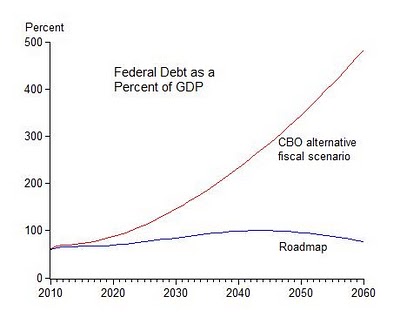
I put together some charts to get started. In these charts I compare the Ryan Roadmap with the road America is currently on, according the CBO’s latest estimate of June 30, 2010. CBO calls the current road the Alternative Fiscal Scenario. Road to Ruin is a better description.

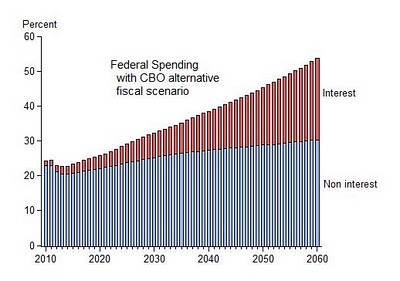
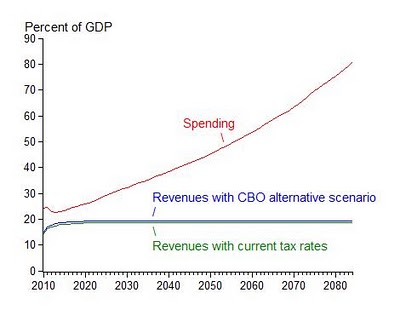
The first chart compares federal debt as a share of GDP under the CBO Alternative with the Roadmap; the Roadmap obviously makes more sense. The second chart shows spending and taxes under the Roadmap and the CBO Alternative; the Ryan Roadmap focuses on controlling the growth of spending as a share of GDP, which makes sense because that is where the growth of the deficit is coming from. The third and fourth charts show how the Ryan Roadmap takes action to control non-interest spending now and thereby dramatically reduces interest payments on the debt in the future.
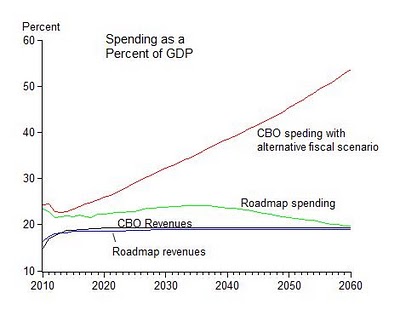
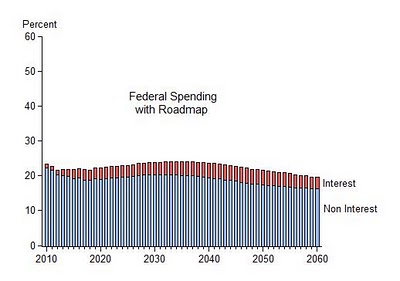
There are alternative plans of course, but at the very least the facts shown in these charts demonstarte that the Ryan Roadmap is a big improvement over the road we are on now.

Posted in Fiscal Policy and Reforms | Comments Off on The Ryan Roadmap versus the Road to Ruin

TV Fiscal Stimulus Debate Reveals Some Agreement

PBS Newshour hosted a live TV debate between Mark Zandi and me yesterday on the question of whether government interventions helped or hurt the economy. The show highlighted a paper by Alan Blinder and Zandi about which I posted comments on this blog yesterday. Several people who watched the show commented on how Zandi agreed with me on two important issues: (1) that the on-again off-again bailout policies in 2008 helped bring about the panic that year and (2) that holding off on any tax rate increases next year would be a stimulus to economic growth. Of course we disagreed about other things.

Posted in Stimulus Impact | Comments Off on TV Fiscal Stimulus Debate Reveals Some Agreement

More on the Blinder-Zandi Working Paper on the Crisis

Yesterday the New York Times published an article about simulations of the effects of fiscal stimulus packages and financial interventions using an old Keynesian model. The simulations were reported in an unpublished working paper by Alan Blinder and Mark Zandi. I offered a short quote for the article saying simply that the reported results were completely different from my own empirical work on the policy responses to the crisis.

I have now had a chance to read the paper and have more to say. First, I do not think the paper tells us anything about the impact of these policies. It simply runs the policies through a model (Zandi’s model) and reports what the model says would happen. It does not look at what actually happened, and it does not look at other models, only Zandi’s own model. I have explained the defects with this type of exercise many times, most recently in testimony at a July 1, 2010 House Budget Committee hearing where Zandi also appeared. I showed that the results are entirely dependent on the model: old Keynesian models (such as Zandi’s model) show large effects and new Keynesian models show small effects. So there is nothing new in the fiscal stimulus part of this paper.

Second, I looked at how they assessed the impact of the financial market interventions. Again they do not directly assess the interventions. They just simulate the model with and without the interventions. They say that they have equations in the model which include the financial interventions as variables, but they do not report the size or significance of the coefficients or how they obtained them.

Third, the working paper makes no mention of previously published papers in the literature which get different results. It is rather standard in research to provide a literature review and to explain why the results are different from previous published papers. For the record there are different results in papers by John Cogan, Volcker Wieland, Tobias Cwik and me in the Journal of Economic Dynamics and Control, by John Williams and me in the American Economic Journal; Macroeconomics, or by me published by the Bank of Canada or the St. Louis Fed

Finally, when I read the paper I discovered in an appendix that Blinder and Zandi find that policy was not as good as the model shows and was in fact quite poor when one does a more comprehensive evaluation. They say in Appendix A that “Poor policymaking prior to TARP helped turn a serious but seemingly controllable financial crisis into an out-of-control panic. Policymakers’ uneven treatment of troubled institutions (e.g., saving Bear Stearns but letting Lehman fail) created confusion about the rules of the game and uncertainty among shareholders, who dumped their stock, and creditors, who demanded more collateral to provide liquidity to financial institutions.” I completely agree with this statement, but how can one then argue that policy intervnetions worked, when, in fact, viewed in their entirety they caused the problem?

Posted in Stimulus Impact | Comments Off on More on the Blinder-Zandi Working Paper on the Crisis

More Economists Voice Concerns about Deficit-Spending Proposals

The number of economists arguing forcefully against efforts to use more deficit spending to stimulate the economy is increasing. Their arguments differ in important respects, ranging from empirical evidence that the stimulus programs thus far have done little to help the economy to the recognition that the growing debt is a serious threat to long term growth and economic stability. Already this week we have
Niall Ferguson’s Today’s Keynesians Have Learned Nothing,
Ken Rogoff’s No Need for A Panicked Fiscal Surge,
Vernon Smith’s Please, No More Government Spending ,
and my Cutting National Debt = Stimulus.
The bottom line is that we can help the economy more by laying out a credible plan to end the debt explosion.

Posted in Budget & Debt | Comments Off on More Economists Voice Concerns about Deficit-Spending Proposals

Government Policy and the Slowdown

Is the economy slowing down and what has been the role of government? Recently EconTalk host Russ Roberts and I discussed these questions and our conversation was made available today as a podcast at the Library of Economics and Liberty.

Like many economists, I am concerned about the slowdown in the economy which prolongs the high unemployment rate. I think uncertainty about the growing federal debt and the increased government interventions—from health care to financial markets—is the cause of the slowdown. In my view the best stimulus right now would be a clear and credible plan to reduce the deficit and bring down the growing debt.

Posted in Slow Recovery | Comments Off on Government Policy and the Slowdown

New Data Show the Debt Problem Is Spending (not Taxes) and Obamacare Worsens the Problem

Everyone now seems to agree that the exploding federal debt is a serious problem that must be addressed. But how? The following two charts provide some data to help answer that question. I put the charts together using budget data from CBO’s new Long Term Budget Outlook released on June 30. They take account of the budget effect of latest legislation—including the Obamacare bill.

The first chart presents the outlook for spending (red line) and revenue (blue line) as a share of GDP using CBO’s “alternative scenario,” which assumes that President Obama’s tax increase proposal is passed, including increasing the two top income tax rates. The deficit is the difference between the red and blue lines. Thus the chart clearly demonstrates that the deficit is exploding because government spending is exploding.

The chart also shows (green line) what would happen to tax revenue if tax rates stay at their current level and are not increased as President Obama has proposed. Taxes would average about 18.5 percent of GDP compared with 19.3 percent for CBO’s estimate under the Obama tax rate increase. According to the chart the Obama tax increase would not have a material effect on the very large deficit (the chart even overstates the effect because it assumes static budget scoring). Again the problem is spending growth, not taxes. To me this chart implies that it is far better to leave tax rates where they are and focus on a plan to end the explosive spending growth, especially in a weak economic environment where higher marginal tax rates can severely reduce economic growth and employment.

The second chart looks at the reasons for the explosive spending. It divides non-interest spending into three parts: (1) social security, (2) health care (Medicaid, Medicare, and Obamacare) and (3) everything else. Item 2—spending on health care—is clearly the most important source of the spending explosion. Remember that these data came out after Obamacare was passed. Thus, Obamacare does not address the explosive health care spending problem, which will come as no surprise to its critics, but is clearly contrary to the claims of those who supported it. Moreover, to the extent that Obamacare slowed growth in Medicare it more than offset this with new entitlements, making controlling health care spending even more difficult now. The data are clear: In order to control government spending, you have to start over on health care reform. Whether you call that “repeal and replace” or “repeal and reduce (the deficit)” the message is the same.

In sum, these new budget data show three things: First, the deficit is exploding because government spending is exploding. Second, the tax increase proposed by President Obama would not have a material effect on the exploding deficit. Third, we need a new approach to health care reform if we are to control government spending and wind down the deficit.

Posted in Budget & Debt | Comments Off on New Data Show the Debt Problem Is Spending (not Taxes) and Obamacare Worsens the Problem