Back to the Ad Hoc Age

The title and the content of Gillian Tett’s short article “Goodbye Moderation, Hello to the Ad Hoc Age,” (FT, Nov 26, reprinted here) describe succinctly the remarkable swing in the pendulum from rules towards discretion in policy in recent years. In my view, this swing is a major reason for the end of the great moderation and the painfully protracted slump in the United States, as Tett describes in the article. She also expands on the idea by incorporating the government-caused debt mess and bailout operations in Europe.

Having been bombed back to the Ad Hoc Age we can only hope it is a lot shorter than the Stone Age, but the first step in ending it is understanding what happened, and this short article is very helpful in this regard.

Posted in Regulatory Policy | Comments Off on Back to the Ad Hoc Age

Toward Price Stability Within a Framework of Economic Stability

Today Congressman Paul Ryan and I published an article explaining the rationale for a reform of the Federal Reserve Act to establish a single “goal of long-term price stability within a framework of economic stability, including clear reporting and accountability requirements.” As part of the reporting framework the Fed would “explicitly publish and follow a monetary rule as its means to achieve price stability.” The Fed would have the discretion to choose its own rule or strategy and it “should have the discretion to deviate from its strategy,” but be accountable when if it did so: “it should have to promptly report to Congress and to the public on the reasons for the deviation”

Some have asked how such a proposal would have worked recently. That depends very much on what rule or strategy the Fed had chosen. Suppose, for example, they had chosen the rule that I proposed a number of years ago, which described Fed policy well in most of the 1980s and 1990s as Bill Poole showed in his article Understanding the Fed when he was president of the St. Louis Fed. With inflation now below the two percent target and the economy still in a slump, that rule would now be calling for a federal funds rate close to, or just slightly above, what it is now, not the minus six percent that advocates of QE2 refer to as justification for such a highly unconventional policy.

Equally important, interest rates would not have been held so low in 2002-2004 which was one of the reasons for the financial crisis. Of course the Fed might have chosen a different rule, but then we would at least have had the opportunity for public discussion and understanding of its strategy for monetary policy. The proposed reporting and accountability requirements would restore the requirements that were removed in 2000 (as explained here), but with an emphasis on a rule for policy rather than ranges for the growth of the monetary aggregates.

Posted in Monetary Policy | Comments Off on Toward Price Stability Within a Framework of Economic Stability

A Proposal to Restore Reporting and Accountability Requirements for the Fed

In a speech in Washington last week I made a proposal to restore the legislative requirement that the Fed report and be accountable for its strategy for monetary policy. Such a requirement was the law throughout the 1980s and 1990s, but was removed in 2000. There is a big difference, however, between the old law and what I proposed. The old law focused on reporting about the “ranges of growth or diminution of the money and credit aggregates,” while the new law would focus on the “strategy, or rule, of the Board and the FOMC for the systematic adjustment of the federal funds rate in response to changes in inflation and in the real economy needed to achieve the price stability objective.” Money would still be a factor in the strategy in that the interest rate would be determined in the money market through the demand and supply of money. The Fed would have the discretion to choose the strategy, but would be required to explain in writing and in hearings any deviations from the strategy. One possible strategy could be the Taylor rule, but the Fed could choose any rule as long as it stuck with it or explained why it deviated from it. .

Here is some press reaction to the proposal

Bloomberg News: “Taylor Proposes Altering Fed Law to Require ‘Systematic’ Rate Setting Rule”
Dow-Jones: “Stanford’s Taylor Urges Turning Monetary Policy Rules Into Law to Limit Fed”
Reuters: “Economist Taylor Wants New Law for Fed Policy”
Globe and Mail: “A Rules Based Fed?”

Another reaction, not covered in these articles, came from some of the people who had experience at the Fed in the 1980s and 1990s. They say that they found the old reporting and accountability requirements to be of value in creating a process at the Fed for discussing a monetary strategy and that the new requirements could be of similar benefit.

Posted in Monetary Policy | Comments Off on A Proposal to Restore Reporting and Accountability Requirements for the Fed

The End of the Recrudescence of Keynesian Economics

This past weekend Columbia University hosted a conference on the occasion of the 40th anniversary of the famous Phelps volume on the micro foundations of macroeconomics. In addition to the technical papers, which will eventually be published in a conference volume, important lunch and dinner talks were given by two of the most recent Nobel Prize winners in economics–Dale Mortenson and Chris Pissaredes–as well as by Fool’s Gold author Gillian Tett of the FT and Ned Phelps.

Ned spoke about what he called the “recrudescence of Keynesian economics.” He explained why, as he put it in his New York Times column of last August, “The steps being taken by government officials to help the economy are based on a faulty premise. The diagnosis is that the economy is ‘constrained’ by a deficiency of aggregate demand. The officials’ prescription is to stimulate that demand, for as long as it takes, to facilitate the recovery of an otherwise undamaged economy — as if the task were to help an uninjured skater get up after a bad fall. The prescription will fail because the diagnosis is wrong.”

The problem with these Keynesian policies is that at best they give short term boosts to the economy, but then fizzle out as we are seeing now. Sustaining growth in employment requires sustaining investment, which requires government policy that encourages investment and innovation, not short-run stimulus packages that try to boost consumption and government purchases, which crowd out investment.
.
Will there be an end of this recrudescence? Politics as well as economics will be an important determining factor, at least that’s what the historical analysis in the paper I presented at the conference shows. The good news then is that more people are beginning to see the problems with these stimulus packages and the political process is responding.

Note, however, that Russ Roberts has an alternative and quite plausible “political economy” explanation for why policymakers tend to choose interventionist policies such as discretonary Keynesian stimulus packages.

Posted in Fiscal Policy and Reforms | Comments Off on The End of the Recrudescence of Keynesian Economics

The 2010 Little Big Game in Economics

Once a year, in November, the graduate students in the Stanford and Berkeley Economics Departments get together for the Little Big Game, a series of contests in basketball, volleyball, Frisbee, touch football, and soccer. The Little Big Game takes place in the days before the Big Game between the Stanford-Cal varsity football teams. This year the Little Big Game was held at Berkeley, where the Big Game between 6th ranked Stanford and unranked Berkeley will take place tomorrow.

I am happy to report that the Little Big Game was great this year for the Stanford team, which racked up 3-1-1 won-loss-tie record, much better than last year’s 2-3 record. Stanford won in basketball, volleyball, and Frisbee, lost in football, and tied in soccer.

Stephen Terry, a second year Stanford Ph.D. student, explained the victory in the post-game wrap up, saying “I give the first year students’ credit for this one, especially Isaac Opper who led Stanford in almost all of the games. But of course we shouldn’t forget our t-shirts. We rule!”

In case you’re wondering, I’ve included a picture of the front and back of the Stanford economics team’s t-shirt uniform for this year’s Little Big Game.

Posted in Teaching Economics | Comments Off on The 2010 Little Big Game in Economics

The QE2 Letter

Many have asked me what I think about the letter criticizing QE2 which was signed by me and other economists. The letter has created quite a stir. I have already written and spoken many times explaining my oppostion to QE2, both before the decision was made and afterwards, so it might be helpful just to give a list of posts on this blog and some media interviews:

Jackson Hole, August 29 “the benefits in terms of lower rates are very small, while the short-term costs of greater uncertainty about the exit strategy and long-term costs from a loss of independence are large.”
The Taylor Rule Does Not Say Minus Six Percent, September 1
it says .75 percent which provides no rationale for QE2
More on Massive Quantitative Easing, September 8 which refers to a WSJ oped and many other critiques
Announcement Effects Do Not Prove QE Works, October 7 so the evidence cited in favor of QE2 is pretty weak
A New Normal for Monetary Policy? October 27 reflects my concerns that there would be a QE3 and a QE4. Maybe the letter and other objections will reduce the chances of this.
Milton Friedman Would Certainly Not Have Supported QE2, November 3 so be careful about citing him as support
Empirical Concerns about Anticipation Effects of QE2, November 5 which disagreed with the Washington Post article by Ben Bernanke defending QE2
QE2 and G20, November 14 in which an unintended consequence of QE2 is discussed

I have also done many TV interviews, from this interview with Steve Liesman on October 15 at the Boston Fed before QE2 was announced to this one last week on Squawk Box. To hear both sides of the issue discussed togehter, view this Newshour program with Alan Blinder and me which was also aired on October 15, or listen to this NPR program On Point with Jeremy Siegel and me. An earlier QE2 debate took place on Squawk Box on October 8 in which Jim Bullard President of the Federal Reserve Bank of St. Louis and Larry Meyer also appeared.

Posted in Monetary Policy | Comments Off on The QE2 Letter

QE2 and G20

An unintended consequence of QE2 has been the strong openly voiced opposition from some of America’s traditional allies as well as those countries, like China, perceived to be on the other side of the bargaining table. So the Fed is affecting U.S. foreign policy, and the fact that President Obama has had to defend the Fed in other countries raises questions about the Fed’s independence.

The administration’s main defense is that a growing U.S. economy is good for the world. While a strong U.S. economy is certainly good for the world, it is not so clear that QE2 will help the U.S. economy grow more strongly. I have argued that QE1 did not have much positive stimulus effect and the same is likely to be true for QE2 as I explained for example in this recent interview. Moreover, if the Fed thinks that quantitative easing helps by depreciation of the dollar, that policy certainly does not help demand in other countries.

But the insertion of QE2 into the negotiations was not the reason that the United States came away with so little at the G20 meeting in South Korea. The same thing happened at the previous Q20 meeting in Canada and there was no QE2 then. As I wrote at the time of the Canadian finance ministers and central bank governors meeting, the problem with the U.S. position then and now is that the idea that more deficit spending stimulus is needed to increase demand is an idea that other countries strongly disagree with, and in my view they are right. Indeed, the G20 has been getting on the right track despite the U.S. postion. The United States was able to sell stimulus packages to the G20 in early 2009, but most see that it has not done much good and has made the debt higher. The way to have a more successful G20 meeting in France next year is for the United States to go with a credible plan to reduce the budget and stop increasing the debt.

Posted in Monetary Policy | Comments Off on QE2 and G20

Empirical Questions About the Anticipation Effects of QE2

No doubt there will be many empirical studies evaluating the impact of the Fed’s November 3 decision to begin another dose of quantitative easing (QE2). Ben Bernanke gave his first assessment of the impact of QE2 in an op-ed yesterday in the Washington Post. He argued that QE2 started working even before the decision on November 3. In particular he wrote that:

“Stock prices rose and long-term interest rates fell when investors began to anticipate the most recent action.”

How can one determine whether stock prices rose and long-term interest rates fell in anticipation of QE2? Obviously it is very difficult because many other things affect stock and bond markets, and one can never know for sure, but the data presented in the following charts raise serious doubts that such anticipation effects were either substantial or sustainable.

First consider long-term Treasury interest rates. The first chart shows the interest rate on benchmark 10-year Treasury bonds. Note that these long-term interest rates had been coming down since May—long before markets could reasonably have anticipated another large dose of quantitative easing. They have been relatively flat since August. But to assess more formally whether long-term interest rates fell “when investors began to anticipate” QE2, one must consider a date or dates on when such anticipations are likely to have begun.

One logical date is August 27, the day of Ben Bernanke’s Jackson Hole speech where he discussed the framework of quantitative easing in detail. Indeed, this Jackson Hole speech is frequently mentioned in the financial press. The date of the speech is shown in the chart. The long-term rate was 2.66 percent on that date. If anticipations of quantitative easing lowered long-term interest rates, then one would expect this rate to have been lower on November 2, the day before the FOMC’s recent action. But this is not what happened. The interest rate was the same 2.66 percent on November 2 as it was on August 27.

What about other long-term interest rates? The second chart shows the interest rates on Moody’s Aaa and Baa corporate bonds. On November 2 the Moody’s Baa corporate rate was 5.71 percent compared with 5.62 percent on August 27. And on November 2 the Aaa rate was 4.66 percent compared with 4.41 percent on August 27. In both cases rates were higher, rather than lower, compared with what rates were on the day investors could plausibly have begun to anticipate the recent action.
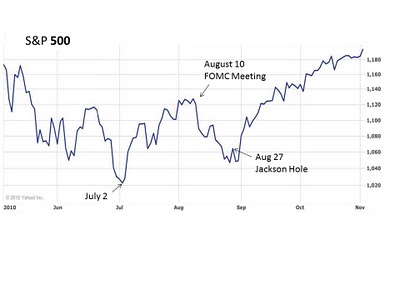
Next consider stock prices. The third chart shows the S&P 500 index over the same period. Observe that the current rally began in early July as shown in the chart. Evidently concerns about a double dip recession had diminished by early July and earnings reports began improving. From July 2 to August 10 the S&P 500 rallied by 10 percent. That rally was temporarily interrupted starting on August 10, but then continued. From August 10 to November 2 the S&P 500 rose another 7 percent.


Any assessment of the impact of anticipations of QE2 on stock prices depends crucially on how one interprets this rally and the interruption around August 10. It is important to note that August 10 was the day of the FOMC meeting where the Fed first indicated it would reinvest the maturing mortgage backed securities into the Treasury market, so this first hint of quantitative easing had a negative impact on stock prices. This was also the meeting where the Fed appeared to be very downbeat about the economy and revealed considerable dissention among FOMC members about how policy decisions would be made going forward. Jon Hilsenrath later wrote about this meeting in detail in the Wall Street Journal calling it “among the most contentious in Ben Bernanke’s four and a half year tenure as central bank chairman.” Hence, the large negative impact on stock prices is understandable.

Ben Bernanke’s August 27 Jackson Hole speech was helpful in this regard because it undid the damage of the August 10 meeting, as I argued at the time, by presenting a transparent framework for making decisions and conveying the image of a more functional FOMC than portrayed, for example, in Hilsenrath’s article. So in my view, the consistent story is that the August stock market dip was Fed-induced and its reversal was also Fed-induced. In contrast an explanation based on anticipations of quantitative easing is inconsistent because stock prices went one way on August 10 and another way on August 27.

In any case these interest rate and stock price data raise doubts about the narrative that long-term interest rates fell and stock prices rose in anticipation of QE2. As with all the other stimulus programs tried in recent years, it is important to get the narrative right, and more empirical work is welcome.

Posted in Monetary Policy | Comments Off on Empirical Questions About the Anticipation Effects of QE2

Certainly Milton Friedman Would Not Have Supported QE2

Many have asked whether Milton Friedman would have favored the type of massive quantitative easing which the Fed embarked on today. I have argued that he would not. In tomorrow’s Wall Street Journal, Allan Meltzer addresses the question and concludes even more forcefully: “I am certain he would not.” See also the piece in today’s Financial Times by Martin Feldstein with similar criticism of quantitative easing.

One issue which is not addressed by these pieces is the argument that the rise in the stock market since late August, when Ben Bernanke started the march toward QE2 at Jackson Hole, is evidence in support. I view the stock market behavior differently. The recent rally began in July, but was interrupted by the highly argumentative and downbeat FOMC meeting on August 10, which Bernanke clarified in Jackson Hole on August 27, and then the rally continued, bolstered by good earnings reports and strong growth abroad, not, in my view, by anticipations of quantitative easing.

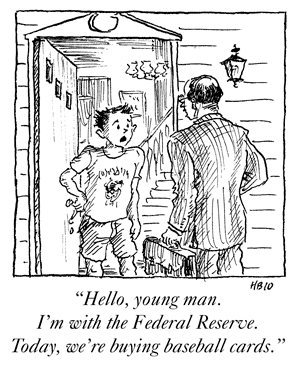
But at times like these we need a little humor. This cartoon is from the collection of Hank Blaustein posted on Jim Grant’s Interest Rate Observer web page, where you can purchase this and other cartoons in a 4″ x 4″ reproduction, signed by the artist.

Posted in Monetary Policy | Comments Off on Certainly Milton Friedman Would Not Have Supported QE2

More Evidence on Why the Stimulus Didn’t Work

Polls show that most Americans don’t believe that the stimulus package worked, but debate continues among economists. The most debated issue is the size of government purchases multiplier. Suppose that the government purchases multiplier is 1.5. Then Economics 1 students learn that the change in GDP due to an increase in government purchases is found by multiplying the change in government purchases by 1.5. That is:

change in GDP =1.5 times change in government purchases

Government purchases include spending on items such as infrastructure, law enforcement, and education, but do not include interest and transfer payments. (A derivation is in Ch. 23 appendix of the Taylor-Weerapana principles text.)

The example of 1.5 is at the upper range of estimates, and was used in a paper by Christina Romer and Jared Bernstein to estimate the impact of the American Recovery and Reinvestment Act of 2009 (ARRA). However, John Cogan, Volker Wieland, Tobias Cwik, and I found that the multiplier in the case of ARRA was much smaller, around .7. Robert Barro argues that it is zero. So there is debate.

But few have focused on the second term in the above multiplier formula: the change in government purchases due to ARRA. John Cogan and I have been tracking data on the changes in government purchases since ARRA was passed, using a new data series provided by the Commerce Department. We just finished a working paper reporting the details of our findings, which provide additional evidence that the stimulus has not worked and, just as important, on why it has not worked.

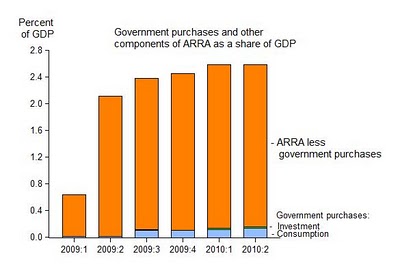
Despite the gigantic $862 billion stimulus package, the change in government purchases due to ARRA has been immaterial to the economic recovery: government purchases increased by only 2 percent of the $862 billion package ($18 billion). Infrastructure was even less at $2.4 billion. There has been almost no change in government purchases for the multiplier to multiply. It’s no wonder people don’t think the stimulus worked. And the size of the multiplier is largely irrelevant!

Our research looks at both federal and state and local purchases. Federal purchases due to ARRA reported by the Commerce Department are very small. We also find that large ARRA grants to the states did not increase state and local government purchases at all. To check our results we traced where the grant money went (it went mainly to reduce state borrowing) and we considered counterfactuals (in the absence of ARRA, government purchases would likely have been higher). The chart below summarizes the findings with all the government purchases at the federal level. The implication of this research is not that the stimulus program was too small, but rather that such countercyclical programs are inherently limited by feasibility constraints of the federal system. John Cogan and I first reported these results in a preliminary way over a year ago in a September 16, 2009 a Wall Street Journal article with Volker Wieland, entitled “The Stimulus Didn’t Work”. Though ARRA data were then only available through the second quarter of 2009, it was clear to us that government purchases were not contributing to the recovery, and we reported that “there is no plausible role for the fiscal stimulus here.” Many dismissed our conclusion, saying it was too soon to judge. Another year of data has confirmed our results as we explain in our new working paper.
Posted in Stimulus Impact | Comments Off on More Evidence on Why the Stimulus Didn’t Work