A Diverse and Wide Open Hearing on Fed Reforms

The House Domestic Monetary Policy subcommittee, with Ron Paul in the chair, is holding hearings tomorrow (May 8) on six proposed bills to reform the Fed. The bills are remarkably diverse ranging from Ron Paul’s Federal Reserve Board Abolition Act to Barney Frank’s bill to remove the Fed district bank presidents as voting members on the FOMC and replace them with appointees of the president of the United States.

Two of the bills (Kevin Brady’s and Mike Pence’s) would refrom the Fed’s dual mandate, which in my view would help the Fed get back to more a rules-based policy with fewer of the recent discretionary interventions which have proved so harmful. The Brady bill would go further and restrict the degree to which the Fed can purchase large quantities of mortgages and other non-Treasury securities. Kevin Brady and Barney Frank will be there to defend their own bills, and Ron Paul will be able to do so as the chair.

The witnesses for this hearing also have very diverse views: two economists from the Austrian school: Jeffrey Herbener and Peter Klein, as well as Jamie Galbraith, Alice Rivlin and me. All the written testimonies are posted on the House Financial Services Committee website.

Regardless of the disagreements one might have with specific proposals or individual witnesses, the subcommittee should be thanked for placing monetary policy reform issues in a prominent place in the public debate and for endeavoring to keep the debate wide open.

Posted in Monetary Policy | Comments Off on A Diverse and Wide Open Hearing on Fed Reforms

Talk about Economic Successes and Follies

Russ Robert’s latest EconTalk is about my new book First Principles. As with so many of Russ’s EconTalk interviews, he quickly gets to the heart of the matter and spends a good part of interview on the “naming names” sections of the book including the chapter “Who Gets Us In and Out of These Messes?”

This part of the book is based on my personal experiences in Washington with policymakers such Alan Greenspan, Paul O’Neill, Charlie Schultze, or on long discussions with current or former colleagues such as George Shultz and Milton Friedman who were involved in making decisions in earlier times.

As Russ brings out in the interview, it’s important to try to identify policymakers who stuck to, or ignored, or compromised on the principles and then draw lessons from successes and mistakes. The history shows that neither political party wholly owns the successes or the mistakes.

The issues are quite relevant to the current situation as Gene Epstein brings out in this recent Barron’s interview with me, appropriately titled Fiscal Follies and Monetary Mischief.

Posted in Regulatory Policy | Comments Off on Talk about Economic Successes and Follies

Debate and Evidence on the Weak Recovery

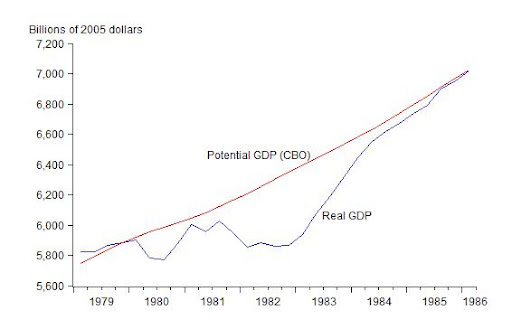
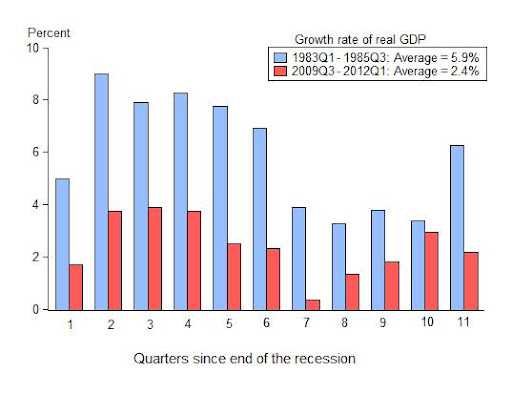
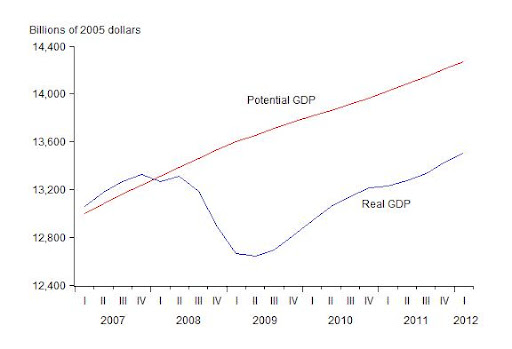
Last week’s GDP release is yet more evidence that this recovery has been remarkably weak, and has been so from the start—averaging only 2.4 percent in the 11 quarters since the recovery began. See my updated charts below with a comparison with the 1983-85 recovery. Debate about the causes of the weak recovery continues, however, with some still blaming the severity of the downturn and the financial crisis and others blaming economic policy. Indeed this was a big part of the recent debate at Stanford between me and Larry Summers which is now available on video.

Economic historian Mike Bordo, who is visiting at Hoover and Stanford this year sheds new light on the subject in a recent working paper with Joseph Haubrich of the Federal Reserve Bank of Cleveland. In a study of U.S. business cycles they find that deep recessions have always been followed by strong rather than weak recoveries and that this is also the case when there are severe financial crises. So history is not on the side of those who blame the preceeding deep recession and financial crisis. Other factors have likely been at work.

Posted in Slow Recovery | Comments Off on Debate and Evidence on the Weak Recovery

New Model Validation of Stimulus Impacts

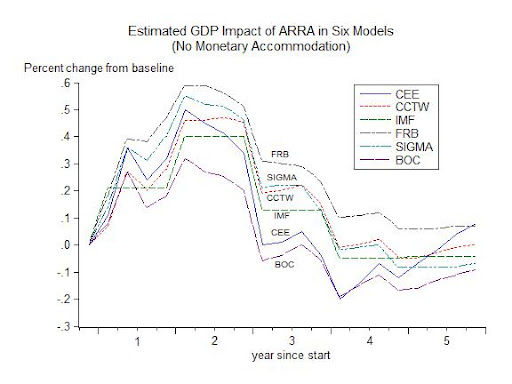
A paper just published in the American Economic Journal: Macroeconomics sheds additional light on the Keynesian multiplier debate, which has surged since the 2009 stimulus package—ARRA—was enacted. In January 2009 Christina Romer and Jared Bernstein released a widely-cited paper showing that the multiplier for ARRA would be quite large. In February 2009, John Cogan, Tobias Cwik, Volcker Wieland and I (CCTW) released a paper showing that more modern “New Keynesian” models implied a much smaller multiplier. Since then many papers have been written including a paper by Christiano, Eichenbaum and Rebelo which found larger multipliers in the Christiano, Eichenbaum, and Evans (CEE) New Keynesian model. The debate has focused on the size of the government purchases multiplier.

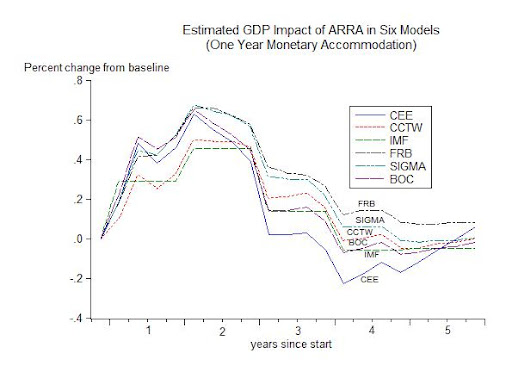
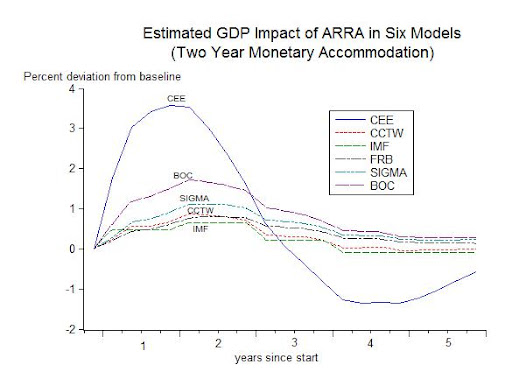
The new paper, Effects of Fiscal Stimulus in Structural Models, is written by 17 authors from central banks and international institutions around the world (Guenter Coenen, Chris Erceg, Charles Freedman, Davide Furceri, Michael Kumhof, René Lalonde, Douglas Laxton, Jesper Lindé, Annabelle Mourougane, Dirk Muir, Susanna Mursula, Carlos de Resende, John Roberts, Werner Roeger, Stephen Snudden, Mathias Trabandt, and Jan in’t Veld). As part of the research reported in the paper the authors compare the CCTW and the CEE estimates of ARRA with four estimated “New Keynesian” structural models of the kind used in practice by policymakers and their staffs. The other four models are:

Bank of Canada’s GEM model (BOC)
Fed’s FRBUS model (FRB)
Fed’s SIGMA model (SIGMA)
International Monetary Fund’s GIMF model (IMF)

Coenen and his colleagues simulated all 6 models in order to contrast and compare the impact of ARRA (using same time profile of government purchases first used by CCTW). The results for GDP are shown in the following three graphs (which correspond to Figure 7 of Coenen et. al. and refer to the US with three different levels of monetary accommodation). Observe that the four policy models confirm or validate the original CCTW estimates in the sense that they cluster around CCTW. In the case of the two year monetary accommodation the CEE model is a large outlier.

Posted in Stimulus Impact | Comments Off on New Model Validation of Stimulus Impacts

References to Policy Rules in a Speech by the Fed Vice Chair

In a speech to the Money Marketeers in New York City this past week, Fed Vice Chair Janet Yellen gave a useful description of how she and other policy makers are thinking analytically about monetary policy. The speech referred extensively to monetary policy rules, and I hope it generates more discussion of policy rules and strategies both within and outside the Fed. I have argued the the Fed has moved too far in a discretionary direction, and if it is going to move back to a rules-based policy, this is the kind of discussion that has to take place.At this point I would only comment on two issues, both related to references to the Taylor rule in the speech.

First, the speech indicates that I proposed two different policy rules for the federal funds rate, one in a paper published in 1993 and the other published in 1999. As Janet Yellen puts it, “John Taylor has proposed two simple and well-known policy rules.” She then goes on to consider what she refers to as the Taylor (1993) rule and the Taylor (1999) rule. However, I did not propose or advocate another rule in 1999, as I emphasized after similar statements were made at a Senate Banking Committee hearing with Ben Bernanke in March of last year.

In the 1999 paper which Janet Yellen refers to, I did examine two rules: one which I described as the “policy rule I suggested” and another which I said “others have suggested.” The “others” were people at the Fed, and I did not propose this other rule. It is important to correct the record because the “others have suggested” rule has a much larger coefficient on the GDP gap and is therefore more likely to generate zero interest rates now and be used to rationalize quantitative easing.

Second, in the graphs contained in the speech Janet Yellen has the Taylor rule showing zero or below now and for quite a while longer. But if you assume inflation of 2 percent, the Taylor rule implies that the funds rate should be 1 percent even if you assume an output gap of negative 6 percent.  (1 = 1.5X2 + .5X(-6) + 1). The implied rate is higher for a smaller gap of 4 percent.

Posted in Monetary Policy | Comments Off on References to Policy Rules in a Speech by the Fed Vice Chair

Policy Failure and the Great Recession

 The debate about the causes of the financial crisis and the great recession will continue for many years, and the facts and analysis that Robert Hetzel put forth in his new book The Great Recession: Market Failure or Policy Failure? should now be part of that debate. As I said in my comments for Cambridge University Press, “Hetzel applies his experience as a central banker and his expertise as a monetary economist to make a compelling case for rules rather than discretion, showing that ‘monetary disorder’ rather than a fundamental ‘market disorder’ is the cause of poor macroeconomic performance. At the same time, he acknowledges and discusses disagreements among those who argue for rules rather than discretion.”a

One area of disagreement among those who agree that deviations from sensible policy rules were a cause of the deep crisis is how much emphasis to place on the “too low for too long” period around 2003-2005—which, as I wrote in Getting Off Track, helped create an excessive boom, higher inflation, a risk-taking search for yield, and the ultimate bust—compared with the “too tight” period when interest rates got too high in 2007 and 2008 and thereby worsened the decline in GDP growth and the recession.

In my view these two episodes are closely connected in the sense that if rates had not been held too low for too long in 2003-2005 then the boom and the rise in inflation would likely have been avoided, and the Fed would not have found itself in a position of raising rates so much in 2006 and then keeping them relatively high in 2008. For example, if the Fed had raised the federal funds rate above 1 percent earlier (in 2003 and 2004) then the inflation rate would likely not have picked up as much and the Fed would not have felt the need to take the federal funds rate above 4 percent or keep it high. But in reality the Fed overshot and took the funds rate to 5-1/4 percent and held it there until just before the recession began. This is what I was referring to in Thursday’s Wall Street Journal piece when I said the Fed “overshot the needed increase in interest rates, which worsened the bust.”

Hetzel bases his assessment of policy in 2003-2005 on a policy rule which he calls “LAW (leaning against the wind) with credibility.” Conceptually LAW with credibility differs from a Taylor rule in that interest rate changes are based on changes in GDP rather than the level of GDP compared with potential GDP. (The advantage is that you do not have to estimate potential GDP, which of course is difficult to do.)

In his book, Hetzel suggests that using a LAW rule with a given price stability goal does not indicate that policy was too easy in 2003-2004. However, as he argues on page 197 of the book, the Fed seemed to have relaxed its price stability goal at this time, so in this sense policy may have actually been too easy, and in fact inflation did rise. Hetzel was working at the Fed and thus speaks with considerable personal knowledge. Here is how he puts it:

“In 2003-2004, the Greenspan FOMC did make a decision that would later have enormous implications. At this time, the FOMC backed off its long-run objective of returning to price stability and instead adopted an ill-defined objective of positive inflation, perhaps best characterized as 2 percent plus…. Starting in spring 2004, both core and headline PCE inflation moved persistently above 2 percent…. By summer 2008, that overshoot caused the FOMC to allow a growing negative output gap to persist by holding the funds rate unchanged at 2 percent. If the FOMC had maintained its target for price stability….the sustained inflation shock that began in summer 2004 with increases in energy prices would have yielded lower headline inflation. The FOMC in summer 2008 might have then felt comfortable allowing the inflation shock to pass through the price level while aggressively using monetary policy to deal with the worsening recession.”

So with this interpretation, there is a clear connection between the too easy period and the too tight period, much like the connection between the “go” and the “stop” in “go-stop” monetary policy, which those who warn about too much discretion are concerned with. I have emphasized the “too low for too long” period in my writing because of its “enormous implications” (to use Hetzel’s description) for the crisis and the recession which followed. Now this does not mean that people are incorrect to say that the Fed should have cut interest rates sooner in 2008. It simply says that the Fed’s actions in 2003-2005 should be considered as a possible part of the problem along with the failure to move more quickly in 2008.

In this regard Scott Sumner recently raised some good questions about the part of my analysis on the crisis, where I wrote that one possible unintended consequence of the Fed’s large unanticipated interest rate cut in early 2008 was the decline in the dollar and associated jump in oil and gasoline prices (which were clearly a factor in accelerating the downturn). There were many discretionary moves during this period, but in the part of my analysis Sumner refers to I was discussing interest rates. Recall that on January 22, 2008 the FOMC cut the federal funds rate by 75 basis points in one day, which was most unusual and certainly unanticipated. It was not on an FOMC meeting day, which made it particularly unusual.

The Fed was apparently concerned about stock market turbulence which was later associated with a large trading loss and panic selling incident caused by a single trader Jérôme Kerviel at Société Générale. I was concerned that such a discretionary move tied to stock prices could have adversely affected the Fed’s credibility regarding the dollar and thereby affect oil prices. It was one of many discretionary moves I wrote about, emphasizing that “It is difficult to assess the full impact of this extra sharp easing, and more research is needed” Given that more than four years have transpired, more research is still needed, and I appreciate Scott Sumner raising the issue. In my view the issue is best viewed as only one part of a massive switch away from rules and toward discretion over a number of years, and, as Hetzel’s emphasizes in his book, this is the kind of monetary policy that generally leads to poor economic performance.

Posted in Regulatory Policy | Comments Off on Policy Failure and the Great Recession

A Little Dynamic Scoring of the House Budget

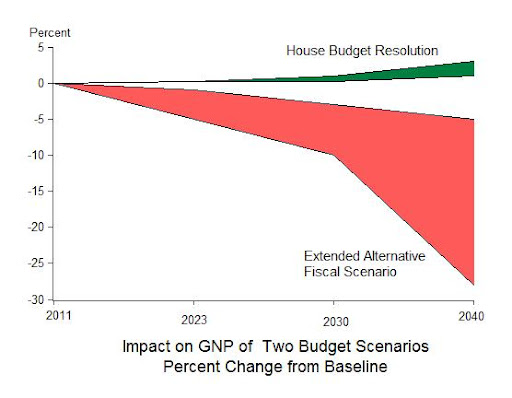
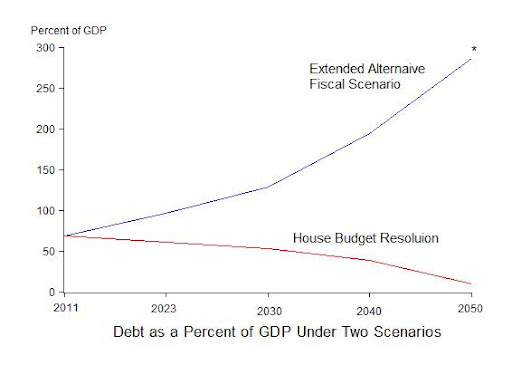
In a recently released report the Congressional Budget Office calculated how debt reduction with the House Budget Resolution (which just passed the House today), would affect GNP in the United States. The CBO took the spending and tax parameters from the House Budget Committee staff and computed the resulting deficit and debt. They then compared the debt path under the House budget with the debt path under their “extended alternative fiscal scenario, which is their description of current law and its most likely extensions. They then estimated the effect of the different debt levels on economic output.  This is a “little” dynamic scoring in the sense that other positive effects of lower marginal tax rates and other incentives in the House budget plan are ignored. 
Nevertheless, CBO reports that the reduced level of debt has large positive economic effects. I created the following “fan charts” to illustrate this.

The fan charts represent the range of uncertainty as reported by CBO. If you take the midpoint of the fan charts, you will find that GNP is 19 percent greater in 2040 under the House plan and the gap continued to grow after that. That is about $5.6 trillion per year and growing. The difference is three times the maximum annual loss of output under the Great Recession, but it continues year after year.

The difference in the federal debt as a fraction of the economy under the two scenarios is shown in the next chart. While CBO projections go through 2050 under the House plan, the CBO does not report numbers greater than 200 percent of GDP in the alternative fiscal scenario. In the chart, I estimated the actual percent by extrapolating the 2011 Long Term Scenario and showing the little star. But no matter how you look at it, the effect on the debt and thus the economy is huge. 
Posted in Fiscal Policy and Reforms | Comments Off on A Little Dynamic Scoring of the House Budget

More Debates about the Stimulus Debate

In a blog post yesterday Paul Krugman repeats a claim made by Christina Romer (in footnote 18 of a speech at Hamilton College last November) which he says answers “in devastating fashion” the empirical paper by John Cogan and me which shows that stimulus (ARRA) grants led to lower net borrowing by state and local governments. But Romer’s claim actually provides no such answer or rebuttal.Romer argues that state balanced budget laws would have prevented states from increasing their borrowing by any significant amount in the counterfactual event that ARRA did not exist. Her argument does not apply to our paper for two reasons. First, state and local governments can increase and decrease their borrowing by considerable sums for infrastructure projects (schools, roads, light rail, etc.) within their balanced budget laws. Second, net borrowing (which is what Cogan and I examined) is the difference between the net increase in liabilities and the net acquisition of financial assets. As ARRA funds came in, state and local government increased their net acquisition of financial assets, and thereby reduced net borrowing compared to what they would have done in the absence of ARRA. Neither state balanced budget laws nor conditions in municipal bond markets, would, in the absence of ARRA, prevent the state and local government sector from increasing net borrowing simply by buying fewer financial assets.

So the point I made at the Harvard debate with Larry Summers stands: While state and local governments received substantial grants under the 2009 stimulus, a statistical analysis by John Cogan and me shows that they did not use these grants to increase their purchases of goods and services as many had predicted. Instead they reduced net borrowing and increased transfer payments. Even with balanced budget laws, state and local governments can borrow for infrastructure, and they borrowed less on a net basis during the stimulus period, while they put additional funds into financial assets.

Krugman’s post also refers to Mark Thoma’s comments on my recent blog post summarizing my opening remarks at the Harvard debate. Thoma criticizes me for focusing on what actually happened to the stimulus funds rather than just simulating existing models. But I think it is essential to look at what actually happened. While this may seem to leave open the theoretical possibility that some other hypothetical better-designed stimulus would have worked, the fact that the actual program was designed the same way as the one that did not work 30 years ago raises serious questions about the feasibility of some such hypothetical stimulus.

Both Thoma and Krugman were led to make these comments after reading John Cochrane’s post on the Harvard debate in which he raises good questions about observed state-by-state employment correlations.

Finally, last November I responded to several other misleading statements made about my research by Christina Romer in her Hamilton College speech.

Posted in Stimulus Impact | Comments Off on More Debates about the Stimulus Debate

Debating Stimulus and Harvard and Stanford

Larry Summers and I debated “Did Fiscal Stimulus Help the Economy?” at Harvard this week. There was no video streaming or recording, and I will not try to summarize the back and forth (which the overflow crowd seemed to enjoy), but here is a summary of things I said in my opening remarks. There will be a follow-up debate at Stanford on April 4 which will be recorded.

The issue we are debating today is central to economic policy. It’s an issue where there‘s obviously a great deal of disagreement. Students want to know why there’s disagreement, and the point-counterpoint of debate is an important way to learn. So I thank Harvard for sponsoring this debate, and I thank you all for coming.

I have been doing a lot of empirical research on the impact of discretionary Keynesian stimulus packages—the temporary and targeted packages intended to counter recessions and jump-start the economy by increasing government purchases, transfer payments, or tax rebates. I don’t find convincing empirical evidence that they helped the economy, or that they increased economic growth in any significant or sustained way. In fact, by increasing unpredictability about policy and by raising uncertainty about increased deficits and debt, they are likely to have harmed the economy.

Let me start with a few points of clarification:

First, I want to emphasize that I not saying that permanent or long-lasting changes in fiscal policy, such as tax reforms that lower marginal tax rates, cannot help the economy, or that the automatic stabilizers are ineffective. This debate focusses on temporary discretionary fiscal stimulus packages.

Second, I am not objecting to certain features of macroeconomic theory that are sometimes labeled Keynesian, such as that wages and prices are sticky, or that aggregate demand has a role in short run fluctuations, or even that people’s expectations matter, though I would emphasize that expectations have important rational characteristics. For me such complications—which I have been researching for many years—suggest the need for fewer discretionary policy actions and more systematic rule-like ones.

Third, I take a longer perspective than the February 2009 stimulus package and the related cash for clunkers and first time home buyer programs. There were also fiscal stimulus packages in 2008 and 2001, as well as in the 1970s.

The basic idea behind Keynesian stimulus packages is presented in basic college courses: A shift down in aggregate expenditures can be countered by increasing government purchases—augmented by possible multiplier effects—which shift up aggregate expenditures and fill the “gap.” Temporary changes in tax payments and transfers work the same way except that increased consumption is supposed to fill the gap.

Estimated macro models used for policy evaluation—whether old Keynesian or new Keynesian—have this basic mechanism built into them. However, they differ greatly in their predictions of the policy impact because of different assumptions about expectations, the marginal propensity to consume, the speed of price adjustment, and crowding out of other spending. For example, Christina Romer and Jared Bernstein used old Keynesian models to predict the effect of the stimulus package of 2009 before it was implemented. They predicted large effects of the package with multipliers around 1.5. In contrast, in research with John Cogan, Volker Wieland and Tobias Cwik, I used a new Keynesian model to predict the effects of the 2009 stimulus. We predicted a much smaller effect, with multipliers averaging 0.5, even less when you include transfer payments.

The problem with using these existing macro models to answer the question of this debate “Did fiscal stimulus help the economy?” is that they will simply repeat the same prediction story over and over again. You learn virtually nothing if you use the same models to evaluate the impact that you used to predict the impact.

So it is necessary to look at what actually happened, to look at the changes in aggregate consumption or GDP due to the stimulus packages, and that is what I have done. For the parts of the packages which include temporary tax rebates or temporary tax cuts I find no significant consumption effect using regression analysis and controlling for other factors that affect consumption. If you look at a chart of the tax rebates in 2008, for example, the evidence is striking: There was a big increase in personal disposable income at the time of the rebate, but no similar change in consumption. This is exactly what the permanent income or life cycle theories of Milton Friedman and Franco Modigliani tell us. People largely saved the injection of cash. The same thing is true for the 2001 and 2009 stimulus packages.

In the case of the 2009 stimulus package, there was also an attempt to increase significantly government purchases of goods and services. But the evidence is that this attempt largely failed. A special satellite account produced by the Bureau of Economic Analysis shows that federal infrastructure investment—at the peak quarter—increased by only .05 percent of GDP as a result of the stimulus and federal government consumption by only .14 percent.

While state and local governments received substantial grants under the 2009 stimulus, a statistical analysis by John Cogan and me shows that they did not use these grants to increase their purchases of goods and services as many had predicted. Instead they reduced net borrowing and increased transfer payments. Even with balanced budget laws, state and local governments can borrow for infrastructure, and they borrowed less on a net basis during the stimulus period, while they put additional funds into financial assets.

So when you look at what actually happened, you find that the stimulus packages in recent years did not help the economy; they did not significantly increase aggregate expenditures as the simple rationale for such Keynesian interventions suggests. Remarkably, economists found the same ineffectiveness when similar policies were tried and evaluated in the 1970s including a temporary tax rebate in the Ford Administration and stimulus grants to the states in the Carter administration. After studying the 1975 rebate, Ford’s own Council of Economic Advisers (I was on the staff) concluded that: “Tax reduction should be permanent rather than in the form of a temporary rebate,” and research by Ned Gramlich on the Carter stimulus grants to the states showed that they were not effective. By the end of the terribly performing 1970s, Robert Lucas and Thomas Sargent wrote their famous paper “After Keynesian Macroeconomics” and macro policy switched away from the focus such temporary fiscal stimulus packages. Not surprisingly, in my view, economic performance improved greatly for more than two decades. It is too bad we had to go through the recent revival of these ineffective policies to relearn what was known thirty years ago.
Posted in Stimulus Impact | Comments Off on Debating Stimulus and Harvard and Stanford

Getting Off Track and the Panic of 2008 Revisited

In a recent blog Paul Krugman, borrowing from the Economics of Contempt, takes on John Cochrane and me for our interpretations of the events leading up to the panic of 2008, and in particular my point that it was not the Lehman bankruptcy per se that was the underlying cause of the panic but rather the ad hoc and unpredictable policy leading up to and following the bankruptcy. The only evidence Krugman gives against my point is a plot of the “B of A Merrill Lynch US High Yield Master II Effective Yield” over a two year interval in which the crucial timings of the day to day movements are barely visible.

I first wrote about the panic of 2008 (including the Lehman bankruptcy, the AIG bailout, and the rollout of the TARP) in my book Getting Off Track: How Government Actions and Interventions Caused, Prolonged and Worsened the Financial Crisis, published three years ago in February 2009, which in celebration of the three year anniversary is now available as an e-book for only $2.40.

If you look at the charts in that book you will see a detailed consideration of the daily data. I focused on the spread between Libor and the overnight index swap (OIS), and showed that the major upward movements in this measure of stress occurred at the time of the TARP rollout. Moreover, this measure of risk peaked as soon as it was clarified that the TARP would be used for equity injections, suggesting that confusion about the TARP was a large source of the uncertainty and panic.

I wrote that the surprise of the bankruptcy (a consequence of the ad hoc nature of the policy) made things worse. Due to the careful work of Kimberly Summe we know that many creditors of Lehman did not have to go into bankruptcy, and while I referenced that fact it was not a major part of my argument and not even mentioned in Getting Off Track. That reference is now criticized under the claim that all those creditors were in turn bailed out, but that claim needs to be verified empirically.

To bolster the original case I also looked at daily movements in the S&P 500, as shown in this chart (drawn from my introductory economics text). Note that the S&P 500 was higher on the Friday after Lehman than the Friday before Lehman. Note also that the panic ends on Oct 13 when the operations of the TARP were clarified.

Posted in Financial Crisis | Comments Off on Getting Off Track and the Panic of 2008 Revisited