Who and What is to Blame for the Global Turbulence

The recent large impact of U.S. monetary policy on the rest of the world–especially emerging markets–has understandably been attracting a lot of attention in financial markets with headlines like:

Fear of Fed Retreat Roils India, WSJ, Aug 20

Istanbul Skyline Reflects Cheap Dollars Now Growing Scarce, NYT, Aug 21

Currency Depreciation Adds to Brazil Central Bank’s Inflation Worries, WSJ, Aug 21

Fluctuations In Currencies Roil Markets, NYT, Aug 21

The issue also came up yesterday in a press conference in Washington with Mohamed El-Erian, Shelia Bair and me, and it will be a big topic at Jackson Hole with a good paper by Helene Rey.

There are two ways to think about this, as Mohamed summarized at the press conference.  (The two views are presented in more detail in a paper I presented last June at the BIS.)

One view is that the US should do whatever it thinks it needs to do to get the American economy growing and this will be the best for the rest of the world.  This view is held by people at the Fed and in the Administration.  The implication, as Steve Rattner ‏@SteveRattner tweeted yesterday, is that “Emerging markets have no one to blame but selves for their problems.”  But it is not a popular view for emerging market central bankers who feel that “whatever it takes” policy is causing a lot of problems for them.

For the other view, consider what El-Erian said yesterday.  “We [in the United States] are at the middle, in the middle, of the global system, so we hold it together and therefore when we implement policies we need to think about the feedback loops to the rest of the world. And I think what happened today, to pick up on what John has said, if you look at the newspapers, is that the rest of the world finds it very difficult to navigate a world in which the US is behaving the way it is. And the result of that is that the most powerful engine of growth in the past few years—the emerging world —ok, is slowing down. And the reason why US companies have been able to do well despite the sluggish economy in the US is that they have been selling abroad. And now the risk is that we see increasing policy interference in countries like Brazil, in countries like Indonesia, countries like India, not because they have suddenly become inept, but because it is difficult to navigate in a global system which is so fluid that capital flowing in and out.…And that is very destabilizing to countries that have been pursuing pretty good policies so far.”

This view—which I share—implies that US behavior–such as the on and off unconventional monetary policies and their impact on capital flows, first out and now back–should at least share some of the blame.   The US did not create such problems when it was following more rules-based conventional policies during the great moderation period of the 1980s, 1990s and until recently. Then it was correct to say that the emerging markets had no one to blame but themselves. But many of these countries changed policies for the better. Unfortunately the US also changed policies, but more for the worse.

Posted in International Economics | Leave a comment

What to Call This Very Slow Recovery?

Economists love the word “Great” for significant economic events—such as The Great Depression—probably using it too much.  I’m as guilty as anyone. I used the terms Great Inflation and Great Disinflation for the late 1960s and 1970s inflation and its end, and Great Deviation for the harmful deviation from good economic policy in recent years. Researchers at the BIS, detecting similar developments in other countries are going global and calling it the Global Great Deviation.

For variety, back in the 1990s, I used the term The Long Boom to refer to the long period of nearly uninterrupted economic growth that began in the early 1980s. But, true to tradition, it didn’t stick.  Instead, The Great Moderation caught on.  Unfortunately the Great Moderation was killed by The Great Deviation which then gave birth to The Great Recession.

Now, keeping with tradition, Merle Hazard has named his new song about the Fed’s current problem of undoing its unconventional monetary policy The Great Unwind.  (It’s a great song by the way). I’ve been arguing for several years that uncertainty about this Great Unwind has been in part the cause of the very slow recovery.  Now already in its fifth year, there is plenty of evidence that this recovery has been unusually slow compared to recoveries from previous deep recessions in US history.

But what to call this very slow recovery?  Some call it The Not-So-Great Recovery, but will that stick?  Bob Hall calls it The Long Slump, which would be an especially good term if the Long Boom had been the preferred term for the Great Moderation.  How about the Great Slump? Following the book by Lee Ohanian, Ian Wright and me, it could be the Great Delayed Recovery, or simply, the Great Delay. Time will tell.

Posted in Slow Recovery | Leave a comment

Economics One for Preschoolers

Meghan Cox Gurdon has a nice review article in the Wall Street Journal celebrating Richard Scarry’s books for children. This is the 50th anniversary of “Richard Scarry’s Best Word Book Ever.”  I’ve been reading some of Scarry’s books to my grandson recently.  One thing Meghan skips over, which I really like (and I bet many Journal readers would too), is how Scarry brings basic economics—money, exchange, gains from trade, production, investment, saving, productivity, circular flow–into his stories in a way even preschoolers can understand.

Here is an example from the Scarry book “What Do People Do All Day?”  It shows Farmer Alfalfa selling some of his crops to the Grocer Cat for money, shown as nice big shiny  coins. (In another part of the book Grocer Cat sells the vegetables to other workers in town.)

people-money-scarry

Then on the next page (shown below) Alfalfa uses some of the money to buy a new suit from Stitches the tailor. He also buys a new tractor (investment) from Blacksmith Fox, so he can grow more food than he could before (yes, increase labor productivity!). Then he buys some presents for his family (consumption).  He puts the rest of the money into the Busytown bank. 

Scarry money

These pictures are from the 1968 edition.  They do not have the part about the bank making too many risky loans and then being bailed out by the government as in the fall of 2008.  Of course, you can explain this to the kids by saying that Busytown bank is not a too-big-to-fail bank, like the banks in the big city.  So piggy, who owns and runs the bank, is not expecting a bailout and thus is not so foolish to make so many risky loans.

There are not many children’s books with economics so explicit. Another is “Caps for Sale: A Tale of a Peddler,  Some Monkeys and Their Monkey Business,” which I once gave a graduation speech about.

Posted in Teaching Economics | Leave a comment

Crawling Along

It wasn’t any fun updating my charts this morning with the new data released this week.  None of the charts looked better and some looked worse.

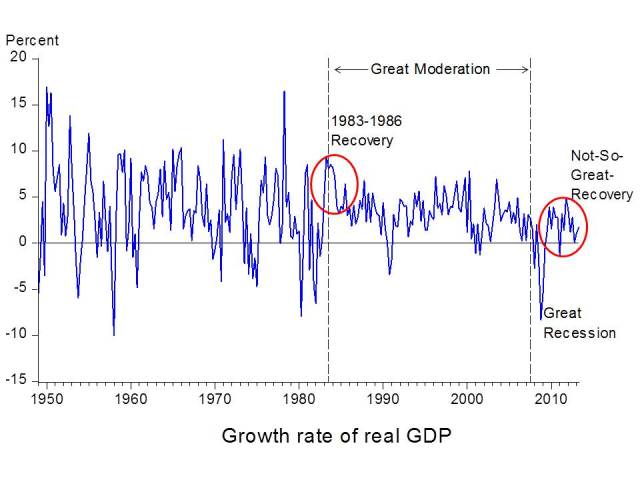
The EKG chart showing real GDP growth quarter-by-quarter over the decades remains as tragic and worrisome as ever. You can see the stability of the Great Moderation fading into the past, followed by the Great Recession and now by the Not-So-Great-Recovery.   EKG

I argue that the Great Moderation’s demise came from a Great Deviation of policy from what worked well in the 1980s, 1990s, and until recently.  There’s a Great Debate over that view, of course, but it gives a reason for some optimism.  If the poor economic performance is caused by policy, it can be reversed by a change in policy.

The bar chart shows how the growth rate in the Not-So-Great-Recovery compares with the 1980s.  The average growth rate over the past four years–little changed with the revised data (2.2% compared with 2.1%)–is still much lower than the 5.2% in the comparable four years of the 1980s recovery. But we now see that we had a near double dip recession in the first quarter of 2011, and that growth in the first three quarters of 2011 was only 1.1 percent.

growth comp 80s 2013q2

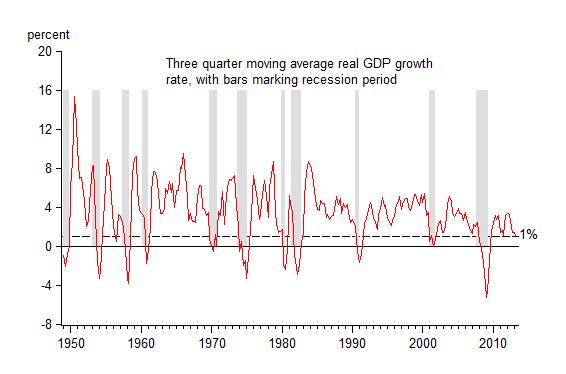
The worrisome part is that growth in the past three quarters was even lower. You have to go back 6 decades (to 1956Q3) to find a slower three quarter growth rate that was not part of an actual recession!  I illustrate this in the next chart which shows 3-quarter average growth with recessions marked off.

3quartergrowth

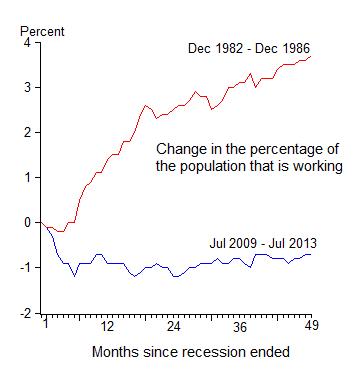
Finally, the chart of the change in the employment-to-population ratio—the percentage of working age population that is actually working—still reveals no sign of a takeoff.  The ratio is still lower than at the start of the recovery.  The increase in jobs is not enough to employ a greater fraction of the working population.  The labor force participation rate has continued to decline.

emptopopjul13

Posted in Slow Recovery | Leave a comment

Don Kohn on Rules-Based Monetary Policy

President Obama just widened the race for Fed chair. Up on Capitol Hill he mentioned Don Kohn along with Larry Summers and Janet Yellen. So we should widen the hunt for things that Don has said that help answer the key question I asked in a recent blog about Summers and Yellen: “who is more most likely to implement a monetary policy that will help keep us out of a serious financial crisis, and create price and output stability more generally. In other words who will implement a more predictable, less interventionist, more rules-based monetary policy strategy of the kind that has worked well when tried, as in the 1980s, 1990s and until recently?”   

I know that Don has thought deeply about rules-based monetary policy. As Don put it in a 2007 speech at the Dallas Fed, he and I “have spent countless hours discussing how the Federal Reserve arrives at decisions about monetary policy and how it should arrive at decisions.  Those conversations began in earnest in the late 1980s, when [I] was on the Council of Economic Advisers, and they have continued to the present day.  They have occurred not only in offices and classrooms in Washington and Stanford and at numerous conferences around the globe, but also around dinner tables in Washington and Palo Alto and on hiking trails from Vermont to Wyoming.”

In that same speech Don listed “Three Benefits of Simple Rules in Monetary Policymaking.” I’ll just quote the key phrases without comment, so you can get a sense of what Don says in his own words.

First, “a simple rule…can provide a useful benchmark for policymakers.  It relates policy setting systematically to the state of the economy in a way that, over time, will produce reasonably good outcomes on average.” 

Second, “simple rules…help financial market participants form a baseline for expectations regarding the future course of monetary policy.” 

Third, “simple rules can be helpful in the central bank’s communication with the general public.  Such an understanding is important for the transmission mechanism of monetary policy.” 

But Don points out that “Simple rules have limitations…” He mostly uses the Taylor rule as an example: 

First, “the use of a Taylor rule requires that a single measure of inflation be used to obtain the rule prescriptions…. To be sure, over long periods, most of these measures behave very similarly.  But policy is made in the here and now, and the various indexes can diverge significantly for long stretches, potentially providing different signals for the appropriate course of monetary policy.

Second, “the implementation of the Taylor rule and other related rules requires determining the level of the equilibrium real interest rate and the level of potential output; neither of them are observable variables, and both must be inferred from other information.” 

Third, “using simple rules for monetary policymaking stems from the fact that, by their nature, simple rules involve only a small number of variables.  However, the state of a complex economy like that of the United States cannot be fully captured by any small set of summary statistics.” 

Fourth, “simple policy rules may not capture risk-management considerations.  In some circumstances, the risks to the outlook or the perceived costs of missing an objective on a particular side may be sufficiently skewed that policymakers will choose to respond by adjusting policy in a way that would not be justified solely by the current state of the economy or the modal outlook for output and inflation gaps.”   

Don “offered this analysis in the spirit of so many of the discussions” I had with him.  While his bottom line was that “it’s not so simple to use simple rules!” you really get the sense that he would like to do so.

Posted in Monetary Policy | Leave a comment

Policy Uncertainty Makes Firms Reluctant to Hire: New Evidence

I have been arguing that economic policy–in particular policy unpredictability or uncertainty–has been a factor in the slow recovery.  That’s the main theme of the book I edited with Lee Ohanian and Ian Wright. A chapter by Scott Baker, Nick Bloom, and Steve Davis in that book discusses a measure of policy uncertainty that supports this view empirically.

Further support now comes from two San Francisco Fed economists, Sylvain Leduc and Zheng Liu, who have uncovered a relationship between firms’ reluctance to hire workers and the level of policy uncertainty.  In their paper Uncertainty and the Slow Labor Market Recovery, they present “evidence that heightened uncertainty about economic policy during the recovery made businesses more reluctant to hire workers.”

The following chart from the paper shows that their measure of recruiting intensity has been low while the measure of policy uncertainty has been high.  Moreover, the relationship between vacancies and unemployment has shifted (this is the Beverage curve shifter) in the direction of higher unemployment.

SF Fed uncertainty

The magnitude of the effect is significant: They find that the unemployment rate is about 1.3 percentage points higher because of policy uncertainty.

Posted in Slow Recovery | Leave a comment

About Rules-Based Monetary Policy: Summers versus Yellen

The financial press has narrowed down the race for the next Fed Chair to Larry Summers and Janet Yellen. Though there are other candidates with Democratic credentials, such as Alan Blinder and Tim Geithner, most stories are about a pairwise comparison: Between Summers and Yellen, who is closer to Barack Obama, more able to get along with Wall Street, more dovish, or better able to intervene in a serious financial crisis?

But the most important question is who is more likely to implement a monetary policy that will help keep us out of a serious financial crisis, and create price and output stability more generally. In other words who will implement a more predictable, less interventionist, more rules-based monetary policy strategy of the kind that has worked well when tried, as in the 1980s, 1990s and until recently?

Janet Yellen has spoken at length about this issue, and though Larry Summers has recently been in “radio silence” mode, he did discuss the issue in a debate I had with him last year at Stanford.  So there is a basis for comparison using each person’s own words. And because Summers and Yellen both chose to discuss rule-like policy in terms of the Taylor Rule, it is not an apples and oranges comparison.

Here is what Janet Yellen has been saying about rules-based monetary policy, drawn from her speech of last November:

Many studies have shown that, in normal times, when the economy is buffeted by typical shocks—not the extraordinary shock resulting from the financial crisis—simple rules can come pretty close to approximating optimal policies. In fact, empirical research suggests that a modified version of the original Taylor rule fits the behavior of the Fed reasonably well from the late 1980s until the financial crisis. Given that participants in financial markets are familiar with both the FOMC’s historical behavior and simple rules, the communications challenges might arguably be less severe if the FOMC followed such a strategy. To be sure, I would never advocate turning over monetary policy to a computer, but why shouldn’t the FOMC adopt such a rule as a guidepost to policy?  The answer is that times are by no means normal now, and the simple rules that perform well under ordinary circumstances just won’t perform well with persistently strong headwinds restraining recovery and with the federal funds rate constrained by the zero bound.

So, though Yellen rationalizes the departure from rules-based policy, she at least wants to get back to rules-based policy in normal times, largely because that will help, in her view, maintain greater macroeconomic stability.

In contrast, here is what Summers said at the Stanford debate (based on a video recording):

The Fed’s job is to set monetary policy and it may or may not have done the right job….Look, on monetary policy I have enormous respect for the Taylor Rule, but it is not yet the law of the land.  So to call the failure to follow the Taylor Rule an argument that the government is somehow acting excessively and being the cause of the problem…  I mean, yes.  I think government should act more wisely in their macroeconomic policies.  I think we probably can agree on that proposition.  And I’m not choosing to argue with you on the proposition that the Taylor Rule would have represented more wise monetary policy at some point…. Look, are there things that were done in the wake of crisis that in with the benefit of hindsight you would have done differently?  Of course.  …was the right policy to have less government?  I don’t see how you can come down on any side other than, thank God we had an activist government.

Like Yellen, Summers rationalizes the recent discretionary deviations from rules-based policy as due to special factors, but his words reveal less willingness to endorse a rules-based policy strategy, even in normal times, with a preference that government officials should simply “act more wisely” in their discretionary interventions.

Posted in Monetary Policy | Leave a comment

The Apple E-book Price Fixing Case: A Teaching Moment

The recent Apple e-book prize-fixing case made surprisingly little news, but it’s a very interesting example for teaching (in Economics 1 or other courses) about market power, pricing, and antitrust policy. It is also a fascinating story involving behind the scenes conversations between Steve Jobs, his colleagues at Apple, Rupert Murdoch and the other publishing executives. And you run into smart economists on opposite sides of the issue, such as Orley Ashenfelter and Richard Gilbert, serving as expert witnesses at the trial.

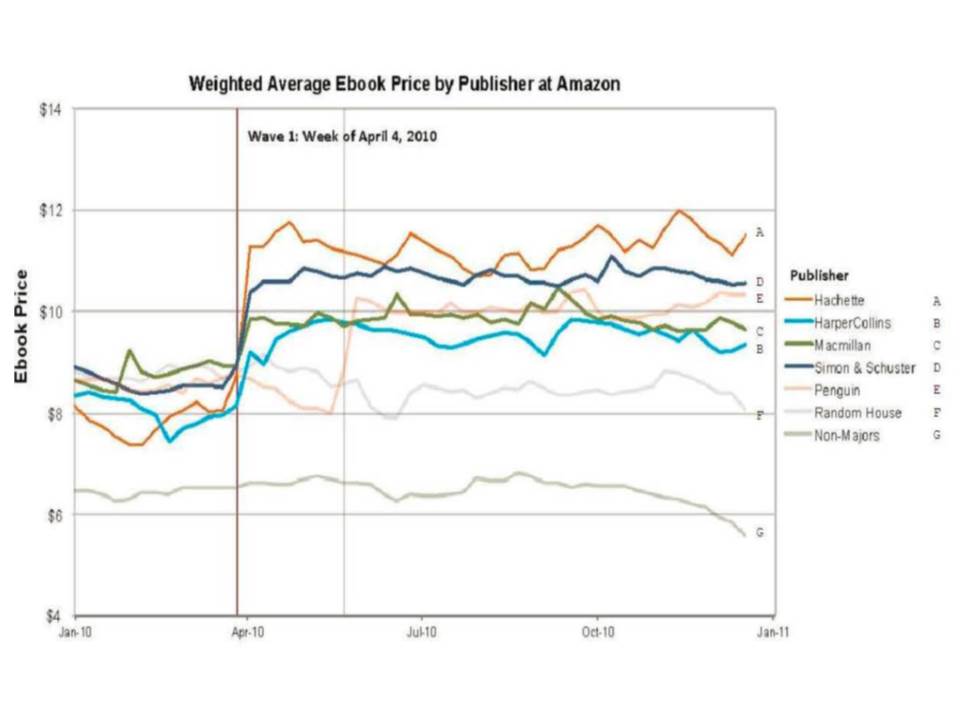
The case relates to Apple’s entry into the ebook market in early 2010 and the closely associated increase in the price of ebooks, including at Amazon.  Here is a chart showing the increase in prices at that time:

Pub price

The policy issue relates to what role Apple had along with the book publishers in bringing about the price increase.

The court (Judge Denise Cote) found “by a preponderance of the evidence that Apple conspired to restrain trade in violation of Section 1 of the Sherman Act.”   She writes that “Compelling evidence of Apple’s participation in the conspiracy came from the words uttered by Steve Jobs, Apple’s founder, CEO, and visionary.”

Though quite long, Judge Cote’s full opinion is actually a pretty good read.  It includes such passages as this:

“On January 27, Jobs launched the iPad…. As part of a beautifully orchestrated presentation,…To show the ease with which an iTunes customer could buy a book, standing in front of a giant screen displaying his own iPad’s screen, Jobs browsed through his iBooks “bookshelf,” clicked on the “store” button in the upper corner of his e-book shelf display, watched the shelf seamlessly flip to the iBookstore, and purchased one of Hachette’s NYT Bestsellers, Edward M. Kennedy’s memoir, True Compass, for $14.99…. When asked by a reporter later that day why people would pay $14.99 in the iBookstore to purchase an e-book that was selling at Amazon for $9.99, Jobs told a reporter, ‘Well, that won’t be the case.’ When the reporter sought to clarify, ‘You mean you won’t be 14.99 or they won’t be 9.99?’ Jobs paused, and with a knowing nod responded, ‘The price will be the same,’ and explained that ‘Publishers are actually withholding their books from Amazon because they are not happy.’”

Posted in Regulatory Policy | Leave a comment

Cross-Checking “Checking in on the Taylor Rule”

In Jared Bernstein’s interesting recent piece “Checking in on the Taylor Rule and the Fed,” he writes that the federal funds rate has been “camping out at between -1 and -2 percent” according to the Taylor Rule.

He then goes on to give this definition the Taylor Rule: The federal funds rate should equal

                                                       2 + p + 0.5(p – 2) + y  

where p is year-over-year percent change in the PCE inflation index and y is the output gap: 2*(nairu-unemp) where 2 is the Okun coefficient and the nairu is from CBO.

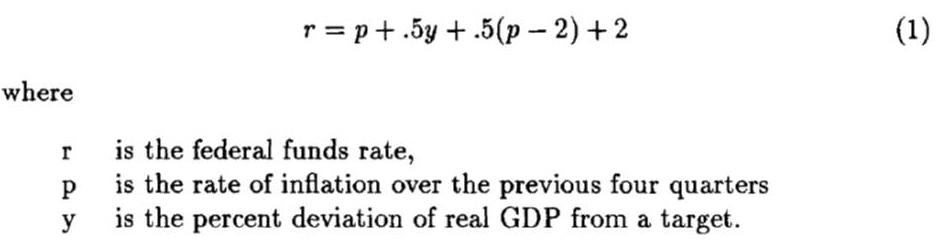
But this is not the policy rule I recommended in a 1993 paper using a formula which has come to be called the Taylor Rule. Here is the formula copied from that paper*

equation

The two equations may looks similar, but there is a key difference. Bernstein’s formula leaves off the .5 coefficient on y.  Thus, he effectively doubles the impact of the output gap on the interest rate compared to what I recommended then—and still recommend now.

How much difference does this make?  For the first quarter of this year, I calculate that Bernstein’s output gap (y) is about  -4.4% [that is, 2*(5.5- 7.7)]. So if you use 0.5 rather than 1.0 for the coefficient on y, the interest rate would be 2.2 percentage points higher than Bernstein calculates. (The difference was much larger in 2009 and 2010 when the gap was larger). Adding back in the 2.2% puts the interest rate into positive territory (say 0.7% rather than -1.5%), which would mean that the zero-lower-bound on the federal funds rate is not “a serious macroeconomic constraint on policy” contrary to what Bernstein argues.  That constraint is the rationale for quantitative easing and forward guidance.

I realize that there are differences of opinion about what is the best rule to guide policy and that some at the Fed (including Janet Yellen) now prefer a rule with a higher coefficient. But at the least people should be cross-checking below-zero interest rate calculations and debating the difference with other approaches when the Fed’s rationale for purchasing $85 billion per month of mortgage-backed and Treasury securities hangs on those calculations.

There are other important cross-checks on such calculations. Bernstein’s estimate of the output gap uses an Okun’s law coefficient of 2, but if you use 1.5 (the empirical estimate over the past 50 years) rather than 2, the gap is smaller, which also moves the rate up toward positive territory.  Similarly, the average of the San Francisco Fed’s most recent survey of output gaps is smaller than what Bernstein uses. And the inflation rate over the past 4 quarters with the GDP price index is higher than with the PCE price index used by Bernstein; that cross-check also pushes the interest rate toward positive territory.

*Discretion Versus Policy Rules in Practice, Carnegie-Rochester Series on Public PolicyNorth-Holland, 39, 1993, pp. 195-214

Posted in Monetary Policy | Leave a comment

Paul Krugman in South Park

Some of the points Paul Krugman makes in his response to my article in today’s Wall Street Journal criticizing unconventional monetary policy are irrelevant.  The others are wrong.

First, he goes after other people who are critical of the unconventional policy, as he has done before. He says they are wrong because inflation has not picked up yet, as he has said before.  But my concerns have been about a two-sided risk, with downside effects on the economy due to the uncertainty about the exit, the distortions of financial markets (including the Fed replacing several large markets with itself), the international repercussions which feed back on the U.S. economy, and other unintended consequences.   Unfortunately, those downside risks have panned out with a terrible economic recovery to show for it. Paul Krugman downplays this argument saying that it is just “about financial stability.” No, my concern has been about the economy and unemployment.

Second, Paul Krugman does not mention other critics who I referred to the article, such as Paul Volcker, Peter Fisher, and Raghu Rajan, who have serious misgivings about the Fed’s quantitative easing based on their own policy and market experience. It’s clearly not only an inflation worry for them.

Third, he misreads the history of the mid-1970s and how it may apply today.  At that time a consensus steadily grew around Milton Friedman’s view that monetary policy was not working in its aim to reduce unemployment. But people argued against stopping the policy because the short run costs were high, even if there were long run benefits of a new policy.

Fourth, in his long paraphrase of my argument, Krugman says that my view about the exit from unconventional policy is that “in fact it would have no cost.”  But that is precisely the opposite of what I have been saying. A major concern of mine has been the costly exit.

Fifth, he says I want to “stop it immediately.”  No, I have argued that the Fed needs to have a gradual and credible exit strategy.

Posted in Monetary Policy | Leave a comment