Bernanke Says “The Fed Has a Rule.” But It’s Only Constrained Discretion and It Hasn’t Worked

In response to a question about the policy rules bill at Brookings recently, Ben Bernanke remarked that the “The Fed has a rule.” His claim surprised quite a few people, especially given the Fed’s resistance to the policy rules bill, so he then went on to explain: “The Fed’s rule is that we will go for a two percent inflation rate. We will go for the natural rate of unemployment.  We will put equal weight on those two things. We will give you information about our projection, our interest rates. That is a rule.”  But the rule that Bernanke has in mind is not a rule for the instruments of the kind that I and many others have been working on for years, or that Janet Yellen referred to in speeches over the years, or that Milton Friedman made famous.

Rather the concept that he has in mind is called “constrained discretion,” a term which he dubbed long ago in an effort to distinguish it from the idea of a rule for the instruments such as Milton Friedman’s which he sharply criticized. Bernanke first used the term in a 1997 paper with Rick Mishkin and later in a 2003 speech shortly after joining the Fed board.  In fact, it is a concept he has favored from before the time that I first presented the Taylor rule.

It is that all you really need for effective policy making is a goal, such as an inflation target and an unemployment target. In medicine, it would be the goal of a healthy patient. The rest of policy making is doing whatever you as an expert, or you as an expert with models, thinks needs to be done with the policy instruments. You do not need to articulate or describe a strategy, a decision rule, or a contingency plan for the instruments. If you want to hold the interest rate well below the rule-based strategy that worked well during the Great Moderation, as the Fed did in 2003-2005 after Bernanke joined the board, then it’s ok as long as you can justify it at the moment in terms of the goal.

“Constrained discretion” is an appealing term, and it may affect discretion in some sense, but it is not inducing or encouraging a rule as the language would have you believe. Simply having a specific numerical goal or objective function is not a rule for the instruments of policy; it is not a strategy; it ends up being all tactics, all discretion.  Bernanke obviously likes the approach in part because he believes “the presumption that the Taylor rule is the right rule or the right kind of rule I think is no longer state of the art thinking.” There is plenty of evidence that relying solely on constrained discretion has in fact resulted in a huge amount of discretion, and that has not worked for monetary policy.  David Papell and his colleagues have shown empirically that it is during periods of rules-based policy, rather than periods of so-called constrained discretion, that economic performance has been good.

Posted in Monetary Policy | Leave a comment

Central Banks Without Rules Are Like Doctors Without Checklists

Recent proposals for policy rules legislation have led to a fascinating replay of issues that have long been at the heart of the rules versus discretion debate. Larry Summers raised one in a debate between him and me at the American Economic Association meetings in Philadelphia and again at a conference at Stanford a week ago.  Here is how Larry started in Philadelphia (from the transcript in the Journal of Policy Modeling Vol. 36, Issue 4, 2014)

“John Taylor and I have, it will not surprise you…a fundamental philosophical difference, and I would put it in this way. I think about my doctor. Which would I prefer: for my doctor’s advice, to be consistently predictable, or for my doctor’s advice to be responsive to the medical condition with which I present? Me, I’d rather have a doctor who most of the time didn’t tell me to take some stuff, and every once in a while said I needed to ingest some stuff into my body in response to the particular problem that I had. That would be a doctor who’s [advice], believe me, would be less predictable.”

Much as the proponents of discretion in earlier rules versus discretion debates (Keynes and Hayek, Heller and Friedman), Summers argues in favor of relying on the all-knowing expert, a doctor who does not perceive the need for, and does not use, a set of guidelines, but who once in a while in an unpredictable way says to ingest some stuff or does something else.

I expressed my concern that Larry’s non-rules-based doctor would recommend the wrong stuff saying: “You know it would be great to have the all-knowing doctor that is there in every particular situation and just continues to do the right thing. But we have a lot of experience with economic policies; it’s not just model simulations, it’s historical. You know when things have worked better, [is] when they’re more predictable, more rules-based. You have the Great Moderation period, very clear in that respect. But I think the main thing here is we have theory, we have facts, and [they suggest]…the dangers of too much discretion.”

Greater doubts about Larry’s analogy with doctors come from direct experience and facts about medical care, especially surgery.  Indeed, there has been much progress in medical care over the years due to doctors using rules in the form of simple checklists, as described so well in a New Yorker article by Atul Gawande “The Checklist: If Something So Simple Can Transform Intensive Care, What Else Can It Do?” and in more detail in his book, Checklist Manifesto.  (Here is an interesting Daily Show  interview about his book.)  Simple checklists have proved to be invaluable for preventing mistakes, getting good diagnoses and appropriate treatments. Of course doctors need to exercise judgement in implementing checklists, but if they start winging it or skipping steps the patients usually suffer. (Here’s a surgery demo).

Practical experience and empirical studies show that checklist-free medical care is wrought with dangers just as rules-free monetary policy is.

Posted in Monetary Policy, Teaching Economics | Leave a comment

Witness Allan Meltzer and the Ouija Board Analogy

Last week the Senate Banking Committee held a hearing about monetary reform and the need for “responsible oversight” of the Fed as Senator Richard Shelby, the Committee Chair, put it.  Allan Meltzer was a witness, and I sat next to him at the witness table listening carefully when he spoke.  Meltzer was remarkably clear, articulate and convincing, directly addressing Senators on the Committee, both Democrats and Republicans.  Indeed, both sides seemed to be listening carefully, in part because he was so obviously nonpartisan, supportive, for example, of a bill by Ranking Member Brown and Senator Vitter and for a lender of last resort proposal by Senator Elizabeth Warren about which he said,” I congratulate you, Senator Warren, for keeping this issue alive.”

Meltzer spent a lot of time explaining in simple terms the merits of the policy rules bill, especially in comparison with other reforms, including the Audit the Fed bill.  It’s worth listening to. Here are some highlights:

In his opening, Meltzer saidWe need change to improve the oversight that this Committee and the House Committee exercises over the Fed. You have the responsibility. Article I, Section 8 gives that to you. But you do not have the ability to exercise authority. You are busy people. You are involved in many issues. The Chairperson of the Fed is a person who has devoted his life to monetary policy. There is not any series of questions that you can ask on the fly that they are not going to be able to brush aside. That is why you need a rule. I agree with John Taylor about some of the reasons for the rule, but I believe one of the most important is that Congress has to fulfill its obligation to monitor the Fed, and it cannot do that now because the Chairman of the Fed can come in here, as Alan Greenspan has said on occasion, Paul Volcker has said on occasion, and they can tell you whatever it is they wish, and it is very hard for you to contradict them. So you need a rule which says, look, you said you were going to do this, and you have not done it. That requires an answer, and that I think is one of the most important reasons why we need some kind of a rule.”

Later in the hearing Senator Brown raised the issue of the audit the Fed bill, saying “Dr. Meltzer, be specific, if you would, about your thoughts about the Audit the Fed proposals,” and Melzer answered: “I think you do not get what you want. Suppose you knew everything. Suppose you found out that the Fed chooses its policy using a ouija board. What would you be able to do with that? What you want to do is get something which permits you to see that the policies that are carried out, are carried for the benefit of the public….The information you want has to come from having something very deliberate that you know they are going to do and that they tell you they are going to do, and you are able to say, ‘You did not do it,’ or, ‘You did.’”

Meltzer later elaborated:The problem with many of these proposals [release transcripts earlier, audit the Fed, etc.] is they don’t look at what would be the circumvention….What I think the Congress needs to do, it needs to face up to its responsibilities. Its responsibility is to be able to say to the Fed: ‘You told us you were going to do this, and you didn’t do it. Why?’ That’s what the rule gives you. That’s more important….You have to get a discipline in the Fed to tell you what it is going to do and then do it.” At this point Senator Shelby interrupted: “That is more important, isn’t it?” and Meltzer answered “That is more important than any other single thing you can do. You do not have the ability now to monitor them.”

Posted in Monetary Policy, Regulatory Policy | Leave a comment

Which Fed Bill Would Milton Friedman Have Liked?

Writing last week on the Cato at Liberty blog, Steve Hanke argued that Milton Friedman would have supported the “Audit the Fed” bill recently introduced in the Senate.  Steve’s reasoning is based on Friedman’s 1962 essay “Should there be an Independent Monetary Authority?” where Friedman said, as Steve pointed out, that “The case against a fully independent central bank is strong indeed.”  However, in that same essay Friedman concluded—based on the history and experience with central banking in many countries—that legislating rules for the instruments of policy was the preferred alternative.

For this reason, it is very likely that Milton Friedman would have preferred the policy rules bill rather than the Audit the Fed bill.  The policy rules bill is Section 2 of HR 5018 that passed the house Financial Services Committee last year and that the Senate Banking Committee considered in a hearing last week This bill would require that the Fed “describe the strategy or rule of the Federal Open Market Committee for the systematic quantitative adjustment” of its policy instruments. It would be the Fed’s job to choose the strategy and how to describe it. The Fed could change its strategy or deviate from it if circumstances called for a change, but the Fed would have to explain why.

Such a bill would meet the goal enunciated by Milton Friedman.  As he explained in Capitalism and Freedom, (p. 53) he preferred “legislating rules for the conduct of monetary policy that will have the effect of enabling the public to exercise control over monetary policy through its political authorities, while at the same time it will prevent monetary policy from being subject to the day-by-day whim of political authorities.”

As Steve emphasized “we don’t know for certain” what Milton would have thought, but in my view there is substantial evidence that he would have liked something like the policy rules bill.

Posted in Monetary Policy | Leave a comment

Liberate the Recovery

My piece in today’s Wall Street JournalA Recovery Waiting to Be Liberated,” starts with data showing that economic growth last year was in the end disappointing again.  So far this year it looks even worse: Macroeconomic Advisers one of the best shops for now-forecasting, estimates only 1.9% in the first quarter of this year after light vehicle sales in February were disappointing.  We need to get started with the reforms.

Another way to think about work by Chris Erceg and Andrew Levin (mentioned in the WSJ article) is that were it not for the unusual drop in the labor force, the unemployment rate would be 3 percentage points higher, say 8.7% rather than 5.7%.

So in several ways the U.S. economy resembles an economy at the bottom of a recession ready for a post-recession boom.  This is because the economy has crawled along at a pace no greater than the pre-recession trend, leaving a gap of unrealized potential that can be closed with rapid growth for a few years

Posted in Slow Recovery | Leave a comment

Janet Yellen’s Speech on Policy Rules

For many years, going back to the days before Google and Google Scholar helped us find and keep track of things, I created a monetary policy rule home page with links to papers, articles and speeches on policy rules, including a written version of a 1996 speech by Janet Yellen on the Taylor rule.

Janet Yellen’s  speech is one of the clearest, most sensible, and most supportive analyses ever written about the Taylor rule.  I strongly recommend reading it, especially pages 4 to 11, in light of the recent congressional interest in policy rules.  She describes the rule, and then she carefully discusses “several desirable features” it has “as a general strategy for conducting monetary policy.”

She says that “the framework of a Taylor-type rule could help the Federal Reserve communicate to the public the rationale behind policy moves, and how those moves are consistent with its objectives.”  She mentions that she is “certainly not proposing the mechanical use of the Taylor rule.” And she adds correctly that “Nor would Taylor himself.”  She indicates that more work should be done to improve on such rules, and that in certain circumstances, which she describes, there could be deviations from the rule.

So one cannot help but be amazed by the exchange of views on the Taylor rule or rules in general between Janet Yellen and Richard Shelby, Chair of the Senate Banking Committee on Tuesday, and between her and Jeb Hensarling, Chair of the House Financial Services Committee on Wednesday.  In many respects, her speech makes the case for using monetary policy rules in the way that is called for by the policy rules bill that Shelby and Hensarling were asking her about and she seemed to be objecting to.  Some observers indicated that they seemed to be talking past each other.  But at the least there should be some common grounds for agreement that could form the basis for progress going forward.

Posted in Monetary Policy | Leave a comment

A Feature Not a Bug in the Policy Rules Bill

In his opening line of questions for Janet Yellen at the Senate Banking Committee today, Senator Richard Shelby asked about the use of monetary policy rules and the Taylor Rule, apparently referring to the recent policy rules bill (Section 2 of HR 5018) that would require the Fed to report its strategy or rule for policy. The headline-grabbing first sentence of Janet Yellen’s  response was about not wanting to “chain” the FOMC to a rule, and it did get a lot of attention (including many real time tweets). But it was the rest of her response that really focused on the Senator’s question. Here is a transcript from C-Span (minute 28:39).

SENATOR SHELBY: YOU HAVE OPINED ON THE USE OF MONETARY POLICY RULES SUCH AS THE TAYLOR RULE, WHICH WOULD PROVIDE THE FED WITH A SYSTEMATIC WAY TO CONDUCT POLICY IN RESPONSE TO CHANGES IN ECONOMIC CONDITIONS. I BELIEVE IT WOULD ALSO GIVE YOU — GIVE THE PUBLIC A GREATER UNDERSTANDING OF, AND PERHAPS CONFIDENCE IN, THE FED’S STRATEGY. YOU’VE STATED, AND I’LL QUOTE, RULES OF THE GENERAL SORT PROPOSED BY TAYLOR CAPTURE WELL OUR STATUTORY MANDATE TO PROMOTE MAXIMUM EMPLOYMENT AND PRICE STABILITY. YOU HAVE EXPRESSED CONCERNS, HOWEVER, OVER THE EFFECTIVENESS OF SUCH RULES IN TIMES OF ECONOMIC STRESS. WOULD YOU SUPPORT THE USE OF A MONETARY POLICY RULE OF THE FED’S CHOOSING IF THE FED HAD DISCRETION TO MODIFY IT IN TIMES OF ECONOMIC DISRUPTION? >>  CHAIR YELLEN: I’M NOT A PROPONENT OF CHAINING THE FEDERAL OPEN MARKET COMMITTEE IN ITS DECISION MAKING TO ANY RULE WHATSOEVER. BUT MONETARY POLICY NEEDS TO TAKE ACCOUNT OF A WIDE RANGE OF FACTORS SOME OF WHICH ARE UNUSUAL AND REQUIRE SPECIAL ATTENTION, AND THAT’S TRUE EVEN OUTSIDE TIMES OF FINANCIAL CRISIS. IN HIS ORIGINAL PAPER ON THIS TOPIC, JOHN TAYLOR HIMSELF POINTED TO CONDITIONS SUCH AS THE 1987 STOCK MARKET CRASH THAT WOULD HAVE REQUIRED A DIFFERENT RESPONSE. I WOULD SAY THAT IT IS USEFUL FOR US TO CONSULT THE RECOMMENDATIONS OF RULES OF THE TAYLOR TYPE, AND OTHERS, AND WE DO SO ROUTINELY, AND THEY ARE AN IMPORTANT INPUT INTO WHAT ULTIMATELY IS A DECISION THAT REQUIRES SOUND JUDGMENT.

Note how Janet Yellen refers to my 1993 paper where I pointed to the 1987 stock market break as a case where there was a deviation from the Taylor rule. However, this example is really an illustration of how the policy rule legislation would work effectively rather than a critique of the legislation. To see this, take a look at this chart from my original paper:

fig 1 of taylor 1992


Notice how the funds rate was cut in 1987 while the policy rule setting kept rising.  This is the deviation that Janet Yellen was referring to.  It is actually quite small and temporary, but in any case the Fed could easily take such an action and stay within the terms of the policy rules bill.  The Fed chair would simply explain the explicit reason for the deviation as required in the legislation. I can’t imagine the case would be difficult to make given the size of the shock unless for some reason the deviation continued long after the shock.   This example illustrates a feature not a bug in the bill

Posted in Monetary Policy | Leave a comment

A Review of Recoveries in Contrast

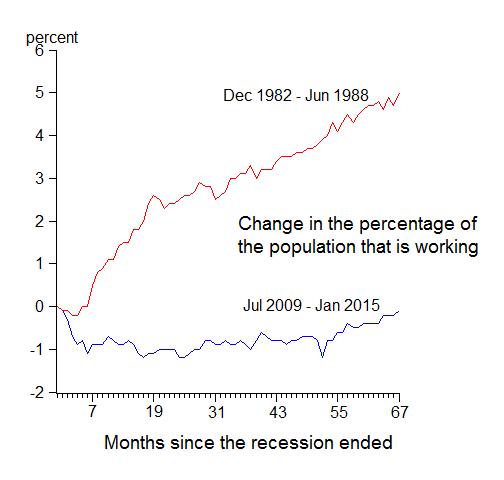
I’ve been tracking the economic recovery with charts and commentaries on this blog since it began in 2009. The simplest but most revealing charts compared and contrasted this recovery with the recovery of the 1980s. Here’s an update of two of those charts. The first shows the change in the employment-to-population ratio,emptopop-1-2015

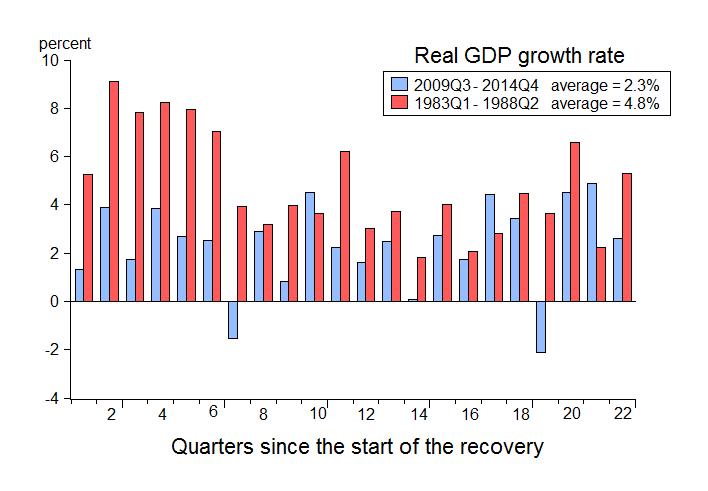
and the second shows the growth rate of real GDP for the two recoveries.

80sgrowthcomp-2014-4

One can’t help but notice the enormous difference back at the start of this recovery, but the difference has persisted year after year for going on six years now.

At the time of the first anniversary of current recovery in 2010, it showed clear signs of weakness compared to the recovery from the recessions in the early 1980s and from all other deep recessions in American history. Some said it was a natural occurrence because of the depth of the recession, but Milton Friedman long ago showed that there was nothing natural about it.

By the recovery’s second anniversary in 2011, it was weak for long enough that I called it “a recovery in name only, so weak as to be nonexistent.” Still some said it was not so bad given the depth of the recession, but research by Mike Bordo and others verified that something unusual was going on.

By the recovery’s third anniversary in 2012, it was now the worst recovery from a deep recession in American history.  Some still disputed that but an analysis of the data in these charts showed we clearly had a problem on our hands. In my view the problem was economic policy and I wrote First Principles to explain that view.

By the recovery’s fourth anniversary in 2013, few disputed any more that it was unusually weak and disappointing.  But rather than consider government policy as the cause, other explanations arose, such Larry Summers’ “secular stagnation” (see Chapter 2 of Baily-Taylor) which took the economic commentary world by storm.

By the recovery’s fifth anniversary, we were so far away from the recession that linking the terrible performance to the recession became increasing far-fetched.  The sarcastic sounding “not-so-great-recovery” had become a favorite label, and the “it’s policy” versus “it’s secular” debate continued.

With the recovery now approaching its sixth anniversary, there is more optimism that we are finally coming out the excruciating slow growth. There is also some wishful thinking that the drop of people out of the labor force—which has made the unemployment rate come down—is due to demographic factors not the slow growth itself. And we are not as bad as Europe.

But as these charts show there is still not much in this recovery to write home about. Growth over the four quarters of 2014 looks to average only 2.2% compared with 4.4% in the corresponding quarters of the 1980s recovery. And as of January 2015 the employment-to-population ratio is still lower than at the start of the recovery.

Posted in Slow Recovery | Leave a comment

It’s Not About Conspiracy Theorizing, It’s About Effectiveness

Yesterday Paul Krugman took some pot shots at an op-ed that Paul Ryan and I wrote nearly five years ago—an op-ed that was critical of quantitative easing. Here’s why Krugman missed his mark and the QE critics are correct.

The op-ed stated that QE1—the 2009 actions “in which the Fed bought not only large amounts of Treasury securities but also securities backed by private mortgages”—“failed to strengthen the economy.” Krugman claims that the only evidence we had at the time was that the economy did not strengthen. As he puts it, “when I stepped outside this morning, it was cold, so I put on a coat — but it didn’t work, because it was still cold.” But there was and is evidence, including econometric research by Johannes Stroebel and me completed in 2010–later published in the International Journal of Central Banking–and basic finance theory as explained by John Cochrane in an interview published in Econ Focus by the Richmond Fed.  A short summary based on my research of the role of monetary policy in the crisis is found here. It is critical of monetary policy before and after the panic in the fall of 2008, but not during the panic.

The op-ed also said that an upcoming round of “QE2 will create more economic uncertainty, stemming mainly from reasonable doubts over whether the Fed will know exactly when and how to contract its balance sheet after such an unprecedented expansion” and that these quantitative easing operations “involved the Fed in areas of fiscal policy, such as credit allocation,” arguing that such operations were the proper role of Congress.  Here Krugman simply resorts to the accusation that the article engaged “conspiracy theorizing.” This is way off. There was no mention of individuals, no mention of conspiring or even talking with other people in the op-ed.  The concern clearly expressed in the oped was about the loss of central bank independence and the departure from rules-based policy—a concern expressed by many people then and now—not that there was a conspiracy.

Krugman also criticized once again a letter written on 2010 criticizing quantitative easing. I responded to that criticism here.

Update: Krugman put material from his blog post of yesterday into his  NYT column today, so my response in this blog pertains to that column too.

Posted in Monetary Policy | Leave a comment

Paul Krugman Pontificating on Policy Rules

In a recent blog post Paul Krugman talks a lot about policy rules and the Taylor rule in particular.

He complains that “Republicans are pushing to mandate that the Fed follow the so-called Taylor rule.”  But the policy rule legislation that has come out of Congress recently would simply require the Fed to describe a rule or strategy of its own choosing, not follow any specific rule.  The legislation refers to a policy rule that I invented, but simply as a “reference rule,” not a “mandated rule.”   Fed officials have been referring to that rule for many years as a benchmark, or as an example, or simply as a framework to argue for change, such as a lowering of the equilibrium real interest rate in that rule. Such references reflect standard practice for the Fed.

Krugman talks about the history of the Taylor rule.  He does not dispute that monetary policy was well described by that rule during the good economic performance period of the Great Moderation. And he does not dispute that policy departed from that rule during the pre-crisis period leading up to the end of the Great Moderation. Rather he claims that the departure was slight and, according to some models, not enough to cause a deterioration of economic performance.  But the departure was not slight; it was as large as the deviations during the 1970s when economic performance also deteriorated. And there are plenty of empirical studies that connect that departure to a deterioration in performance,  including the work on monetary policy and the housing boom and bust I presented in Jackson Hole in the summer of 2007 and the work by Jarocinski and Smets and Ahrend.

Historical research showing that a more rules-based policy works better than pure discretion is vast, much of it reviewed in a recent issue of the Journal of Economic Dynamics and Control. “I think it is important, based on my own experience, to have a rules-based monetary policy,” writes former Secretary of Treasury, George Shultz in the volume.  And monetary historian Allan Meltzer concludes that “The main lesson of this trip through history is that following a rule or a quasi- rule…produced two of the best periods in Federal Reserve history.”  Michael Bordo states that “The Fed has moved away from rules policy in its lender of last resort function,” and “this policy shift contributed to moral hazard and created new threats to financial stability.”

Krugman talks about the zero interest rate bound and the Taylor rule. He claims that the zero bound on interest rates was considered too minor to incorporate in work on policy rules. But the bound was explicitly taken into account in my research work that led to the Taylor rule.

Krugman opines that people are “inventing ever-more bizarre stories to avoid admitting having been wrong about something,” the Taylor rule in particular. Yet my 2007 paper was completed before the start of the Great Recession, and empirical macroeconomists, such as David Papell and his colleagues, are carefully reviewing the same old policy rule story not inventing new bizarre stories.

Krugman offers a funny video of Woody Allen to illustrate his piece. Funnier would be the famous “You know nothing of my work,” clip from Annie Hall.

Posted in Monetary Policy | Leave a comment