A New Normal for Monetary Policy?

A year and a half ago when the Fed’s extraordinary quantitative easing (QE) was shifting from emergency liquidity programs to large scale asset purchases, we convened a conference at Stanford’s Hoover Institution to discuss the shift. Jim Hamilton, of UC San Diego, in his talk Concerns about the Fed’s New Balance Sheet and Peter Fisher of Blackrock in his talk The Market View expressed serious concerns about the extraordinary policies and the use of the Fed’s balance sheet to finance them. Don Kohn, then Fed Vice-Chair, attended and defended the Fed’s position

One concern expressed at the time (March 2009) was that such extraordinary measures would become a “new normal” for monetary policy, in which the Fed would not restrict its massive doses of QE to times of panics and other emergencies. Such a new normal would likely breed uncertainty and reduce the Fed’s independence, eventually leading to economic instability and inflation. I put it this way in my paper in the book, Road Ahead for the Fed, which came out of the conference:

“The danger I see is that as the recovery begins, or after we are a couple of years into it, people may feel that it’s not fast enough, or there is an unpleasant pause. Either could generate heavy pressure on the Fed to intervene…. Why would such interventions only take place in times of crisis? Why wouldn’t future Fed officials use them to try to make economic expansions stronger or to assist certain sectors and industries for other reasons?”

Many Fed officials dismissed the concerns about such a scenario, saying that the crisis was unique. Yet this is exactly the scenario that is now playing out. Sure enough, the recovery paused, and lo and behold, there is a QE2 in the works.

Today’s Roubini Global Economics newsletter is ominous. It predicts that after QE2 the Fed will “announce QE3 (and eventually even QE4).” After Road Ahead for the Fed we published another book Ending Government Bailouts as We Know Them. Perhaps the title of the first book should have been The End of Monetary Policy as We Know It

Posted in Monetary Policy | Comments Off on A New Normal for Monetary Policy?

Cash for Clunkers in a Macro Context

More empirical studies are demonstrating that temporary fiscal stimulus actions are a poor way to get the economy moving again on a sustainable basis. More permanent and predictable policies are much better. I demonstrated this problem in the case of the stimulus packages of 2008 and 2009, but perhaps the clearest case is the “cash for clunkers” program of July and August 2009. To illustrate the problem quantitatively, it is useful to put some new micro-empirical results of Atif Mian and Amir Sufi into a macroeconomic context, as I do with the following charts.

The first chart shows disposable personal income along with personal consumption expenditures in the United States. In previous work I focused on how the two big bulges in disposable income due to the stimulus programs failed to jump start consumption. But here I focus on the cash for clunker program, which clearly did change consumption.
Using the Mian-Sufi results, which are based on a comparison of different regions of the United States, I estimated the amount by which total personal consumption expenditures first increased as people were encouraged to trade in their clunker and purchase new cars, and then declined because many of the trade-ins were simply brought forward. To make this increase and subsequent decrease easier to see, the second chart focuses on personal consumption expenditure during the period of the program. You can see that consumption rises above what it would have been without the program and then actually falls below what it would have been. Some argue that bringing forward purchases like this is exactly what such programs are supposed to do, but the graph makes it very clear that the offsetting secondary effects occur so quickly that the net result is an insignificant blip in the recovery. The impact is not sustainable.
An important result of Mian and Sufi is that the positive effects are completely offset in a few months, as you can see in the picture. But even if they were not offset, the graph raises serious doubts about how such a program could sustain a recovery. Suppose that the red line never dipped below the blue line. We would still see growth simply picking up for a month and then slowing down again. That is not sustainability.

Posted in Fiscal Policy and Reforms | Comments Off on Cash for Clunkers in a Macro Context

Beware of Announcement Effects When Assessing Policy Interventions

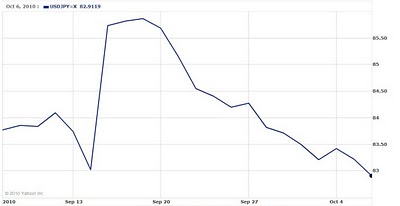
The effects of exchange market interventions are frequently estimated by looking at what happened on the day of the announcement of the intervention or of the intervention itself. But my observation—based in part on experience running the international division of the U.S. Treasury and engaging in financial diplomacy with Japan and other countries—is that announcement effects can be very misleading as an estimate of the overall effect of interventions because the impacts can wear off with no announcement or reverse interventions. The recent experience with the September 14 announcement of an exchange market intervention by the Bank of Japan is an important case in point as clearly indicated by this chart of the yen-dollar exchange rate. The yen did noticeably depreciate against the dollar on the day that the intervention was announced and took place, but that has already been reversed.
This is one of the reasons why I think it is unwise to rely on announcement effects to assess the impact of central bank asset purchase programs as in Gagnon et al. Better to look over longer periods of time where you can control for other factors as in this paper with Johannes Stroebel.

Posted in Monetary Policy | Comments Off on Beware of Announcement Effects When Assessing Policy Interventions

Meltzer’s History Lesson

I recently had the pleasure of reading, and then writing a review of, Allan Meltzer’s monumental A History of the Federal Reserve, Volume 2 which is published in Book 1 and Book 2. The lesson from this thorough 2,112-page history (volumes 1 and 2 together) deserves careful consideration by policymakers today.

It is a history of policy successes and policy failures. The failures are the Great Depression of the 1930s, the Great Inflation of the 1970s, and the Great Recession of recent years. The successes are the Great Disinflation of the early 1980s and the Great Moderation which succeeded it. What caused these successes and failures? Meltzer focuses on two types of policy errors: (1) succumbing to “political interferences or pressure” and (2) basing policy on “mistaken beliefs.” Failure comes from making one or both of these errors; success comes from avoiding them.

He argues that the Great Depression was mainly the second source of error: mistaken beliefs about the real bills doctrine. The Great Inflation was a combination of both types of errors, but failure to resist political pressure dominated because when beliefs changed in the 1970s, policies did not. The Great Disinflation was marked by an absence of both types of errors as Paul Volcker regained independence and restored basic monetary fundamentals about the impact of changes in the money supply and interest rates. The Great Moderation was a period where independence was solidified and rules-based policy, grounded in fundamentals, was followed. The Great Recession was a return to a combination of both kinds of errors, a departure from rules-based policies that worked in the Great Moderation and a loss of independence as the Fed engaged in fiscal and credit allocation policy.

Meltzer’s historical research thus leads him to conclude from the past that “Discretionary policy failed in 1929-33, in 1965-80, and now,” and to recommend for the future that “The lesson should be less discretion and more rule-like behavior.” While I registered some disagreements with parts of Meltzer’s history in my review article, I think his overall conclusion and recommendation are largely correct.

Posted in Monetary Policy | Comments Off on Meltzer’s History Lesson

Trading Places: HIPCs and HIICs

I thought of the movie Trading Places when I saw the term HIIC in the headline of today’s Wall Street Journal article by Kelly Evans. The new term refers to the “Heavily Indebted Industrialized Countries” and of course to the exploding debt of these countries–including the United States. It was not so long ago that the main concern in the international community was the debt of the “Heavily Indebted Poor Countries,” or the HIPCs; these low income countries were the focus of the debt relief, or the “drop the debt,” movement.

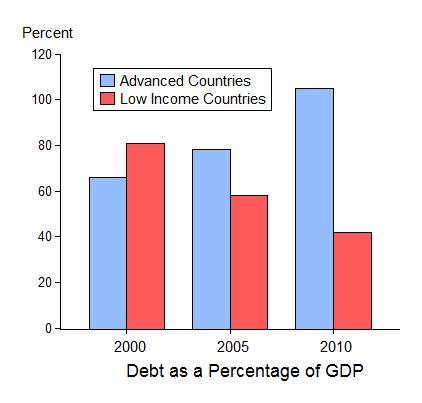
Remarkably the debt of the advanced countries is now higher and growing more rapidly than the debt of the lower income countries, as I show in this chart based on data from the IMF’s Fiscal Monitor of last May. The switch seemed to take less time than it took to change the P to an I. It’s good news for the lower income counries, but not such good news for the industrialised countries which obviously have to get back on track.

Posted in International Economics | Comments Off on Trading Places: HIPCs and HIICs

New Evidence Shows that Low Interest Rate Led To Yield Search

New empirical research establishes a strong relationship between very low interest rates set by the Fed, as in the period 2002-2005, and a risk-taking search for yield. This policy-induced lessening of risk aversion has been emphasized by Raghu Rajan and others as a key factor bringing on the financial crisis. The new empirical support for this view is reported in the working paper “Risk, Uncertainty and Monetary Policy” by Geert Bekaert, Marie Hoerova, and Marco Lo Duca.

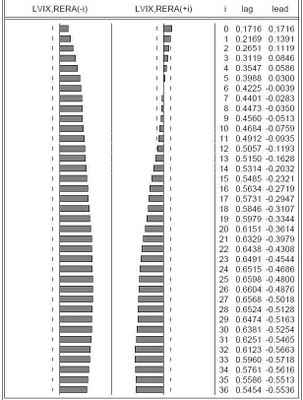
The basic evidence is the pattern of correlations over time which can found by looking carefully through the following bar graphs and table drawn from the paper.

The bar graphs show the correlation between market volatility, measured by VIX, and the interest rate set by the Fed, measured by RERA—the federal fund rate minus the inflation rate. The two columns of five-digit numbers in the table labeled lead and lag are the values of the correlations shown in the bars. (VIX, of course, is the implied volatility of the S&P 500. The identifier LVIX is used because they actually look at the log of VIX).

The bar graph on the left (and the first column of numbers) shows the correlation coefficients between the VIX and values of the federal funds rate at previous months going back into the past from 1 month to 36 months. For example, the correlation between the VIX and the federal funds rate 12 months earlier is 0.5057. Observe that these correlations are all positive and significant, evidence that lower interest rates are associated with lower future values of the VIX, or less risk aversion as explained in the paper. In this sense, low interest rates tend to lower risk aversion and high interest rates raise it. In other words the low rates cause a search for yield with a willingness to take on more risk.

The bar graph on the right (and the second column of numbers) shows the correlation coefficients between the VIX and values of the federal funds rate at varying months going into the future. After the first few months, these correlations are negative and significant indicating that the Fed tends to react to high levels of volatility by lowering interest rates.

The bottom line of this empirical research, as the authors put it, is that “lax monetary policy increases risk appetite (decreases risk aversion) in the future, with the effect lasting for about two years and starting to be significant after five months.” Their result is important to the policy debate because such monetary policy has been “cited as one of the contributing factors to the build up of a speculative bubble prior to the 2007-09 financial crisis.”

Posted in Monetary Policy | Comments Off on New Evidence Shows that Low Interest Rate Led To Yield Search

Policy Rule Gaps as Forecasts of Currency and Interest Rate Movements

Currency strategists at the Scotiabank are using “policy rule differentials” rather than simple “interest rate differentials” in a creative way to predict interest rate and currency movements. As reported in this Bloomberg piece Taylor Rule Gap with U.S. at 15-Year High Signals Rate Jump in Canada by Matt Walcoff and Chris Fournier, the policy rule differential is currently 275 basis points, while the current interest rate differential between Canada and US is only 75 basis points. Hence, Camilla Sutton and Sacha Tihanyi at Bank of Nova Scotia argue that the Canadian dollar and the Canadian interest rate will rise. Where do they get the 275 basis points? They estimate that the Bank of Canada is below their policy rule by 1 percentage point and that the Fed is above by 1.75 percentage points for a gap of 2.75 percentage points. Here are their calculations (scroll to page 13 of the September 10, 2010 issue). It is another example of how foreign interest rates affect central bank decisions, as I described in this recent post

Posted in International Economics | Comments Off on Policy Rule Gaps as Forecasts of Currency and Interest Rate Movements

The Transparent Effect of Foreign Interest Rates on Central Bank Decisions

Last June the central bank of Norway hosted a fascinating conference in Oslo on the use of monetary policy rules in small open economies. The Norges Bank is a remarkably transparent central bank. As with the Swedish Riksbank, it announces not only its most recent interest rate decision, but also the likely path for its interest rate decisions in the future. While some have criticized publishing future interest rate forecasts, the experiences in Norway and Sweden show that there are advantages of such increased transparency. For example, consider the debate at the Risksbank earlier this month about the path of interest rates in the next two years. The Riksbank minutes (which provide much more detail than FOMC minutes) reveal a substantive debate between some, such as Deputy Governor Lars Svensson, who preferred an interest rate path in which rates were held low for a long time and others who wanted to increase rates more rapidly.

As explained in the minutes, the debate was in part over forecasts of monetary policy rate decisions abroad: “Given statements made by the Federal Reserve and the ECB, …low policy-rate expectations must be regarded as very realistic. The differential between Swedish and foreign interest rates is currently moderate. If the repo-rate was to become credible and policy-rate expectations for Sweden were to shift up to the repo-rate path, the expected differential in relation to other countries would be considerable. This would trigger substantial capital flows and lead to a dramatic appreciation of the krona. Both higher market rates and a stronger krona would entail a drastic tightening of actual monetary policy.”

More light is shed on the effect of lower interest rates abroad on policy by the experience of the Norges Bank; the effects can be illustrated using charts from their Monetary Policy Reports. Consider the decision to lower the path of interest rates in Norway earlier this year. The lower path is shown by the red line in this picture:

The Norges Bank explained this change with their useful (and very transparent) “interest rate accounting” bar chart. Observe that a big reason for the rate cut was that foreign interest rates were expected to be lower.

Further evidence is shown in the Norges Bank efforts to use monetary policy rules in their decision-making. As shown in the third graph, their interest rate path is lower than a Taylor Rule without the foreign interest rate and about the same as a policy rule in which the foreign interest rate is added to a Taylor Rule. Whether such adjustments are good or bad was the subject of my keynote address at the conference, but whatever the answer, we should be grateful for their high level of transparency which helps us research the question.

Posted in Monetary Policy | Comments Off on The Transparent Effect of Foreign Interest Rates on Central Bank Decisions

Senate Budget Committee Reopens Debate on Policy and the Crisis

In a hearing today, the Senate Budget Committee reopened the debate about whether the stimulus packages and other federal interventions have been effective. Here is the written testimony of Alan Blinder, Mark Zandi, and me, the three economists who were invited to testify. The chairman of the committee Kent Conrad began by outlining the results of a recent study by Blinder and Zandi (which I have previously critiqued on this blog) arguing that the packages were effective. Ranking Member Judd Gregg followed up expressing his skepticism of such studies.

My testimony summarized the results of studies conducted at Stanford during the past three years examining the empirical impact of the policies (the studies are described in the appendix).

One simple fact which I reported received considerable attention in the senators’ discussion. It was that only $2.4 billion of the $862 billion in the 2009 stimulus package (ARRA) has been spent on federal infrastructure—three-tenths of a percent. More may have resulted at the state and local level but there is no clear connection between the federal grants and such spending.

More generally I reported that on balance the federal policy responses to the crisis have not been effective. Three years after the crisis began the recovery is weak and unemployment is high. A direct examination of the fiscal stimulus packages shows that they had little effect and have left a harmful legacy of higher debt. The impact of the extraordinary monetary actions has been mixed: while some actions were helpful during the panic stage of the crisis, others brought the panic on in the first place and have had little or no impact since the panic. The monetary actions have also left a legacy of a large monetary overhang which must eventually be unwound.

I am frequently asked what I would have done differently. It turns out that I testified before the same Senate Budget Committee two years ago in November 2008 and recommended a specific four part fiscal policy response to the crisis. The response was based on certain established economic principles, which I summarized by saying that policy should be predictable, permanent and pervasive affecting incentives throughout the economy.

But this is not the policy we got. Rather than predictable, the policy has created uncertainty about the debt, growing federal spending, future tax rate increases, new regulations, and the exit from the unorthodox monetary policy. Rather than permanent, it has been temporary and thereby has not created a lasting economic recovery. And rather than pervasive, it has targeted certain sectors or groups such as automobiles, first time home buyers, large financial firms and not others. It is not surprising, therefore, that the policy response has left us with high unemployment and low growth. Given these facts, the best that one can say about the policy response is that things could have been even worse, a claim that I disagree with and see no evidence to support.

Posted in Financial Crisis | Comments Off on Senate Budget Committee Reopens Debate on Policy and the Crisis

Timely Views on Deflation from Governor Shirakawa

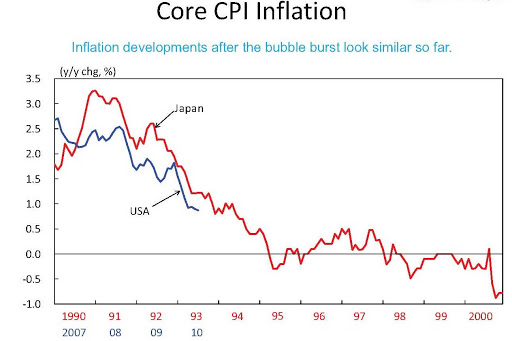
For years economists and policymakers in the United State have been expressing fears that America would enter a Japanese-style deflation and thereby experience a lost decade like Japan in the 1990s. One of the earliest examples was the October 1999 Woodstock Vermont conference (later published in the Journal of Money Credit and Banking) on how to avoid deflation, which may have been an impetus to the Fed’s decision to hold interest rates so low in the period from 2003-2005. In his recently published history of the Federal Reserve Volume 2, Allan Meltzer reports, based on conversations at the time, that “Chairman Alan Greenspan believed and said that the country faced risk of deflation” during this period. Concerns about deflation are clearly on the minds of members of the FOMC as they meet next week.

It was therefore very helpful and quite refreshing that Bank of Japan Governor Masaaki Shirakawa’s chose to address this issue in a speech this week at the Bank of Japan, Uniqueness or Similarity? Japan’s Post-Bubble experience in Monetary Policy Studies. Hearing from a person in a top leadership position who can reflect on the experience of dealing with deflation is very useful right now. I heard the speech in person and can report that many in the audience (including me) were very positive about the interesting ideas, the clarity of the exposition, and the many helpful charts. The most discussed chart, reproduced here, suggested an eerie similarity between the United States and Japan.

Other interesting points in the speech were that the recent Japanese-style deflation has been remarkably mild compared to the Great Depression and that “Empirical studies on Japan mostly show that quantitative easing produced significant effects on stabilizing the financial system, while it had limited effects on stimulating economic activity and prices.”

Posted in Monetary Policy | Comments Off on Timely Views on Deflation from Governor Shirakawa