In Praise of an Extraordinary Teacher of Economics

Those of us who teach economics stand on the shoulders of those who taught us economics.

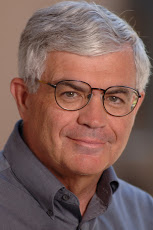
I just heard the sad news that one of my truly extraordinary economics teachers, E. Philip Howrey, recently died in a biking accident. When I was an undergraduate, Phil taught me an approach to macroeconomics—very new at the time—which has served me well throughout my career, and for which I will forever be grateful. Several years ago Robert Leeson asked me “Who influenced you most when you were an undergraduate at Princeton? What sparked your interest in policy rules?” I talked mostly about Phil in my answer.

Looking back I would say that Phil Howrey had the most influence on me, at least in areas that turned out to be closely related to my career as an economist. Phil had a great deal of interest in time series analysis as it applied to macroeconomics. For example, he had written an important paper on the “Long Swing” hypothesis with Michio Hatanaka. Hatanaka had published a book in 1964 with Clive Granger on Spectral Analysis of Time Series. Granger visited Princeton at the invitation of Oscar Morgenstern who had an interest in applying frequency domain techniques to economic data. While I met Morgenstern then, I did not meet Granger until many years later.

I think my initial interest in policy rules goes back to a course I took from Howrey. Except for Economics 101, it was probably my first introduction to macroeconomics. But we didn’t study ISLM or the other textbook models of the time; instead we studied dynamic models of the economy, with equations that included lags and shocks defining the stochastic processes. In retrospect it was quite unusual that I had the opportunity to learn about these methods as an undergraduate, but at the time I had no idea that it was unusual. The methods forced me to think of the economy as a moving dynamic structure. So the only way one could think about policy was with some kind of policy rule. You couldn’t say let’s shift the LM curve by increasing the money supply by one unit or do whatever people would be doing at the time. Instead you had to have some kind of policy rule. So to me it was natural. I couldn’t think of how else you would do it in those models.

When it came time to choose a topic for a senior thesis, I approached Phil Howrey saying that I was interested in macroeconomic policy issues and wanted to work with the types of models we studied in his course. He suggested that I look into stabilization policy in a model that combined economic growth and the cycle, which we called “endogenous cyclical growth” at the time; he said that no one had done this before, and so it sounded like a great topic and that is what I did. In the preface to my senior thesis I thanked Phil “for suggesting the topic and indicating how I might proceed.” In the end the thesis was about simulating different types of monetary policy rules.

Posted in Teaching Economics | Comments Off on In Praise of an Extraordinary Teacher of Economics

Day 1 of Economics 1

I find the first day of the school year to be exciting, especially when a lot of first-year students are in my classes as is the case with Economics 1, the introductory economics course I teach at Stanford and the course which this blog is named after. Many Day 1 questions are interesting and revealing of the times: Q: “Is this course Keynesian or Austrian?” A: “Adam Smithian.”

On Day 1, of course, we focus on the central idea that economics is about choices people make when faced with scarcity and the interaction between people when they make these choices. Accordingly, we modify slightly the Stanford motto, “The Winds of Freedom Blow” (Die Luft der Freiheit Weht) to get the Economics 1 motto: “The Winds of Economic Freedom Blow.  Examples of opporunity costs this year were hi-tech leaders Mark Zukerberg, Steve Jobs and Larry Ellison, who considered the opportunity cost of college, dropped out, and did pretty well—or Eric Schmidt, John Chambers, and Art Levinson (Google, Cisco, Genentech) who also considered opportunity cost of college, stayed in, and also did pretty well.

This year we are trying out a new Economics 1 lecture hall, CEMEX Auditorium in Zambrano Hall, named after the Mexican-based global cement company and its CEO Lorenzo Zambrano, who also didn’t drop out of college and then did well enough to donate the money for the lecture hall.

Posted in Teaching Economics | Comments Off on Day 1 of Economics 1

Not More of the Same Model Simulations!

Simulations of Mark Zandi’s economic model, which are reported in the press to show that a new temporary stimulus package will create 1.9 million jobs, are being touted as evidence that it will work. This is the same type of model simulation that predicted the very similar 2009 stimulus package would create millions of jobs, and the same type of simulation that claimed that that package worked. Andrew Ferguson reviews the predictions in a recent article in Commentary.But simulations of such models do not provide such evidence, as I have explained on this blog before, for example here and here. They are wrong because they assume “multipliers” for temporary one-time payments or tax changes far in excess of the basic “permanent income” or “life cycle” models (which we teach in Economics 1). They are wrong because they assume that state and local government infrastructure and other purchases respond to federal stimulus grants in a mechanical way, unlike what we have seen practice, as I explained in this article with John Cogan. And they are wrong because they do not take account of the negative growth effects of expected future permanent increases in tax rates. I have debated Mark Zandi on these topics many times before, for example on the NewsHour and in congressional testimony.

However, the terribly weak economic recovery has forced an important change in the way that these predictions are put forward by modelers like Zandi. They have to admit that even their exaggerated estimated impacts of the temporary stimulus packages are, yes, temporary. Macroeconomic Advisers reports the same thing: “the GDP and employment effects are expected to be temporary” and more specifically that “these proposals will pull forward increases in GDP and employment, not permanently raise their level.”

In other words, even if, on balance, jobs are created by the package (which is doubtful), they will be destroyed as soon as the temporary package is over, according to Zandi. Thus even the promoters of such temporary packages agree that they will not jump-start the recovery, which is what is needed to really reduce unemployment.

Perhaps more than anything else, this is the reason why we need to do something besides “more of the same,” and instead follow the wisdom put forth in this speech (video, transcript)  by George Shultz upon winning the first Economic Club of New York Award for Leadership Excellence this past week.

Posted in Stimulus Impact | Comments Off on Not More of the Same Model Simulations!

When So-Called Hawks Are Really Doves

The Fed’s dual mandate of “maximum employment” and “stable prices” is in the news again. At the recent presidential debate, the major Republican candidates made the case for repealing the dual mandate, while the President of the Federal Reserve Bank of Chicago, Charles Evans, made the case for doubling down on it. 
It’s an important issue to understand and discuss. In my Bloomberg News article yesterday, I argued that history indicates that removing the dual mandate will actually help lower unemployment by reducing discretionary interventions and encouraging more predictable rule-like policy.

In this regard the frequently used terms monetary “hawk” and “dove” are quite misleading. A hawk is usually defined as someone who would like the Fed to focus on long run price stability.  But according to the evidence I discuss in my article, such a focus would better characterize a dove in that unemployment would be lower not higher. 

Posted in Monetary Policy | Comments Off on When So-Called Hawks Are Really Doves

Two Congressional Hearings on the Second Stimulus and Alternatives

Congress was busy working on fiscal policy today. This morning, over on the House side, it held its first hearing on President Obama’s fiscal stimulus proposal. As one of the witnesses, I argued that the fiscal policy responses thus far to the unemployment problem have not been effective. Consisting mainly of short-term temporary and targeted interventions, the policy has not had a sustainable impact on economic growth and unemployment. Instead, the policy has increased the federal debt and raised uncertainty, which is an impediment to economic growth. Unfortunately, the proposals made by President Obama on September 8 consist largely of the same type of temporary and targeted interventions that have been tried for the past several years. Recent experience and past experiences show that this type of fiscal policy will not increase economic growth, certainly not on a sustained basis. It will not therefore bring the unemployment rate down to pre-recession levels which should now be the goal of policy.

Over on the Senate side this afternoon, there was a hearing on more comprehensive tax and budget reform. I testified there too, along with Alan Greenspan and Martin Feldstein.  I briefly laid out a more permanent and predictable alternative to the President’s temporary and targetted proposal—a budget strategy to raise economic growth with revenue-neutral tax reform. It builds on the Budget Control Act and brings spending to the level of 2007 as a share of GDP.

Posted in Stimulus Impact | Comments Off on Two Congressional Hearings on the Second Stimulus and Alternatives

The Financial Front in the War on Terror

Few Americans now remember that the United States launched its first post-9/11 attack on terrorists from a very unusual front—the financial front. As President George W. Bush put it, “the first shot in the war was when we started cutting off their money, because an al Qaeda organization can’t function without money.” Here is my Bloomberg News  piece about this financial aspect of the war on terror. The detailed story of the people and what they did is fascinating as I try to describe in more detail in my book Global Financial Warriors: The Untold Story of International Finance in the Post-9/11 World. I will be talking with Tom Keene and Michael McKee about it on Sunday at noon. They will be broadcasting on Bloomberg Radio live from the World Trade Center site.

I was head of Treasury’s international affairs division when the operation began. Under U.S. law, the president had the authority to call on U.S. financial institutions to freeze the accounts of terrorists. In the years before 9/11, however, that law was not used very aggressively. As described later in the 9/11 Commission’s Monograph on Terrorist Financing, “Terrorist financing was not a priority….the Treasury organization charged by law with searching out, designating, and freezing Bin Laden assets, lacked comprehensive access to actionable intelligence and was beset by indifference of higher-level Treasury policymakers.”

Our first action was to end the indifference and define the mission clearly: first to freeze terrorist assets and thereby thwart future attacks; second to trace their assets and thereby get information about terrorists.

We had to have international cooperation; without it, the terrorists and their financiers could escape a U.S. freeze by moving their money to banks abroad. No mechanism for cooperation existed, so we had to create one. We began with the G7 and then fanned out. As Treasury press spokesperson, Michele Davis, said at the time, “We’re talking to everyone under the sun.” A report sponsored by the Council on Foreign Relations in 2002 found that: “The general willingness of most foreign governments to cooperate with U.S.-led efforts to block the assets…has been welcome and unprecedented.”

A total of 172 countries issued freezing orders, 120 countries passed new laws and regulations, and 1,400 accounts of terrorists were frozen worldwide. The total value of frozen accounts was $137 million, much during the crucial months in the fall of 2001. Valuable information from tracking money helped prevent attacks, and to obtain more information about terrorists, we partnered with a global financial messaging service called SWIFT, the Society for Worldwide Interbank Financial Telecommunication. Using this information, intelligence experts mapped terrorist networks and filled in missing links.

Posted in International Economics | Comments Off on The Financial Front in the War on Terror

Don’t Stay the Course

Here is my New York Times oped Not More of the Same on why it is urgent to change the course of economic policy.

My critique of Keynesian countercyclical policy, which is summarized in the NYT article, has been challenged by Fred Bergsten of the Peterson Institute who said at the Jackson hole meeting last week that the Reagan tax cut is an example of a countercyclical policy that successfully stimulated the economy, and therefore disproves my case.   But as Larry Summers famously described it, Keynesian countercyclical policy is “temporary, targeted, and timely.”  The Reagan tax cut was certainly not temporary. And it wasn’t targeted either; it was across the board. And it wasn’t timely because it lasted well beyond the recession and the recovery. In fact, it is just the kind of “permanent, pervasive, and predictable” policy that we need now. 

Posted in Stimulus Impact | Comments Off on Don’t Stay the Course

On the New Greatest Generation

With the 10-year anniversary of 9/11 approaching people have been asking me to write about the impact of 9/11 on economic policy making in Washington, where I ran the international division of the U.S. Treasury at the time, and to reflect on how the world has changed since then. One request for 150 words came from the Stanford News Service. While there are many amazing economic stories to tell, I thought the first one should reflect on the new greaest generation which will help lead the way out of the difficult times we are still in.

Ten years after 9/11 we now have a “new greatest generation” of Americans on the scene and ready to lead. It includes, of course, all the post 9/11 Afghanistan and Iraq veterans to whom Time Magazine dedicates its cover this week. Fifty-one have enrolled at Stanford with more to come. As [Stanford President] John Hennessy and [Stanford Provost] John Etchemendy say, “We are honored and proud to have many excellent current students and alumni who have served in the military.

But I see a new greatest generation that also includes equally dedicated civil servants, like those at the US Treasury who froze terrorists’ assets after 9/11 or funded new schools in Afghanistan; young entrepreneurs, who through ingenuity and hard work have been developing new products to improve peoples’ lives; and the teachers, the doctors, the engineers who are just beginning their careers.

This is the best news and the most promising.

Posted in Teaching Economics | Comments Off on On the New Greatest Generation

The Economic Past is Economic News

You cannot really understand monetary economics or monetary policy without knowing economic history. No self-respecting monetary economist goes to work without knowing the ins and outs of historical periods like the Depression of the 1930s or great works on such periods, such as Milton Friedman and Anna Schwartz’s Monetary History of the United States, Allan Meltzer’s History of the Federal Reserve, or Amity Shlaes recent popular book The Forgotten Man: A New History of the Great Depression building on the research of Harold Cole and Lee Ohanian.
Among fields of economics, this is especially true of monetary economics, where the theories can get quite abstract and thus benefit greatly from historical groundings, though it applies to other field as well. That’s why I took economic history as one of my Ph.D. fields along ago, and why I’m happy that my department at Stanford has always emphasized economic history with historians like Ran Abramitsky, Paul David, Avner Grief, Nate Rosenberg and Gavin Wright, even as it has been de-emphasized in other departments.
That’s why I’m also pleased that the new opinion page at Bloomberg News has decided to establish a blog called Echoes overseen by Amity Shlaes under the courageous assumption that “The past is news,” as Amity puts it. Echoes should remind traders that today’s profit opportunities can often be found in the economic echoes from the past, or at least remind policy makers that opportunities to improve policy can also be found there.
Here are a few pieces I wrote for Echoes since it was established in late May, mostly on policy lessons, including one from today, where I write that Fed officials should listen to a few of those echoes as they gather in Jackson Hole tomorrow:
Posted in Teaching Economics | Comments Off on The Economic Past is Economic News

Why the M2 Growth Spurt?

Quantitative Easing (both I and II) has caused the monetary base—the sum of currency and bank reserves—to explode in the past three years, but has not resulted in similarly large increases in the growth of broader measures of the money supply such as M2. Instead banks have largely held the extra money that the Fed created in order to finance its purchases of longer term Treasuries and mortgage backed securities. You can see this in the following time-series chart. As the monetary base (right scale) increased sharply, the ratio of M2 to the monetary base—the M2 multiplier (left scale)—has moved in the opposite direction in complete lock-step fashion. Thus changes in the multiplier have offset increases in the monetary base.

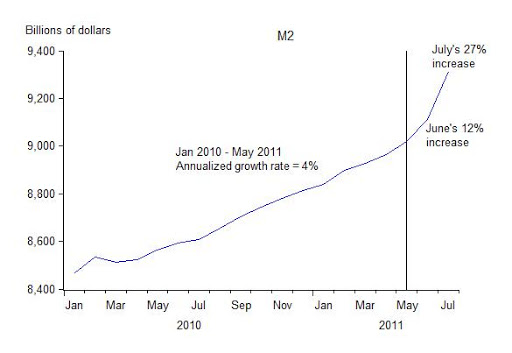
But if you look closely at the lower right of the graph, you can see that this pattern may have shifted recently as the M2 multiplier increased. In fact, over the past couple of months, M2 growth has spurted, as you can see in the next chart showing monthly M2 averages through July. 
It’s important to find out why. Is quantitative easing finally leading to a rapid increase in the supply of the broader money aggregates? If so, the Fed will need to be concerned about the ultimate effect on inflation, and perhaps start reducing the size of its balance sheet (and thus the monetary base) sooner than it would otherwise. Or is the increase due to a sudden rise in the demand for M2, which, with the elevated level of the monetary base, would not require additional adjustments. It’s probably too early to tell for sure, but the Fed’s weekly Money Stock Measures, released each Thursday afternoon, will be important to monitor in the weeks ahead.
The next chart shows the weekly data on M2 through August 8, which were released last Thursday afternoon. Based on a scan through the release, it looks to me like demand deposits and savings deposits at banks are the two components of M2 that are most responsible for the recent increase in M2. I have plotted the sum of those two items below M2 in the chart to demonstrate this (note the dual scale with M2 on the right and the sum on the left). Other components of M2 such as currency, small denomination time deposits, and other checkable deposits have not increased in this way.
What’s the reason for the sharp increase in demand deposits and savings deposits at banks? Perhaps the collapse of interest rates on Treasuries and the risk that Treasury prices could fall from these high levels have made such deposits more attractive, recalling the phrase of Keynes that the bond bulls “join the bear brigade.” The newly announced policy at Bank of New York Mellon that large depositors will have to pay to lodge their funds is consistent with this story. If so, we are seeing a shift in the demand for money. But stay tuned.

Posted in Monetary Policy | Comments Off on Why the M2 Growth Spurt?