So Much For People To Learn About Medicare Reform

There is so much more for people to learn about the various Medicare proposals out there. Many people I talked to were surprised to learn that both the Ryan and the Obama Medicare proposals reduce the growth of federal outlays on Medicare by very large amounts compared with current law, as Dan Kessler and I pointed out in our article in the Wall Street Journal this week. In commenting on our article Arik Roy emphasizes this little known fact (he had pointed it out earlier), suggesting that “an excellent reform plan for a GOP Presidential candidate to take up: the Ryan plan, tweaked to adhere exactly to the Medicare target growth rates advocated by the President…Such an approach would completely neutralize the charge that Republicans (or Democrats, for that matter) were unfairly cutting Medicare, and allow the candidates and the country to have a more substantive debate.”

Some commenters on our article were surprised to hear that President Obama even had a Medicare proposal, assuming that reform was part of Obamacare passed last year. But the Obama Medicare reform proposal was just put forth in an April 13, 2011 speech. Here is the fact sheet from that speech which calls for “setting a more ambitious target of holding Medicare cost growth per beneficiary to GDP per capita plus 0.5 percent beginning in 2018, through strengthening the Independent Payment Advisory Board (IPAB).”

Some commenters said that people could learn more about the proposals with a numerical side-by-side comparison of federal outlays under the two proposals going out into the future. Well I agree, and CBO has prepared such a comparison of current law versus the Ryan plan, but they said they could not estimate the impact of the April 13 proposal because the Administration did not provide enough information in the proposal. Here is a video of CBO Director, Doug Elmendorf, explaining that “We don’t estimate speeches. We need much more specificity than was provided in that speech for us to do our analysis.”

Some questioned our claim that physicians have begun requesting additional fees—‘concierge’ or ‘retainer’ payments—from Medicare beneficiaries to remain part of their practices, saying that they are illegal. But such fees are legal if the doctors accept Medicare and charge on top of this for services uncovered by Medicare, such as telephone or email consultations, though one can see fuzzy lines between this and billing extra for a covered service, which is illegal.

Some were surprised to hear that the Ryan reform proposal is much like the already existing Medicare Part D, which benefitted many at much less cost than experts predicted. This should help remove doubts—which obviously still exist in some quarters—that markets and competition can be a positive force to create better services for each dollar spent.

Posted in Regulatory Policy | Comments Off on So Much For People To Learn About Medicare Reform

No Near-Consensus Among Economists for Another Stimulus Package

Sunday’s Weekend Edition on NPR gave listeners a chance to hear different economic views on how to reduce the high unemployment rate. Joe Stiglitz represented the view that we need another deficit-financed stimulus package with more spending now and tax increases later. I represented the view that the 2009 deficit-financed stimulus didn’t work and that we need to address the problem of expanding debt and regulations, which are holding back investment and job creation, and that we should not increase taxes. In selecting excerpts from an earlier taping, I think the NPR editors gave a fair representation of the views that are out there. 

In the meantime, an article in the New York Times over the weekend suggested that there was a new consensus for the view which Joe put forward. I see no such consensus. Some economists such as Joe, Paul Krugman, and Robert Reich have that view, but that is not new for them. And it is nothing new for Warren Buffett to argue for tax increases as he did in an New York Times op-ed today: When he was an adviser to Arnold Schwarzenegger in the 2003 California recall election, Buffett recommended tax increases, but Arnold told him to cool it or do 500 pushups for punishment. And there are plenty of economists who think that gradually reducing spending and not increasing taxes is better for job creation.  In June, for example, 150 economists (including me) wrote that a debt deal “that is not accompanied by significant spending cuts and budget reforms would harm private-sector job growth”

Posted in Stimulus Impact | Comments Off on No Near-Consensus Among Economists for Another Stimulus Package

When Economic Principles Were Ignored

In televised speech on Sunday evening August 15, 1971, Richard Nixon shocked the world with these words: “I am today ordering a freeze on all wages and prices throughout the United States for a period of 90 days,” (see video) and “I have directed Secretary Connally to suspend temporarily the convertibility of the dollar into gold or other reserve assets…” (see video).
There are many lessons learned from this Nixon shock, as Amity Shlaes, Joe Thorndike and I wrote in pieces this week on Bloomberg Echoes here, here, and here, respectively.  Perhaps the most important lesson, a warning actually, is how a presidential administration with economic principles emphasizing free markets and limited government intervention can end up implementing an economic policy of controlled markets and extensive government intervention, with terrible consequences. By reading contemporary reports, such as the Newsweek columns of Milton Friedman mentioned in my piece, you can see how politics drove the decision making and how administration economists either succumbed or were overruled. In marked contrast, a decade later another free-market, limited-government administration came into power in Washington and stuck to its principles—and the economic performance turned out to be far better.
For a useful quick summary of how these momentous decisions were made (with candid commentary by Milton Friedman and George Shultz), watch this short 5-minute video from Commanding Heights.
Posted in Regulatory Policy | Comments Off on When Economic Principles Were Ignored

Regulatory Capture across the Hudson

The book Reckless Endangerment by Gretchen Morgenson and Joshua Rosner is filled with examples of regulatory capture which the authors uncovered in their investigative reporting of the financial world. Here is my review in the Washington Post. Many of the examples are useful for teaching Economics 1—including what the authors see as a cozy connection between the New York Fed and the Wall Street firms it regulates.

Orley Ashenfelter, President of both the American Economic Association and American Association of Wine Economists, has done some of his own investigative reporting on the other side of the Hudson River. As he explains in a recent oped, the New Jersey liquor lobby has captured the State legislature, and has done so since the Great Depression.

I think these examples are better than the financial industry examples for teaching, at least at the principles level. Liquor stores are easier to visualize and explain than structured investment vehicles and the examples nicely illustrate the advantages of free markets, the dangers of government regulation, the role of special-interest lobbying, and how to reform the system, now that the wine growers in the state have started to rebel and change the law. Better than Jersey Shore as one of the commentators on the oped pointed out.

Posted in Regulatory Policy | Comments Off on Regulatory Capture across the Hudson

More on the S&P Downgrade

Two years age in an article in the Financial Times I wrote that “Standard and Poor’s decision to downgrade… should be a wake-up call for the US Congress and administration.”  At that time I was not, of course, referring to the decision of last Friday, but rather to S&P’s downgrade of “its outlook for British sovereign debt from ‘stable’ to ‘negative’.”  In that May 26, 2009 FT article I listed several reasons why I was concerned that Washington might “sleep through that wake-up call,” and many of those played out, at least until the elections of last November which brought in many new members to Congress who woke up and came to Washington. As a result we have the Budget Control Act of 2011, which is a good first step in a longer term plan to reduce spending.
I have received several comments on my post yesterday on whether or not S&P’s initial assumptions about spending growth in its downgrade report represented a “difference of opinion” with other views or a “math error.” To my knowledge, the initial calculations which are in dispute have still not been made public, so perhaps we will never know for sure, but the main issue seems to be a “difference of opinion” about spending growth following the Budget Control Act (BCA).  The argument that it was a “math error” is based on the idea that the BEA caps on discretionary spending are a fixed dollar amount and that S&P did not use those dollar amounts in their initial calculations.
I have been quite positive about the accomplishments of BCA, but its actual impact on spending may be less than the dollar amounts assumed by S&P in its final draft and closer to those apparently assumed in its first draft.
First, some of the deficit reduction could come in the form of tax increases (if the Joint Committee proposes some tax increases and they are approved) rather than spending reductions; in this case the change in tax revenues would have the same static dollar effect on the deficit, but then there are many potential offsetting effects, such as the current proposal to extend the payroll tax reduction or the slower economic growth if tax rates are raised.
Second, BCA excludes Iraq, Afghanistan, and related discretionary spending; I hope and expect these to come down compared to CBO baseline, but there are differences of opinion.
Third, BCA caps can be changed or altered in the future, perhaps when appropriators find it difficult politically to pass legislation to achieve the caps. Several people have emailed me about this problem in questioning my view that BCA is an accomplishment.
Fourth, and this relates specifically to the chart in my post of yesterday, BCA does not apply through the whole period of the long term budget outlook, which uses CBO’s alternative fiscal scenario.
To clarify these issues, the Treasury and S&P could put out the details of their dispute, including the before and after assumptions and calculations. On the other hand, I do think people should move on.
Posted in Budget & Debt | Comments Off on More on the S&P Downgrade

Treasury Versus S&P on the Downgrade: It’s Not a Math Error

The White House and the Treasury are accusing Standard and Poor’s of making an elementary arithmetic mistake in the recent downgrade decision.  Treasury’s John Bellows writes about what he calls a “$2 trillion mistake” saying that “After Treasury pointed out this error – a basic math error of significant consequence – S&P still chose to proceed with their flawed judgment by simply changing their principal rationale for their credit rating decision from an economic one to a political one.”  White House adviser Gene Sperling adds that “The magnitude of their error combined with their willingness to simply change on the spot their lead rationale in their press release once the error was pointed out was breathtaking.”
But if you examine the details of the S&P–Treasury–White House dispute, rather than a “math error” you will find what is better described as a “difference of opinion” about a forecast for future government spending.  In other words, the issue is about the appropriate “baseline” for government spending in the absence of more actions. Since when did different views or assumptions about the future become a math error?
In their original draft report, S&P evidently assumed that discretionary government spending would grow by about 5 percent per year over the next 10 years if no further action were taken (beyond the Budget Control Act of 2011). In the final draft, at the urging of the Treasury, they assumed that discretionary spending would grow at about 2.5 percent per year if no further actions were taken.  The first assumption leads to a higher level of debt than the second.  Over 10 years the difference is about $2 trillion.
So this is a matter of different assumptions rather than a math mistake.  In fact, the alternative assumption of faster spending growth is not so unreasonable, and whether or not S&P put it in their final report it is something they or anyone else should worry about.  In fact this assumption is used by CBO in their “alternative fiscal scenario,” which I and others have used to project debt into the future as in the exploding debt chart below.  CBO devoted part of its January 2011 Budget Outlook to considering such alternatives. See in particular Table 1-7 of that CBO report where they show that increasing discretionary appropriations at the rate of nominal GDP growth (assumed to be about 5%) increased the debt by $1.8 trillion, or about $2 trillion over ten years, compared with the 2.5% assumption.
There are of course reasons to dispute the downgrade decision of S&P, but a math error is not one of them. It would be more productive for government officials to move on and to use their time to find ways to reform taxes or entitlements, fix the exploding debt problem, and thereby prevent the likelihood of the outcome in this chart, which shows CBO forecasts (during the past three years) under their alternative fiscal scenario explained in more detail here.
Posted in Budget & Debt | Comments Off on Treasury Versus S&P on the Downgrade: It’s Not a Math Error

Debating History and Policy with Reich and Krugman

Tonight’s NewsHour debate between me and Robert Reich was about the role of Keynesian fiscal policy in the context of the today’s budget agreement. Reich was not supportive of the agreement because it precluded another stimulus package which, in his view, would create jobs.  I was supportive because it was a start on budget consolidation path to restore sound fiscal policy which would reduce uncertainty over the exploding debt and thereby create investment and jobs.  I think Jeffrey Brown gave us both a chance to make our case and provide historical evidence on what works and what doesn’t.
Such historical evidence will certainly play a role in the upcoming debates about the role of government in the economy. In this regard I see that Paul Krugman is on the attack again, this time about an article I wrote in the Wall Street Journal.  Here is the paragraph from my article he criticizes following the pull out quote from Richard S. Grossman which he links to.
“With lessons learned from the century’s tougher decades, including the Great Depression of the ’30s and the Great Inflation of the ’70s, America entered a period of unprecedented economic stability and growth in the ’80s and ’90s. Not only was job growth amazingly strong—44 million jobs were created during those expansions—it was a more stable and sustained growth period than ever before in American history.”
So what’s the problem?  No one can deny that the 1930s and the 1970s were tough decades for the economy.   And job creation in the expansions of the 1980s and 1990s was amazing: There were two long expansions in the 1980s and 1990s: 1982-1990 and 1991-2001. In November 1982—the start of the1980s expansion—total non-farm payroll employment was 88,770 according to BLS historical statistics. In March 2001, the peak of the 1991-2001 expansion, it was 132,500. The difference in those 220 month was 43,730, about 44 million.  There is no other 220 month period in the post war period where so many jobs were created. Note that this is not just the Reagan expansion; it includes all of the Clinton years.
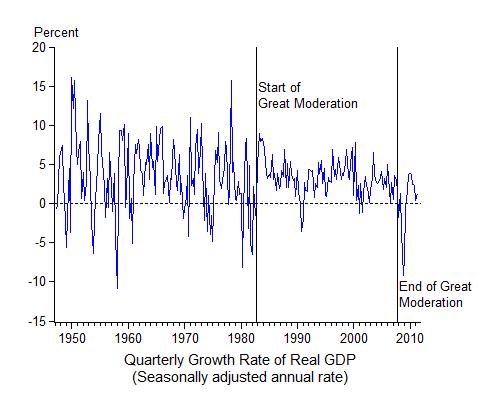
And as the following graph illustrates the 1980s and 1990s were a period of “stable and sustained growth.” In fact because of the stable and sustained growth the period is called the Great Moderation which has been documented by many economists. Here is the Wikipedia entry which uses the same chart and contains many references. Unfortunately, the Great Moderation ended with the Great Recession and the non-existent recovery.
Paul Krugman also links to some total factor productivity plots to make his argument, but they are more supportive of my points. The charts show that productivity growth declined in the early 1970s (more evidence that the 1970s were one of the “tougher decades”). They also show that productivity growth picked up after the return to better macro and micro policies in the 1980s and 1990s. Of course, the pickup occurred with a lag most likely because of the slow diffusion of technology for the reasons emphasized by my colleague economic historian Paul David.
Posted in Fiscal Policy and Reforms | Comments Off on Debating History and Policy with Reich and Krugman

Why Much Was Accomplished in the Debt/Budget Negotiations

Many are still debating how much was accomplished in the debt/budget agreement approved by the House today with the Senate to vote and the president to sign tomorrow. In my view, much was accomplished, and credit goes to all those who have been laying out the arguments and fighting hard for a return to sound fiscal policy as part of a pro-growth program to get the economy moving again.

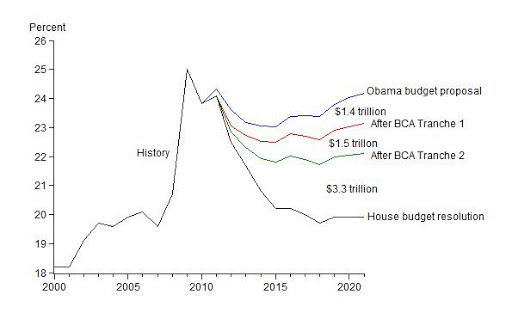
You can see the impact of the agreement on spending with the following chart, which I have used before to show the recent federal spending binge and how to reduce it in a credible way.
It shows total federal government outlays—including both entitlements and discretionary spending—as a share of GDP for the past decade and the next decade under the various budget proposals. In previous posts and articles in the Wall Street Journal I have shown the top line, which is the original White House budget proposal submitted last February, and the bottom line, which is this year’s House Budget resolution due to Paul Ryan; this House proposal brings the budget into balance without any increase in taxes. The issue all year has been where between these two lines we would end up, and what would remain to be settled during the 2012 election.

The middle two lines show what has been accomplished this year. The line labeled “After BCA (Budget Control Act) Tranche 1” is the result of spending reductions agreed to in the Continuing Resolution of last spring and this past weekend’s agreement to cut and cap discretionary spending as part of the first $900 billion increase in the debt limit, along with adjustments in the CBO baseline. This all adds up to $1.4 trillion. The next line shows the additional spending cuts that will occur as a result of the second part of the debt limit increase, scheduled for the end of this year—another $1.5 trillion. (The “Tranche 2” line is drawn by distributing the $1.5 trillion amount to each year in the same pattern as outlay reductions in the “Tranche 1” line, though the actual pattern is yet to be determined.)

So it is clear that the budget has come a long way from the Administration’s first spending proposal—about half way to the House proposal—and it was accomplished without any tax increases. Some are disappointed that Washington did not do more, but there is no question that this represents a very big shift, even though the heavy lifting will go on with a good debate in the upcoming elections.
In addition to the hard work of those deeply concerned about the debt, the deficit, and the economy, an important idea or principle also deserves credit. This is the negotiating principle that “any debt limit increase has to be matched by spending reductions”—call it the Boehner principle. I wrote favorably about the principle in the Wall Street Journal in June and signed a letter with other economists supporting it when it was viewed as controversial, or even, as John Boehner said about himself today “when everyone thought I was crazy for saying it.” But because of its simple reasonableness and good economic rationale, it helped carry the day and achieve an important agreement.
Posted in Budget & Debt | Comments Off on Why Much Was Accomplished in the Debt/Budget Negotiations

Charting the Disappointing Economic News

The sad economic story in this morning’s GDP release can best be told with three simple charts.

First, economic growth in this recovery has been even slower than previously thought, and has averaged less than 1 percent so far this year. This is the main reason why unemployment has remained so high. And the recession was even deeper than previously estimated.

growtholdnew

Second, inflation has been higher in the past two years than previously estimated. The broad GDP price index inflation rate has averaged 2.4 percent so far this year.

inflation

Third, this recovery looks even worse in comparison with the sharp 1983-84 recovery from the deep 1981-82 recession. Real growth in the past eight quarters has averaged only 2.5 percent and has never exceeded 4 percent.

8384new

Posted in Slow Recovery | Comments Off on Charting the Disappointing Economic News

The Boehner and Reid Budget Plans Compared

Today the CBO released its updated score of the Boehner budget proposal and the Reid budget proposal. So we can now do an apples-to-apples comparison of the year-by-year numbers in the two plans, and thereby get a better understanding of the differences between the two. A couple of charts will help.

The first chart shows the impact of the Boehner proposal on federal discretionary outlays. Compared to the March CBO baseline it reduces discretionary outlays by $756 billion over 10 years, which, with interest saving of $156 billion and other smaller changes, reduces the deficit by $917 billion. That is of course a lot less than the $6 trillion in the House budget resolution, but it is a good step in the right direction. The proposal correspondingly increases the debt limit on a nearly dollar-for-dollar basis by $900 billion, which should take us into early 2012. Since this increase will not last through the upcoming presidential election, the proposal also enacts a process to increase the debt limit by another $1.6 trillion with matching spending cuts, which would then last through the end of 2012.
As the chart shows the Boehner plan gets started reducing discretionary outlays in 2012 (by $25 billion) and again in 2013 and then remains well below the baseline. The chart also raises doubts about claims like the New York Times editorial page made yesterday saying that the Boehner plan “would eviscerate discretionary programs.” That is not what the CBO numbers show. If you look at the graph you can see that with the Boehner plan discretionary spending remains far above the levels of only 5 years ago: In 2012 the level of outlays is 27% above 2007, just before the financial crisis—another indication that there is more work to do following this step.

The second chart shows the Reid proposal, which also places caps on discretionary spending. Two lines are needed to explain how the Reid proposal works. The upper Reid line shows the caps on spending excluding Iraq and Afghanistan; this line is nearly the same as the Boehner line in the first graph; it saves $751 billion over 10 years.

The lower Reid line shows that by also capping outlays for Iraq and Afghanistan, well below current CBO baseline for those operations, the Reid plan can be scored as cutting more from outlays than the Boehner plan. However, the CBO baseline for Iraq and Afghanistan simply extrapolates existing budget authority for these operations; it is by no means a forecast of future spending; rather it is an overestimate given current stated policy of the Administration and others regarding Iraq and Afghanistan. But by capping spending below this overestimate of spending and then counting the difference as budget saving, the Reid plan overstates budget saving. It is in this sense that critics say that the Reid proposal is based on gimmicks. And the amount is large; by capping spending in this way the Reid plan brings deficit reduction up to $2.2 trillion over 10 years, thereby justifying a larger increase in the debt limit which goes past the 2012 election.

If the Reid proposal removed this second type of cap it would be very close to the Boehner proposal. And this suggests–assuming that the House votes to pass the Boehner plan tomorrow–that the Senate could vote to approve the Boehner plan or something close to it, perhaps with some compromise about how to treat Iraq and Afghanistan spending projections going forward. 

Like the Boehner proposal, the Reid proposal avoids a tax increase. Following the ‘Boehner principle,” the Reid proposal ties the debt limit increase to reductions in spending growth in roughly dollar for dollar fashion; it is not a “clean” debt limit increase. And the Reid plan caps discretionary spending excluding Iraq and Afghanistan at the same level as the Boehner plan. In all these ways the Senate has moved dramatically toward the House in the last few weeks, and dramatically away from the White House, which this year has called for tax increases, a “clean” debt limit hike untied to spending, and no cuts to spending relative to baseline.

Posted in Budget & Debt | Comments Off on The Boehner and Reid Budget Plans Compared