Reassessing the Recovery

What are the implications of all the recent economic reports (January employment, 4th quarter GDP, CBO’s downward revision of potential GDP) for an assessment of the recovery from the 2007-09 recession? In my view, they still indicate a very weak recovery. As I have argued, a good standard of comparison for this recovery is the most recent recovery from a very deep recession, namely the one that ended in 1982, and I have offered a series of charts to make the comparison easy and objective. Here are updates of those charts based on the latest data.
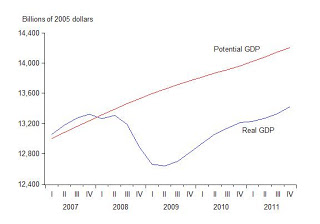
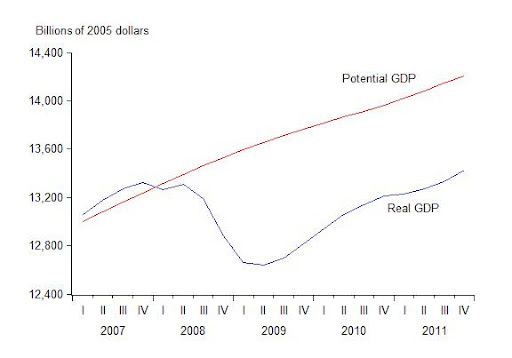
The first chart shows real GDP during the 10 quarters since the end of the 2007-2009 recession along with CBOs recently revised estimate of potential GDP. The chart clearly shows that the economy has yet to recover back to its potential. The only real difference from earlier assessments is that CBO has slightly lowered its estimate of potential.
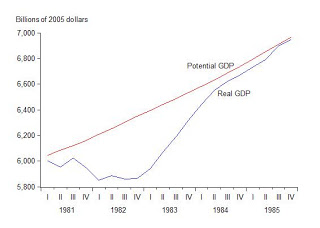
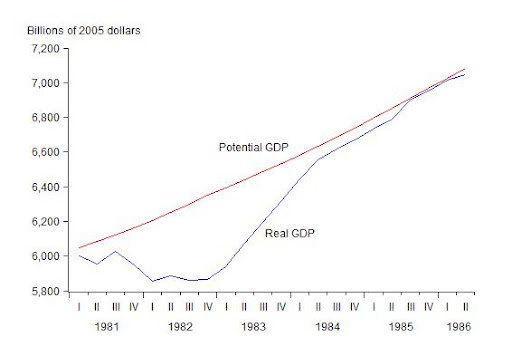
For comparison, the next chart shows the recovery back to potential in the 10 quarters following the 1981-82 recession. The difference between the two charts is striking, and is why one can say that the current recovery is a recovery in name only.
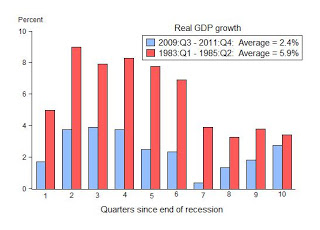
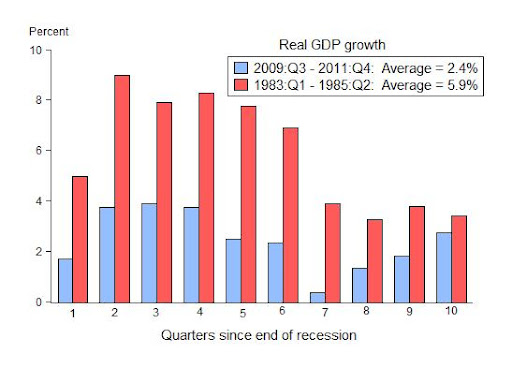
It is also helpful to compare economic growth rates during the two recoveries as shown in the next chart. Growth averaged 2.4 percent in the recent 10 quarters compared with 5.9 percent in the 1980s recovery.
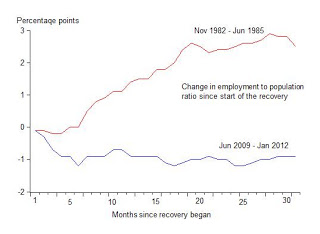
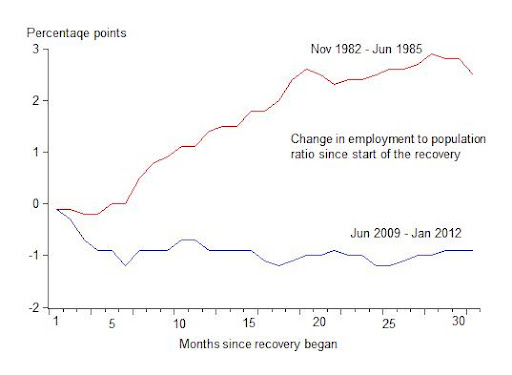
Finally, compare the employment-to-population ratio in the two recoveries as in the next chart. It shows that even with the better news on employment and the unemployment rate, the percentage of the working age population that is actually working is not rising.
Posted in Slow Recovery | Comments Off on Reassessing the Recovery

State of the Union: From Ringside to the WSJ

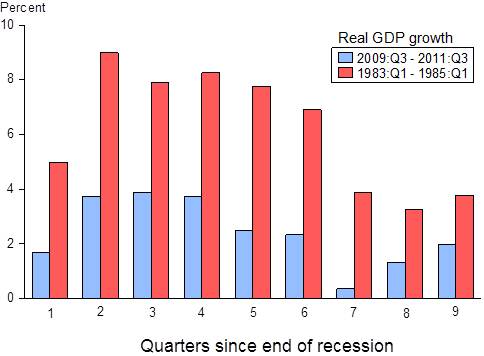
I was at the State of the Union tonight. You cannot help but love the pomp and circumstance of the event, even if you do not agree with everything the President says. In this case, his opening lines on what we can learn from America’s “generation of heroes,” the next greatest generation, were particularly moving to hear in person as was the closing which returned to that theme with “Each time I look at that flag, I’m reminded that our destiny is stitched together like those fifty stars and those thirteen stripes.”But in between there was much to disagree with, especially from an economic policy perspective as I describe in tomorrow’s Wall Street Journal piece which I excerpted from First Principles. For one thing it is a stretch to say that “The state of our Union is getting stronger.” We are not really recovering from the recession, at least not compared to the period after previous big recessions such as the early 1980s as this graph makes clear.

The reason is pretty clear. In the Wall Street Journal piece I refer to and quote from a memo written by President Reagan’s economic adviser George Shultz and others after the 1980 election. It laid out the long run economic strategy they recommended and which Reagan followed. Contrast that with the memo Larry Summers sent to President-elect Obama after the 2008 election, which is making the internet rounds. It laid out the short-run Keynesian policy Summers recommended and which Obama has followed. The big policy differences largely explain the big economic performance differences.

Posted in Regulatory Policy | Comments Off on State of the Union: From Ringside to the WSJ

First Principles on the Business News Networks

Yesterday I spent the day visiting the TV studios of CNBC, Bloomberg Television, and the Fox Business Network to discuss my new book First Principles. Thanks to the news anchors the discussion—and debate—was interesting and lively.

I started early, co-hosting Squawk Box from 7 to 9 am with anchors Becky Quick, Joe Kernan, and Andrew Ross Sorkin on the set at CNBC studios in New Jersey. Here is a video from the opening where I briefly presented the theme of the book—that America has deviated from the principles of economic freedom—and responded to some good questions from Joe and Andrew (author of the best seller, Too Big To Fail). Later in the show Steve Liesman joined us on the set and we had a rousing debate segment about the Fed and why economists so often disagree while Joe Kernan raised doubts about the whole subject of economics (had to work hard to get a word in edgewise here). At the end of the show Andrew and I wrapped up with a brief discussion of the economic implications of the 2012 election and where the big economic differences are between Mitt Romney, Newt Gingrich, and Barack Obama

Then over to midtown Manhattan to Bloomberg News studios on Lexington Avenue for an hour’s visit on Surveillance Midday anchored by Tom Keene. Tom has great ways to bring economic ideas into the news of the day and make them entertaining, and he certainly did that with the ideas in First Principles. Here is a video of the opening and ending of that show. Allan Meltzer joined us halfway through the show via a remote video feed, and he added his strongly held views that monetary policy needed to be less discretionary and more rule-like, which I appreciated.

At the end of the day I went over to News Corporation Building on Sixth Avenue for an interview with Gerri Willis on her Fox Business News show The Willis Report . It was a fast-moving on-point interview (4½ minutes) in which she managed to bring out a host of issues ranging from Fed policy to crony capitalism.

Posted in Regulatory Policy | Comments Off on First Principles on the Business News Networks

Different Economics Texts for Different Economic Views

Alan Blinder and I are frequently on different sides of economic debates, especially when it comes to the effects of monetary and fiscal policy and the impact of short-term discretionary actions. For example, we have both testified together in Congress about the recent stimulus packages. He says they worked. I say they didn’t.

We also both have introductory economics textbooks which we have just revised in different ways in light of the experience with the recent financial crisis, the great recession, the policy response, and the slow recovery. In fact we have the same publisher who recently asked us to explain the rationale for the revisions, and then made videos of the answers. Here is Alan’s video and here is my video. It is not surprising that our approaches to the revisions are somewhat different, but perhaps not as much different as one would expect given the big differences in our views.

Posted in Teaching Economics | Comments Off on Different Economics Texts for Different Economic Views

American Economic Freedom: Moving in the Wrong Direction

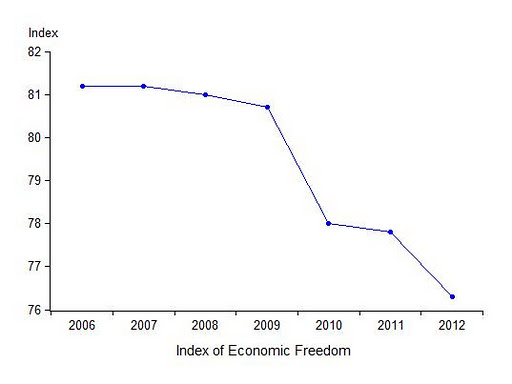
Economic freedom in the United States continues to decline according to the latest Index of Economic Freedom (compiled by the Heritage Foundation) as reported today by Ed Feulner in the Wall Street Journal.

This chart plots the Index from 2006 to 2012. There has been a decline every year since 2007 with a record decline from 2009 to 2010 and another large decline from 2011 to 2012. While nearly every component of the index has declined since 2007, two of the larger declines were due to an increase in government spending as a share of GDP (forcing that component down from 60.3 to 46.7) and a reduction on monetary freedom (bringing that component down from 83.8 to 77.2). The decline in monetary freedom was not due to all the discretionary interventions by the Fed (which the index does not measure), but rather to more government interventions in the price system. Here are the details.

This is not the only quantitative measure to show a decline in economic freedom for the United States. The Economic Freedom Index (compiled by the Fraser Institute) also shows a decline as Gene Epstein points out in this recent Barron’s column, though the data only currently go through 2009

Posted in Regulatory Policy | Comments Off on American Economic Freedom: Moving in the Wrong Direction

No, Austan, Washington Is Spending Too Much

In yesterday’s Wall Street Journal, Austan Goolsbee argues that Washington Isn’t Spending Too Much.  “It’s completely normal,” he says “that spending rises during big downturns….As the economy grows back to health, the government share of the economy will fall,” making it seem as if the Administration’s plan all along was to bring the federal spending share back to what it was before the recession started. It wasn’t.

Take a look at this chart. The top line shows the federal spending share with the budget plan submitted by the Administration last February when Austan Goosbee was Chairman of President’s Council of Economic Advisers. It makes no attempt to bring spending back to pre-recession levels as a share of the economy. While the Congress was able to make a dent in the Administration’s spending plan, we still have a long way to go to gradually get spending back to 2007 levels, which is the pro-growth thing to do, as I explain in First Principles, out later this month.
Posted in Fiscal Policy and Reforms | Comments Off on No, Austan, Washington Is Spending Too Much

Argentina in December 2001 versus Europe in December 2011

This month marks the ten-year anniversary of Argentina’s massive sovereign debt default, an event with many lessons for the European sovereign debt crisis of today, though analogies are far from perfect.

First, as has been discussed and debated on planet money and naked capitalism, the Argentine economy actually recovered quickly from the painful default and crisis of 2001 after it negotiated a substantial write-down of its sovereign debt.

Second, the experience of Argentine’s neighbor Uruguay shows that the economic pain of such crisis is less severe if a more orderly restructuring is employed from the start rather than a chaotic default. Such an orderly restructuring could have taken place in Greece two years ago as it did in Uruguay ten years ago as veteran debt expert Carlos Steneri and I discuss with Juan Forero in this NPR price “What Greece Can Learn from South America” which aired last week. (I worked closely with Steneri during the Uruguayan crisis when I was US Treasury Under Secretary).

Third, and most important, despite the immediate and sharp impact of the default in Argentina, there was very little international contagion at the time of the default. This outcome was contrary to many warnings at the time that such a default would have large contagion effects much as the Russian default three years earlier in 1998. The first chart shows the contagion following the Russian default in terms of emerging market bond spreads in Asia. The second chart shows, using the same measure, that there was virtually no contagion following the Argentine default.

In my view the reason for this remarkable difference is that the IMF and the international policy community was clear (at least following an increase in loans in August 2001) that the bailouts of Argentina would stop, making a debt restructuring inevitable or at least more predictable than the surprise withdrawal of support for Russia in 1998 which caused the contagion then. Contagion is not automatic if the policy is clear and predictable.

As the investigative reports in the Wall Street Journal this week make clear, this same type of fear of contagion (expressed, according the the WSJ story, very strongly by Jean-Claude Trichet during the past two years) is why a restructuring of Greek sovereign debt has been kicked down the road so many of times. Instead of reducing the role of bailouts as occurred for emerging markets around the time of Argentina, the role of bailouts in European policy has increased and this has made policy even less predictable. As the prospects of bailout increased, the political incentives to take action to reduce deficits and debt decreased as evidence in Italy over the past year and made the crisis much worse.

Posted in International Economics | Comments Off on Argentina in December 2001 versus Europe in December 2011

The Return of the Best Economics 1 Lecturer Ever — Plus One

This fall was a great quarter to teach the introductory course (Economics 1 at Stanford) with plenty of good examples from Occupy Wall Street, the crisis in Europe, the continuing debate in Washington over economic policy, and the rising federal debt. Unfortunately nothing much has changed about the debt as I tried to illustrated with the return of a guest lecturer.  

In 2009 I invited this guest lecturer to my Economics 1 class to illustrate the burdens of the debt on future generations.  Though only a few months old, the guest lecturer turned out to be the best ever (here is a  video excerpt). Students in that class still remember her message as she looked up at the exploding debt chart on the big screen, and said “fix it.”

So this fall I invited her back to this year’s Economics 1 class , and her brother joined her, as seen in this second video excerpt (click on the closed caption option as the audio is weak).  Again she looked up at the chart on the big screen in the lecture hall , and again it was “scary.” In fact, it was even worse! Unfortunately, no one has fixed it, either in 2009,  2010, or 2011. I said I’d like to keep bringing them back as guest lecturers until it is fixed. 

(The chart in the first video was developed from Congressional Budget Office data from the long term projection made in 2009; the chart in the second video is from the CBO long-term projection made in 2011.)
Posted in Teaching Economics | Comments Off on The Return of the Best Economics 1 Lecturer Ever — Plus One

Economic Freedom in the News

People are writing about economic freedom a lot these days. George Will’s recent Washington Post column Testing the Waters of Economic Liberty focusses on a big deviation from economic freedom in the State of Washington with implications for America. Jeb Bush’s recent Wall Street Journal article Capitalism and the Right to Rise summarizes the great benefits of economic freedom to improve people’s lives.  My new book, First Principles, out in January, shows that America has deviated from the principles of economic freedom in recent years, and proposes ways to get back to them.  
Of course the concept of economc freedom has been a pillar of basic economics courses for years. When I lecture about economic freedom to Stanford students  I like to build on the Stanford motto which translates from the German words on the Stanford seal as “Let the Winds of Freedom Blow” 
Posted in Regulatory Policy | Comments Off on Economic Freedom in the News

Krugman is Wrong

Paul Krugman is wrong in his criticism of my brief summary of last week’s economic policy conference at Stanford’s Hoover Institution. Krugman was not at the conference, which lasted a full day and went well beyond previous research by the participants.  In general people focused on policies to restore strong economic growth and reduce unemployment in the United States.First, Krugman incorrectly claims that I mischaracterized the research of my Stanford colleague Nick Bloom and his coauthors Scott Baker and Steve Davis presented at the conference. Krugman says my conference summary suggested that “Bloom, Baker and Davis had showed that fear of Obama was holding the economy down.” No, my summary said or implied no such thing; there is no mention of Obama, Bush, or any politician in my summary. It simply says that these authors “presented their empirical measures of policy uncertainty and showed that they were negatively correlated with economic growth.” And that is what they did at the conference. Second, Krugman claims that my summary mischaracterized the presentation of my Stanford colleague Bob Hall, making it look like something it wasn’t. My summary referred to Bob’s interesting presentation at the conference. As part of his presentation Bob said that now and going forward we should assume “no chance of conventional fiscal expansion; rather, possible cutbacks motivated by excessive federal debt.” That is why Bob focused his paper at the conference on monetary policy and the problem of the zero lower bound, and that was what all the discussion of his paper was about, rather than on his earlier work on the multiplier, which is now part of a huge literature recently nicely reviwed by Valerie Ramey.

I stand by my brief summary of the conference as a being accurate. Lee Ohanian and I, as co-organizers of the conference, hope that we can soon get a book published containing the full proceedings (written versions of the individual presentations and many comments by participants), as has been done with other recent Hoover economic policy conferences: The Road Ahead for the Fed and Ending Government Bailouts As We Know Them. We hope the results of each author will be read carefully by policy makers and other researchers.

Posted in Slow Recovery | Comments Off on Krugman is Wrong